Engagement Party Ideas: Formats, Games, Etiquette and a Run-Sheet
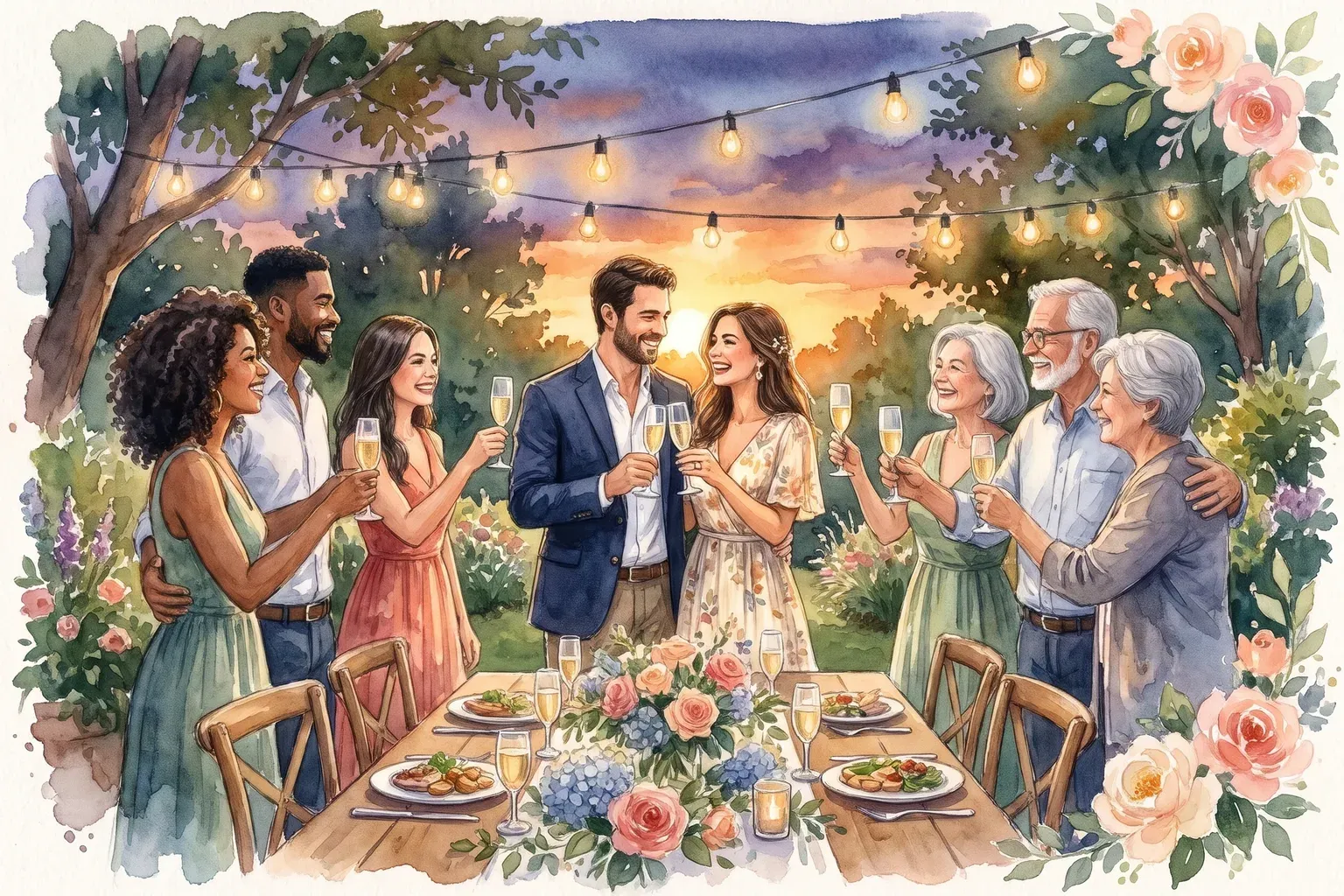
Someone just got engaged, and now you need engagement party ideas, fast. Maybe it's your own engagement, maybe your daughter's, maybe your best friend's. The good news: an engagement party is one of the easiest celebrations to get right, because it has one job. It introduces the people who will be at the wedding to each other, and it lets everyone toast the couple.
Here's the short answer. Hold it one to three months after the proposal. Invite only people who will also be invited to the wedding. Whoever hosts pays. Keep it to about three hours, with one round of short toasts and a little structure so the two families actually talk. A backyard, a dinner, a brunch, or a bar's back room all work.
Below you'll find engagement party ideas grouped by format, ten themes, five games that mix two families, the etiquette questions people actually argue about, a budget method, a four-week timeline, and a minute-by-minute run-sheet you can copy.
Who hosts an engagement party, and who pays
Tradition gave the job to the bride's parents. The Emily Post Institute says the bride's parents are usually offered the chance first, followed by the groom's parents. That's tradition, not a rule. Emily Post's newer guidance puts it plainly: parents, friends, or the couple themselves can host, and today "it's about what's logical."
Zola and WeddingWire say much the same: anyone can host, including the couple. Zola adds that the host is generally expected to pick up the bill, and that several people who offer to host can split a venue cost between them.
Here's how the common setups compare.
| Who hosts | Who pays | Works well when | Watch out for |
|---|---|---|---|
| One set of parents | Those parents | The families live near each other | The other side feeling like guests at someone else's party |
| Both sets of parents | Split, agreed in writing | Both families want a hand in it | Two people deciding the guest list, which needs a referee |
| A friend or sibling | The friend, as their gift | The couple's social life centers on friends | The friend inviting people who won't make the wedding list |
| The couple | The couple | Parents are far away, or the couple wants control | Spending money the wedding budget needs |
| Two separate parties | Each host pays for their own | Families live in different cities | Guests on both lists feeling they owe two gifts |
Zola says multiple engagement parties are fine when the guest lists don't overlap much beyond immediate family. If both sets of parents live 1,000 miles apart, two smaller local parties are kinder to everyone than one party half the guests have to fly to.
Emily Post and WeddingWire both suggest something easy to skip: if the two sets of parents haven't met, have them meet before the party, somewhere quiet. WeddingWire suggests a restaurant rather than someone's home, even if it's the night before. The party is the wrong place for a first handshake between future in-laws.
When to have it: timing after the proposal
The sources give slightly different windows, but they overlap.
- The Emily Post Institute says the party is typically held within one to three months of the engagement, closer to the engagement than to the wedding.
- Zola suggests anywhere from a week to three months after the proposal, and in its etiquette guide, a few weeks to a month or two.
- Emily Post's newer piece suggests holding it before you send save-the-dates.
A practical rule: give yourself at least four weeks, so invitations can go out three weeks ahead, and finish it before save-the-dates go out. If the wedding is only a few months away, an engagement party crowds the shower and the bachelorette, and skipping it is a reasonable call.
Why so many engagement parties land in January to March
Winter is proposal season. The Knot's 2019 Jewelry and Engagement Study found that 37% of couples got engaged between November and February, which it called the most popular time of year to get engaged. That study is several years old, so treat the number as a direction rather than a current count.
Put that window next to the one-to-three-month guideline, and a lot of parties land in late winter. In concrete terms: a couple who got engaged on Christmas Day 2026 (a Friday) would host somewhere between late January and late March 2027. Valentine's Day 2027 falls on a Sunday, so expect restaurants to be busy on Saturday, February 13. If you want a private room that weekend, book early.
Winter parties also change the format. Backyards are out in most of the country, so think about indoor options: a restaurant's private room, a bar buyout on a quiet weeknight, a brunch, or a house party with a fire and a warm drinks station.
The guest list rule nobody gets to break
Every source we checked agrees on this one. Anyone invited to the engagement party should also be invited to the wedding. Emily Post calls the guest list "the most important planning element," and WeddingWire puts it flatly: you can only invite people who are invited to the wedding.
An engagement party invitation reads as a promise of a wedding invitation. Breaking that promise later is far more awkward than not inviting someone now.
That creates a problem if the wedding list isn't final yet, which it usually isn't. Zola's advice is to invite only people who are certain to make the wedding cut. In practice that means:
- Immediate family on both sides. Parents, siblings, grandparents, and their partners.
- The wedding party, if it's chosen. If it isn't, the people who obviously will be.
- Close friends the couple sees regularly. If you'd hesitate to invite them to the wedding, don't invite them now.
- Coworkers only if they're definitely on the wedding list. Emily Post's guidance names coworkers specifically.
Leave out plus-ones you haven't met and the "we should really invite them" crowd. Emily Post notes that a smaller engagement party list is common, precisely because of this rule.
If a friend or a parent is hosting, the couple should approve the final list before anything goes out. That's the single most useful conversation a host can have.
Engagement party ideas by format
Pick the format before the theme. The format decides the budget, the guest count, and how much work falls on the host. Here's a quick comparison, then details on each.
| Format | Good size | Relative cost | Host effort | Best for |
|---|---|---|---|---|
| Dinner in a private room | 10–30 | High | Low | Families meeting properly, formal parents |
| Backyard party | 20–80 | Low to medium | High | Spring and summer, relaxed families |
| Brunch | 15–50 | Low to medium | Medium | Mixed ages, non-drinkers, winter parties |
| Bar or restaurant buyout | 30–100 | Medium to high | Low | Big friend groups, couples who want a night out |
| Open house | 30–100 | Low to medium | Medium | Large families, guests with kids, drop-in schedules |
| Surprise party for couple | 15–60 | Varies | High | Couples who love surprises (ask a friend first) |
| Proposal party | 15–60 | Varies | High | The person proposing knows the answer is yes |
Cost labels are relative, since prices vary so much by city. The budget section shows how to put real numbers on your plan.
Dinner in a private room
A long table, a set menu, toasts between courses. It's the most traditional format and the easiest to host, because the restaurant does the work. The drawback is that people talk only to their neighbors, so plan the seating. Alternate the families down the table, and seat each parent next to someone from the other side.
Backyard party
String lights, a grill or a taco truck, coolers, lawn games. WeddingWire calls hosting at home "extremely cost-effective," since you skip the venue fee. It's also the most work, so recruit two helpers and rent more chairs than you think you need. Have a rain plan, and in winter, don't count on the yard at all.
Brunch
Late morning, mimosas and coffee, a buffet or a family-style menu. WeddingWire says brunch is much more affordable than a fancy dinner. It's also easy on grandparents, families with small kids, and anyone who doesn't drink. It's a strong choice for a January or February party.
Bar or restaurant buyout
Book the back room or the whole place on a slow night. If the venue quotes a food and drink minimum, get it in writing, along with what happens if you fall short. This format suits couples whose crowd is mostly friends, and it's low effort for the host. It's less good for elderly relatives, since bars are loud and seating is scarce. Ask for a quiet corner with real chairs.
Open house
Guests come and go across three or four hours on a weekend afternoon. Nobody has to stay long, and it handles a big family with toddlers and great-aunts better than any other format. Put the toast at a fixed time and say so on the invitation ("toast at 3:00"), or half the guests will miss it.
Surprise engagement party for the couple
A friend or family member invites everyone, and the couple arrives expecting a quiet dinner. The risk is that the couple loses any say over a guest list that carries a promise about the wedding. If you're planning one, quietly confirm the guest list with one of the two, or keep it to immediate family and the closest friends only.
Proposal party
Here the proposal is the party. Guests are told it's a birthday or a dinner, and the proposal happens in front of them. Only do this if you're sure of the answer and sure your partner would want an audience. A middle option: propose privately, then walk into a room where the families are waiting. You keep the private moment and still get the cheering.
Engagement party themes
A theme ties together invitations, food, and decorations. It doesn't need to be elaborate. Ten that work:
- Where they met. Serve the food from the college town or the coffee shop, and name the drinks after it.
- His and hers, or theirs and theirs, signature cocktails. One drink for each person, plus a zero-proof version of both.
- Winter cabin. Plaid, candles, a hot cocoa and mulled cider station, a fire if you have one. Made for a January party.
- Taste of both families. Each side brings a dish from its own tradition, labeled with the story. A good way to start the conversation between two cultures.
- Champagne and fries. A short, cheap menu that feels like a treat. Include a sparkling non-alcoholic option.
- The first date, recreated. If their first date was bowling, pizza, or a dive bar, host there or bring it to the backyard.
- Garden party. Florals, lemonade, lawn games. For a spring date.
- Destination preview. If the wedding is in Mexico or Maine, serve that food and drink so guests get a taste of the trip.
- Black and white. A simple dress code that photographs well and costs guests nothing.
- Wine or beer tasting. Four or five bottles, small pours, score cards. It gives strangers something to talk about.
Skip themes that tease the couple about losing their freedom. That's bachelor and bachelorette material, and grandparents are in the room.
Engagement party games that mix two families
An engagement party has one built-in problem: two groups of strangers on opposite sides of the room. The best engagement party games are short, need no drinking, and put the two sides on the same team. Here are five, with rules.
Couple trivia
Write 10 to 15 multiple-choice questions about the couple: where they met, who said "I love you" first, the worst gift one gave the other, the proposal location. Guests play in teams of four, and each team must include people from both families. Score one point per correct answer, and give the winning team a bottle of something. Fifteen minutes, start to finish. Have the couple check the answers privately beforehand.
How well do you know them
A head-to-head version of trivia. Pick one person from the bride's side and one from the groom's side (or one friend per partner). Ask each a question about the other partner, and they write their answers on cards. The fun is in the cross-questions: ask the groom's brother about the bride. Five rounds, and the losers buy the winners a drink at the wedding. Keep questions kind. Nothing about exes.
Meet the other side bingo
Print a five-by-five card with squares like "has known the bride since kindergarten," "flew in for this," "has met the couple's dog," "can name the groom's first car," and "is related to someone at the other end of the room." Guests find a person who matches each square and get their name. The rule that makes it work: every name must come from the other family. First complete row wins.
Wedding predictions
Hand out cards with blanks: wedding date, first dance song, who cries first at the ceremony, who'll be last on the dance floor, the honeymoon destination. Guests fill them in and drop them in a box. The couple opens the box at the wedding or on their first anniversary.
Photo scavenger hunt
Split guests into mixed-family teams of three or four and give each team a list of prompts: a photo with someone from the other side you just met, both mothers laughing, a recreation of the proposal, the oldest and youngest guest together, the ring in an unusual place. Give them 30 minutes, then show the results during dessert. Our free wedding photo scavenger hunt generator makes printable cards. Most of the prompts work as-is for an engagement party, and you can swap in your own.
If you want more, our list of wedding reception games covers the shoe game, Mad Libs, and table games, and most of them shrink nicely to an engagement party.
One game too many is worse than one too few. At a three-hour party, pick two: one that mixes people early, and one quick group game around the toasts.
Toasts, gifts and thank-you notes
Who toasts, in what order
The Emily Post Institute says an announcement and toast, usually from the father of the bride, is common. Easy Weddings, an Australian planning site, describes the usual sequence: the bride's father toasts the couple, and the couple responds with a toast to their families. Today the host often isn't a father at all, so adapt it.
A modern order that works for most parties:
- The host welcomes everyone. One minute. Thanks for coming, a word about why we're here.
- The host or a parent toasts the couple. Two to three minutes.
- A parent from the other family, if they want to. Two to three minutes. Ask in advance, and don't spring it on anyone.
- The couple responds together. Thanks to the hosts, a word to each family, a toast to everyone in the room.
That's about 10 minutes. Friends who want to speak can save it for the rehearsal dinner or the wedding. Emily Post's advice on tone is simple: keep the focus on the couple, and keep it sentimental, kind, and positive.
A small note from Easy Weddings: when people are toasting you, stay put and don't raise your glass or drink.
Engagement party gift etiquette
Gifts are optional, and customs vary by region and family. The Emily Post Institute says it has become the custom in many parts of the country to bring a gift, and that the choice depends on your relationship to the couple, your budget, and local custom. If you aren't sure, its advice is to call the host and ask.
For guests: something modest the couple can share. Emily Post suggests a cookbook or a picture frame, or a pair of champagne flutes with a bottle. Emily Post's newer guidance suggests skipping monogrammed items for now.
For the couple and hosts:
- Don't put registry details on the invitation. Zola says not to. If the couple has a wedding website with a registry, guests who want it will find it.
- A registry isn't required yet. Emily Post's newer piece says a couple shouldn't be expected to have one picked out already. Hosts can ask the couple for a few ideas in case guests ask.
- "No gifts" is fine. Emily Post says the couple can ask the host to pass the word. Easy Weddings suggests a line like "Your presence is our present."
- Open gifts later. Easy Weddings suggests thanking gift-givers privately and keeping gifts out of sight, so guests who didn't bring one don't feel awkward.
Thank-you notes
WeddingWire says every guest should get a handwritten thank-you note, whether or not they brought a gift, and that the couple should thank the hosts with a note and perhaps a small gift. Do the hosts first. They paid.
Engagement party budget: work it out per guest
We won't quote an average engagement party cost, because it swings too much by city, format, and headcount to help you. Here's a method that works anywhere.
- Decide the total you're comfortable spending.
- Hold back 10% as a cushion.
- Subtract the fixed costs that don't change with headcount: venue fee, rentals, decorations, music.
- Divide what's left by the guest count. That's your per-guest figure for food and drink.
A worked example, with hypothetical numbers. You have $2,000. Hold back $200, leaving $1,800. Fixed costs come to $400 for chair and table rentals and lights, leaving $1,400. With 40 guests, that's $35 a head. Cut the list to 28 and it's $50 a head. Same money, different party.
The guest list is the biggest lever you have, and the wedding-list rule already trims it for you. After that, these are the usual ways to bring the per-guest number down:
- Change the meal. Brunch costs less than dinner, and heavy appetizers cost less than a seated meal.
- Limit the bar. Beer, wine, and one signature cocktail, rather than a full bar.
- Host at home. WeddingWire's budget tips put the backyard first for this reason.
- Share the hosting. Zola notes that friends or family can split duties, such as one person hosting at home while another covers the drinks.
If the couple is hosting, this money comes out of the same pot as the wedding. Our guide to the first 10 decisions in wedding planning covers setting the overall budget and guest count, which the engagement party depends on.
Engagement party timeline: four weeks out to the last guest
Four weeks is enough for a home party, a brunch, or a restaurant room. A popular venue on a Saturday needs longer, so book that first and work backward. Emily Post says invitations usually go out two to four weeks ahead, Zola says at least three weeks, and Emily Post's newer piece says three to six weeks. Three weeks is the safe middle.
The four-week plan
| When | What to do |
|---|---|
| 4 weeks out | Agree on who hosts and who pays. Set the budget. Get the couple's approved guest list. Book the venue or confirm the house. Have the parents meet if they haven't. |
| 3 weeks out | Send invitations with an RSVP date. Book food, drinks, and any rentals. Choose the theme and two games. Ask the couple for gift ideas in case guests ask. |
| 2 weeks out | Order decorations and printed items: bingo cards, trivia sheets, scavenger hunt cards. Ask who's toasting and tell them the time limit. Pick the couple's hashtag or photo plan. |
| 1 week out | Chase RSVPs. Give the caterer or restaurant a final headcount. Write the run-sheet and give it to a co-host. Write the trivia answers and have the couple check them. |
| 2 days out | Buy ice, drinks, and backup snacks. Print everything. Set up the QR code or photo sign. Charge the speaker. |
| Day of | Set up two hours early. Hand the run-sheet to your co-host. Eat something before guests arrive. |
| Week after | The couple sends thank-you notes, hosts first. Share the photos with everyone who came. |
On invitations: Emily Post's newer piece asks hosts to always include an RSVP date, and warns that a group text gets messy for a larger party. Use a real invitation, paper or digital, so replies land in one place. Zola notes that the invitation should state the dress code, since "engagement party" can mean anything from jeans to cocktail attire.
A sample three-hour run-sheet
This assumes a 7:00 p.m. start, around 40 guests, and either a home or a private room. Shift the times to suit a brunch.
| Time | What happens | Who's on it |
|---|---|---|
| 5:00 | Setup. Food stations, bar, chairs, photo QR signs on tables and at the door. | Host, two helpers |
| 6:30 | Couple and both sets of parents arrive. Quick photo of the six of them before anyone else shows up. | Host |
| 7:00 | Doors open. Drinks and appetizers. Bingo cards handed out at the door. | Helper at the door |
| 7:00–7:45 | Mingling. The couple works the room together, introducing each family to the other. | Couple |
| 7:45 | Bingo deadline. Winner announced, small prize. | Co-host |
| 7:50 | Main food goes out, or guests are seated for dinner. | Caterer or host |
| 8:30 | Toasts. Host welcome, host or parent toast, other family's toast, couple's response. About 10 minutes. | Host |
| 8:45 | Couple trivia in mixed teams. 15 minutes. | Co-host as quizmaster |
| 9:00 | Dessert or cake. Wedding prediction cards on the tables. | Helper |
| 9:00–9:45 | Open time. Music up a little. Last photos of the families together. | Everyone |
| 9:45 | Couple thanks the hosts once more, informally. Prediction box collected. | Couple, co-host |
| 10:00 | Bar closes. Guests start leaving. Rides arranged for anyone who needs one. | Host |
The toasts sit after food, not before, because people listen better when they've eaten, and before the energy dips. The family photo happens at 6:30, before guests arrive. At 9:30, someone's dad has left and someone's mom has kicked off her shoes.
Getting the party photos in one place
The couple can't photograph their own party, and guests' photos end up scattered across 40 phones and three group chats. A plan takes five minutes.
The simplest plan is a shared hashtag or a shared album link on a sign. Our free wedding hashtag generator will give you options, and a hashtag you pick now can follow you to the wedding. Hashtags work for guests who post publicly, which many people, especially older relatives, don't.
This is also where we'd suggest Revel, the shared event camera we make. You create a Moment for the party, put a QR code on the tables and at the door, and guests shoot from their phone's browser with no app download and no account. You can set a shots-per-guest limit, so it feels like a disposable camera and you don't end up with 400 near-identical shots of the cake.
A few settings suit an engagement party well:
- Hidden until the end. Photos can stay hidden until the Moment ends, or 12 or 24 hours after. Set it to the next morning, and the couple and every guest see the whole gallery at once over coffee.
- Approval before the reveal. The host can review and approve every photo before the gallery goes live. That's useful when grandparents and college friends are in the same gallery.
- Works offline. Guests can keep shooting in a basement bar with no signal, once they've scanned the code with a connection. Photos sync when they reconnect.
- A live slideshow. If the venue has a TV, you can show a moderated feed during dessert.
Pricing is a one-time payment per event, no subscription. It's free for up to 10 guests, and in the US the 50-guest tier is $5.99 and the 100-guest tier is $19.99 (checked November 2026; prices vary by country and can change). There's more on the engagement party page.
Now, what it can't do. If you want a slideshow of the couple's photos from the past five years, Revel is the wrong tool. Camera-roll uploads are allowed only for photos taken between when the Moment was created and when it ends, so old couple photos, baby pictures, and the proposal itself (unless the Moment was already running) can't be added. For a "their story so far" slideshow, collect those photos in a shared folder on whatever the family already uses, such as Google Photos or iCloud, and build the slideshow separately. Revel also doesn't do video, so ask a friend to film the toasts on a phone. And if the guests are mostly people who won't scan a QR code, or it's a dinner for eight around one table, a single phone and a group thread will do.
Engagement party FAQ
Who traditionally hosts an engagement party?
The bride's parents, according to the Emily Post Institute, with the groom's parents next in line. Today anyone can host: either family, a friend, a sibling, or the couple. The host usually pays.
How soon after the proposal should you have an engagement party?
Emily Post says one to three months after the engagement, and closer to the engagement than to the wedding. Aim to hold it before save-the-dates go out, and allow at least four weeks so invitations can go out three weeks ahead.
Do you have to invite everyone at the engagement party to the wedding?
Yes. Every etiquette source we checked agrees: invite only people who will also be invited to the wedding. If the wedding list isn't final, invite only the people you're certain about.
Are you supposed to bring a gift to an engagement party?
It's optional and depends on local custom and how close you are to the couple. The Emily Post Institute says bringing a gift has become the custom in many places, and suggests something modest. If you're unsure, ask the host.
How long should an engagement party last?
None of the etiquette sources we checked sets a length. Three hours is a practical default for an evening party, enough for food, toasts, and a game without anyone flagging. A brunch can wrap up in two and a half, and an open house can run four with guests coming and going.
What do you do at an engagement party?
Eat, drink, and introduce the two families. Most have a welcome, a short round of toasts, and one or two games that help people mix.
Try it before the party, at no cost
Revel is free for up to 10 guests, so you can test it before the big night. Download it from the App Store or Google Play, create a free Moment, and use it when the couple and parents meet for dinner. Scan the code, take a few photos, and watch the reveal the next morning. You'll know in one evening whether it fits the party.

A writer interested in connection, memory, and the everyday moments that matter more than we realize.
Tags: Party planning , Wedding planning , Event photo sharing