Wedding Planning for Beginners: The First 10 Decisions to Make

Wedding planning gets dramatically easier once you understand one thing: most stress comes from making big decisions in the wrong order.
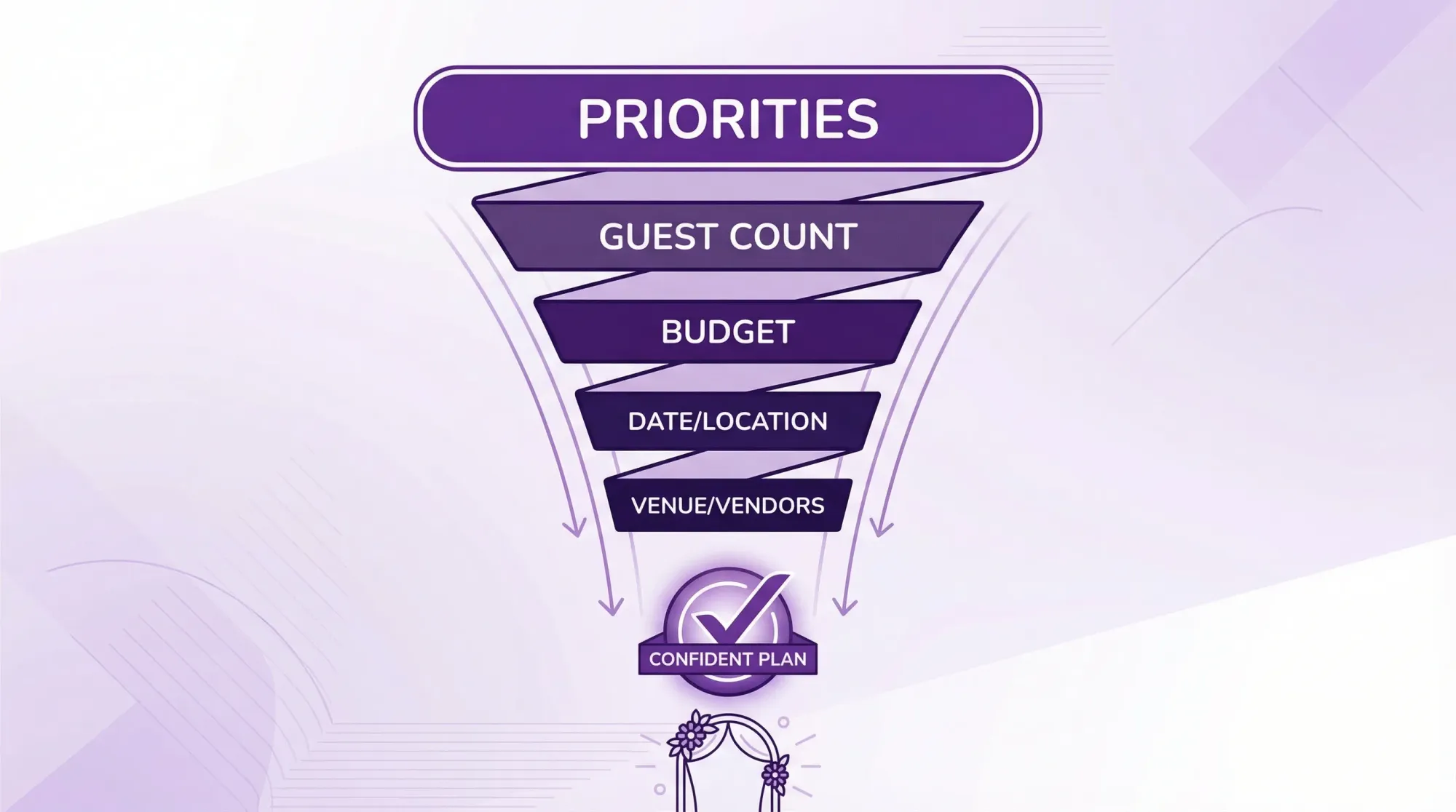
Beginners often jump straight to colors, Pinterest boards, or “who should we book first?” But the early choices that actually determine everything are more foundational: your priorities, guest count, budget, date window, and venue constraints.
This guide walks you through the first 10 decisions to make so you can stop spiraling, start locking in real options, and build momentum.
The goal: create constraints (so choices get simpler)
In project management, constraints are a gift. When you decide your size, budget range, and location window, you eliminate thousands of mismatched venues and vendors instantly.
Before you make any calls or tours, start a simple “decision log” (notes app, Google Doc, or planning tool) and write each decision in one sentence. If you ever disagree later, you will be able to point to what you already decided and why.
Here’s the overall order that keeps most couples out of trouble.
| Decision | Why it comes early | What you should have when you’re done |
|---|---|---|
| Priorities and boundaries | Prevents spending and style drift | 3 priorities, 3 non-negotiables |
| Guest count (range) | Drives budget and venue size | A/B/C guest-count scenarios |
| Budget range + who pays | Stops quote shock and scope creep | A “working budget” and a max cap |
| Date window | Venue availability depends on it | 6–12 acceptable dates |
| Location | Changes vendor pricing and logistics | A city/region decision |
| Venue type | Defines the whole flow and vendor needs | 1–2 venue styles to tour |
| Planning support level | Defines workload and risk | Coordinator/planner decision |
| Vendor priorities | Booking order should match your values | Top 3 vendor categories |
| Guest experience basics | Prevents day-of confusion | A guest-experience checklist |
| Photo capture and sharing plan | Avoids the post-wedding photo chase | A coverage plan + collection system |
1) Decide what “success” means for your wedding
This is the decision that protects every other decision.
A practical way to do it is to write:
- Three priorities (what you want guests to feel or what you care about most)
- Three boundaries (what you will not do, even if it’s trendy)
Examples of priorities:
- “A relaxed day with time to actually talk to people.”
- “Great food and a packed dance floor.”
- “Beautiful photos and a ceremony that feels personal.”
Examples of boundaries:
- “No more than 120 guests.”
- “No multi-location logistics.”
- “Hard stop at $X total spend.”
Write them down and treat them like guardrails. When you get a quote, a venue rule, or a family suggestion, you can run it through your priorities instead of starting a brand-new debate.
2) Decide your guest count as a range (not a single number)
Guest count is the biggest “steering wheel” in wedding planning. It affects:
- Venue options (capacity and layouts)
- Catering minimums and per-person spend
- Rentals, stationery, staffing, and transportation
Instead of fighting over the perfect number now, create three scenarios:
- Scenario A (small): the people you would be heartbroken not to have
- Scenario B (medium): the realistic list if things go normally
- Scenario C (large): the maximum if you include plus-ones, coworkers, and extended family
You will use these scenarios to pressure-test budgets and venues without renegotiating your entire social world every week.
3) Decide your budget range (and the rules for who pays)
Most beginners make two mistakes:
- Setting a budget before they understand guest count and venue costs in their area.
- Treating the budget like a single number instead of a range with rules.
What you want is:
- A working range (what you aim for)
- A hard cap (the true maximum)
- A contingency buffer (money you hold back for surprises)
Then decide the relationship rules that keep money from turning into stress.
For example:
- Who is contributing, and when?
- Are there “sponsored” line items (like photography or flowers)?
- Who has final say when a contributor has a preference?
If the money conversation is tense, write a short “budget agreement” in plain language and share it with anyone contributing. It can be one paragraph. The clarity is worth it.
If you want help tightening your numbers, Revel has a practical companion guide: Wedding Budget Checklist: Where Couples Overspend First.
4) Decide your date window (and what you’re flexible on)
A date is not just a date. It sets:
- Pricing (peak season vs off-season)
- Weather and daylight
- Guest travel ease
- Venue and vendor availability
A beginner-friendly approach is to choose:
- One preferred month
- Two backup months
- Your non-negotiables (outdoor ceremony, fall colors, no summer heat, etc.)
Then create a short list of 6–12 acceptable dates.
If you are set on a specific venue, your “date decision” might actually become: We will take any date the venue has in our window. That is normal.
5) Decide where you’re getting married (local vs destination)
Location is really a decision about logistics.
Ask:
- Are most guests local or traveling?
- Do we want a weekend-long experience or a single-day event?
- Are we comfortable planning from a distance?
A destination wedding can simplify your guest list naturally, but it can also increase planning complexity (travel coordination, vendor scouting, shipping, local rules). A local wedding can be easier operationally, but may create more “obligation invites.”
Neither is better. The right answer is the one that matches your priorities from Decision #1.
6) Decide your venue type and layout needs (before you tour everything)
New planners waste weeks touring venues that could never work for their actual goals.
Before you tour, decide these basics:
- One location vs two locations: ceremony and reception together is often the simplest day-of experience.
- Indoor vs outdoor reality: if you want outdoor, decide what “good enough” rain backup looks like.
- Your must-have layout feature: for example, “dinner and dancing in the same room,” “space for a live band,” or “a separate cocktail area.”
Then choose 1–2 venue styles to focus on (garden, loft, hotel ballroom, winery, private estate, restaurant buyout, etc.). Constraints make searching faster.
7) Decide what planning support you need (and be honest)
This decision is less about taste and more about risk.
Ask:
- Do you enjoy project management and vendor communication?
- Are you planning while working a demanding schedule?
- Is your event complex (multiple locations, cultural ceremonies, lots of moving pieces)?
Common options:
- DIY with a day-of coordinator: you plan, someone runs execution.
- Partial planning: you share planning workload and get expert guidance.
- Full-service planning: highest support, often best for complex logistics.
If you have a demanding career or you’re coordinating lots of stakeholders, treat this like hiring for a critical role. For perspective, some organizations rely on executive search partners such as Optima Search Europe when they need a strong operator quickly, and the same mindset applies when you are hiring a planner or coordinator: define outcomes, check references, and be clear on scope.
For a deeper breakdown of what different planning tiers include, see: Wedding Planning Services: What You Really Get in 2026.
8) Decide your top three vendor priorities (so you book in the right order)
Beginners often ask, “Which vendors do we book first?” The real question is: Which vendors are hardest to replace for our priorities?
Your top three priorities usually determine your booking order. For example:
- If photos are a non-negotiable, photography moves to the top.
- If the guest experience is the priority, venue and food move to the top.
- If the party is the priority, band or DJ moves up.
Two practical tips:
First, define a “good fit” sentence for each priority vendor. Example: “We want documentary-style photos, true-to-color editing, and calm direction.”
Second, decide what you will not care about. That sounds strange, but it prevents decision fatigue. If you do not care about custom linens, stop shopping like you do.
When you get to comparing photographers, this guide can help you avoid apples-to-oranges quotes: Wedding Photographers Near Me: How to Compare Packages.
9) Decide your “guest experience basics” early (not last)
Guest experience is not about fancy extras. It is about removing confusion and discomfort.
At a minimum, decide:
- Schedule clarity: how guests will know where to be and when
- Transportation and parking: especially if you have multiple locations
- Accessibility: seating, walking distance, and bathroom access
- Food expectations: what is served and when (and how you handle dietary needs)
When these basics are decided early, your website copy, signage, and timeline all become easier.
If you want a practical idea bank (without overwhelming yourself), Revel’s guest-focused guide is a strong next read: Wedding Inspiration: 20 Ideas That Improve Guest Experience.
10) Decide how you will capture and share photos (so you don’t chase people later)
Most couples assume photos will “sort themselves out” because everyone has a phone. Then the wedding ends and:
- Some guests never send anything.
- Photos are scattered across group chats and DMs.
- You miss candid moments happening in parallel.
A simple beginner-proof decision is to choose a three-layer photo plan:
- Your pro photographer for must-not-miss moments
- A small set of helpers (friends, bridal party) for specific extra coverage
- A guest photo collection system that makes sharing automatic
If you want the easiest possible guest workflow, Revel.cam is built specifically for this: guests scan a QR code (or tap an NFC tag) and go straight to a shared event camera. On iPhone it can open as an App Clip, so there is no app install or signup. Every photo uploads into one private gallery, and you can set per-guest limits, an end time, and optional review before you share.
That last part is important for beginners: you do not need a complicated tech stack. You need one clear instruction guests will actually follow.
If you want a full, tactical walkthrough, start here: Wedding Photos: A Simple Plan to Avoid Missing Key Moments.
A final note for beginners: make the next decision, not every decision
If you make these 10 decisions in order, you will feel a real shift: planning stops being endless researching and starts becoming a sequence of confident, smaller choices.
Your next step is simple: open your decision log and write Decision #1 in one sentence. Then book 30 minutes this week to do #2 and #3 together. Momentum beats perfection in wedding planning.

A writer interested in connection, memory, and the everyday moments that matter more than we realize.
Tags: Wedding planning , Wedding planning tool , Wedding planning app , Affordable wedding planning , Wedding photos , Wedding photography , Wedding photography costs , Wedding photo gallery , Group wedding photos , Wedding photo sharing , DYI wedding photography