Disposable Cameras in Bulk: A Wedding Buying Guide for 2026
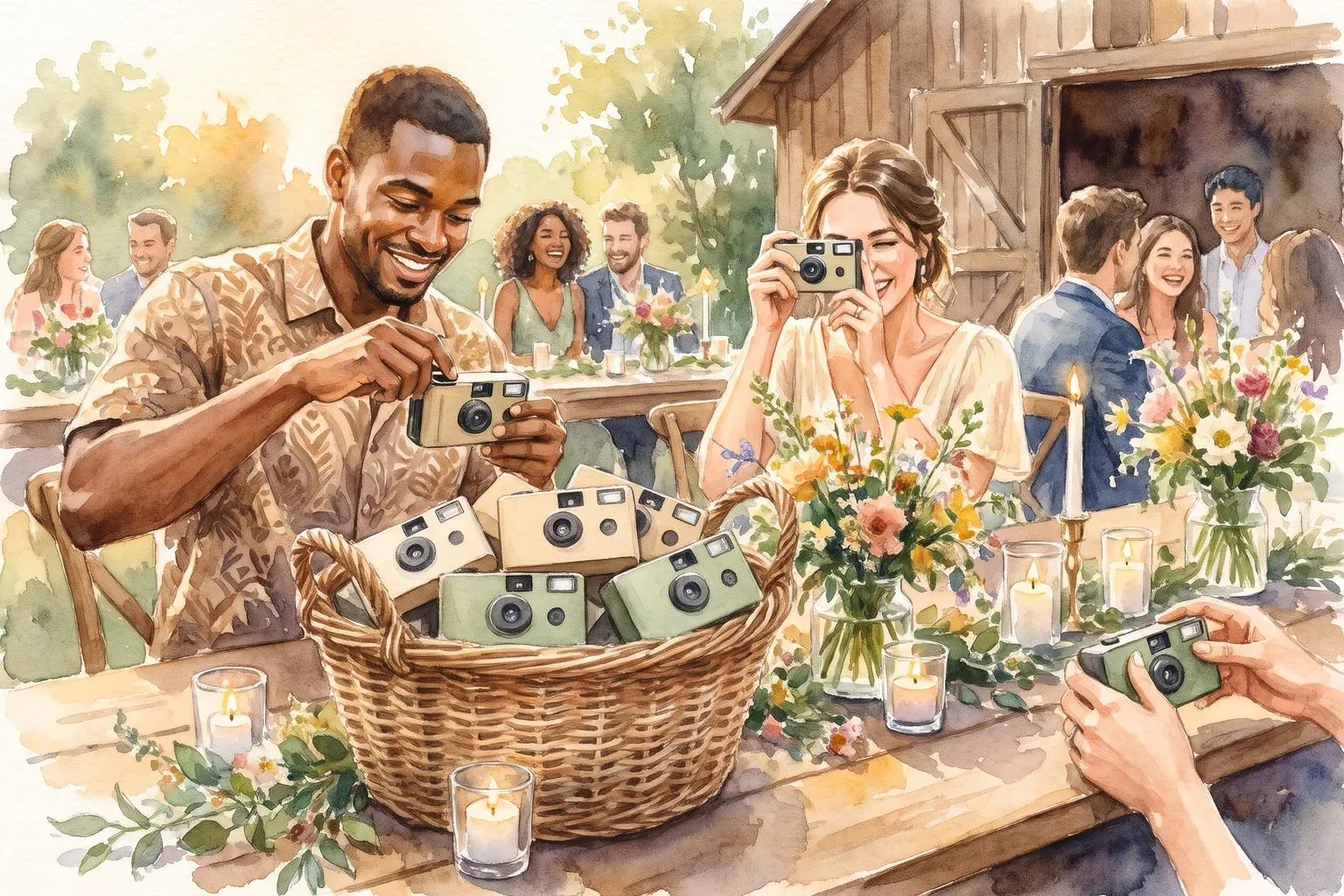
You have a guest count, a budget, and a cart with a pile of cameras in it. Here is the short answer. As of November 2026, disposable cameras in bulk cost about $18 to $20 each from the sellers we could check, and developing with digital scans adds about $16 to $20 per camera. Plan on roughly $40 per camera, all in. Buy one camera per table plus about 25% extra. For a hypothetical 120-guest wedding, that's 15 cameras and somewhere between $500 and $610.
The rest of this guide covers what to order, where the prices come from, what the lab will charge, and how to keep the whole supply from vanishing at table one.
A note on who's writing: we make Revel, an event camera that runs on guests' phones, so we have an interest in this topic. We've tried to make this useful if you buy film anyway. Plenty of people should, and we'll say when.
How much are disposable cameras right now?
Bulk film cameras are a thin market. Stock comes and goes, and there's less of a volume discount than you'd expect. Here's what we found. We checked shop pages directly where we could. Amazon, B&H, and Walmart blocked our direct access, so those rows come from dated secondary reports or search listings, and you should check them yourself before ordering.
| Camera and pack | Seller | Price | Per camera | Source and date |
|---|---|---|---|---|
| Fujifilm QuickSnap Flash 400, single | Glazer's Camera | $18.99 | $18.99 | Product page, November 2026 |
| Fujifilm QuickSnap Flash 400, 2-pack | Glazer's Camera | $34.95 | $17.48 | Product page, November 2026 |
| Fujifilm 4-pack | Amazon | $82 | $20.50 | Reported by The Drunk Wedding Photographer, January 2026 |
| Fujifilm 5-pack | Amazon | $99 | $19.80 | Same report |
| Fujifilm 10-pack | Amazon | $199 | $19.90 | Same report |
| Kodak FunSaver, single | Tuttle Cameras | $17.99 | $17.99 | Product page, 7 in stock, November 2026 |
| Kodak FunSaver, single | Freestyle Photo | $19.95 | $19.95 | Search listing, restock date shown as October 30, 2026 |
| Kodak 7-pack | Amazon | $189 | $27.00 | Reported by The Drunk Wedding Photographer, January 2026 |
| Ilford HP5 Plus, single | ProCam, Reformed Film Lab, FW Photo Lab | $15.99 to $17.99 | same | Search listings, November 2026 |
Two things stand out. First, a bulk pack on Amazon barely beat a single from a camera shop, and the Kodak 7-pack came out well above buying singles. Do the division on every listing. Second, the Glazer's 2-pack listing doesn't spell out whether $34.95 covers both cameras. The name and the single price suggest it does, but confirm before you order.
Walmart pages wouldn't load for us. Search previews in November 2026 showed single QuickSnaps at about $21.90 to $22.95 and a 2-pack from $34.98, usually from marketplace sellers rather than Walmart itself. Check who is actually shipping before you trust those numbers.
Kodak FunSaver stock was patchy when we looked. Search listings showed Reformed Film Lab, Glazer's, and others as sold out. If you want Kodak specifically, order well ahead and don't count on one shop filling a big order.
Wholesale disposable cameras are hard to find
We found no public wholesale price list for a regular buyer. Retail limits can bite, too. Glazer's caps its QuickSnap at 10 units per household every 7 days, so a 25-camera order may mean two or three separate orders or an email to the shop. If you need 50 or more, write to a camera store and ask for a quote. The worst they can say is no.
Wedding-branded packs cost more, and you should read the fine print
Search "wedding disposable cameras" and you'll get floral wraps, custom labels, and generous adjectives. Some are fine. Some aren't what they look like. The Drunk Wedding Photographer warns that wedding-branded cameras can hold expired generic film, weak flash batteries, or as few as 12 exposures. That's one photographer's view rather than a test, but it gives you the right questions: which film, how many exposures, what's the expiry date, does it have a flash?
Walmart search listings showed a third-party 10-pack of wedding-themed cameras at $153.98, or about $15.40 each, which we couldn't open to confirm. If the exposure count is low, a cheap camera is an expensive frame.
At the premium end, Photodom sells custom-branded packs that include processing, scans, and a prepaid return label: $699 for 20 cameras, $1,499 for 50, and $2,999 for 100, per its product page in November 2026. That's $34.95, $29.98, and $29.99 per camera with developing included. Production usually takes two to three weeks after you approve a proof. Its page confirms 27 exposures but doesn't mention a flash, so ask. This option is pitched at brands, but the math can work for a large wedding.
A cheaper route to the pretty version: buy plain name-brand cameras and add your own labels. Many Etsy sellers sell only the printed wraps, so check that you're not paying for a sticker when you wanted a camera.
Which camera to buy: flash range matters more than the box
All three mainstream options hold 27 frames. They differ in film speed, flash, and color.
| Kodak FunSaver | Fujifilm QuickSnap Flash 400 | Ilford HP5 Plus | |
|---|---|---|---|
| Film | Kodak 800 speed color | Fujicolor 400 color | ISO 400 black and white |
| Exposures | 27 | 27 | 27 |
| Flash range | 4 to 11.5 ft (Kodak) | 1 to 3 m, about 3 to 10 ft | Check the listing; versions vary |
| Sharp from | About 3.3 ft | About 3.3 ft | Check the listing |
| Flash control | Charge before each picture | Continuous flash switch | Check the listing |
The Kodak figures come from Kodak's business product page. A shop listing at Tuttle Cameras gives 4 to 10 feet for the same camera, so treat 11.5 as the optimistic end. The QuickSnap specs come from BC Camera's listing, which also gives a fixed-focus 32mm f/10 lens and a 1/100 second shutter.
Those numbers explain almost everything about how wedding film looks.
Fixed focus means guests can't get close. Anything nearer than about a yard goes soft, and that's precisely where people hold a camera for a selfie or a toast with a friend. Put a line about it on the table card.
An f/10 lens and a 1/100 shutter let in very little light, so indoors the flash does nearly all the work. People within about 4 to 10 feet will be lit, while anything beyond falls into the dark. A guest shooting the first dance from table 12 will likely get a dark room with small bright dots in it.
ISO 800 film is twice as sensitive as ISO 400, which gives Kodak an edge in a dim reception. The QuickSnap's continuous flash switch is handy for a guest who won't remember to press a button. On the other hand, the FunSaver's need for a charge before each picture is the kind of step a guest forgets after a second glass of something.
The flash is where film events go wrong. The Darkroom's FAQ says disposable cameras are its most common source of blank rolls, usually because the flash didn't fire in low light. The Drunk Wedding Photographer suggests taping the switch to On once the sun goes down, which is low-tech and very sensible on any camera with a switch.
For most receptions, we'd pick the FunSaver for dim rooms if you can find it, and the QuickSnap otherwise. Ilford HP5 is the lovely wildcard: black and white forgives mixed lighting, and a table of them looks intentional. It does complicate developing, as you'll see below.
How many disposable cameras for a wedding? Work backward from frames
The usual advice is one camera per table plus extras for the bar and photo booth. Knipsmig, which sells a digital alternative, suggests 12 to 15 cameras for 10 tables. That's a decent rule, but the logic behind it helps you adjust it.
Every camera is 27 frames, so what you're really buying is frames per guest.
Say you have 120 guests at 12 tables of 10. Twelve cameras give you 12 × 27 = 324 frames. Divide by 120 guests and you get 2.7 frames per guest. Fifteen cameras give you 405 frames, or 3.4 per guest.
Now apply a keep rate. Nobody has a reliable figure for this, because it depends on the room, the light, and the guests. So take a hypothetical 50%. At 405 frames, that's about 200 keepers. If that sounds right for a wedding that also has a professional photographer, 15 cameras is plenty. If you have no pro and film is your main record, you'd want more frames or a backup plan, because 3.4 shots per guest will not cover a whole day.
Then adjust for the room:
- Larger tables. At rounds of 12, one per table gives each person fewer shots, so add cameras.
- Long reception. More hours means more shots wanted from the same 27 frames, so hold more in reserve.
- Lots of kids. Children love these cameras and shoot quickly. Budget for it, or give them one of their own.
- Cameras that walk off. Knipsmig claims 30% to 50% get lost or taken. That's a seller's figure with no source shown, but some loss is real, so collect them deliberately.
We use 25% extra in the worksheet below. That covers the bar, the dance floor, the wedding party, and a reserve.
What developing costs at named labs
Here's what we could confirm. Prices are per camera, and turnaround excludes any drive to the store.
| Lab | Price | Turnaround | Digital files | Negatives |
|---|---|---|---|---|
| The Darkroom (mail-in) | From $17 per disposable; enhanced scans $3 extra | 2 to 5 days in the mail, then 2 to 4 days in lab | Included, three sizes | Always returned |
| Walgreens | $15.99 per 24-exposure 35mm roll | 3 to 5 business days for 35mm | Free photo CD | Not included |
| CVS | Not published; ask in store | 7 to 10 days; B&W about 3 weeks | 4×6 prints stated; scans not mentioned | Not stated |
| Walmart Photo Center | Not published; ask in store | About six days | CD or USB for a small extra charge | Not stated |
The Darkroom's figures come from its own pages, checked in November 2026. The $17 fits with its $14 starting 35mm price and a $3 single-use camera fee on the order form. Its base rate for round-trip shipping is $6.95. The disposable camera page says a prepaid label can cover multiple cameras, and print sets start at $10 for 4-inch prints. Standard scans are 1024×1536 pixels, fine for small prints and phones. Enhanced scans are 2048×3072, which is the size we'd pay for.
Walgreens comes from its film processing page, checked in November 2026. That page quotes a 24-exposure roll and doesn't give a separate disposable price, so a 27-exposure camera may be priced differently. Guestpix, a seller of a digital alternative, reports a longer wait for disposables at Walgreens, 7 to 10 business days. So get the real date at the counter. A photo CD is also a mixed gift in 2026, since many laptops have nowhere to put it.
CVS and Walmart details come from Pellica's tracker, which checked those chains' published pages on October 27, 2026. Pellica notes that CVS doesn't offer film service at every store. Film Developing Nearby, in a guide updated in July 2026, puts drugstore counters at roughly $10 to $18 per roll and says their scans are about 1 to 4 megapixels, with negatives often not returned.
That's the main trade-off. A drugstore can be a few dollars cheaper and may be closer. A film lab gives you negatives and better files. For a one-time event, we'd pay the extra few dollars, because the negatives are the only true originals you have. If you shoot Ilford HP5, a mail-in lab is the safer choice. The Darkroom says it develops Ilford disposables, while CVS black and white takes about three weeks.
For a deeper breakdown of lab types, rush fees, and scan resolution, see what disposable camera developing costs in 2026. The ranges there are broader, at $20 to $40 per camera with scans, and our numbers here sit at the low end of that range because they use one budget mail-in lab. A boutique lab will cost more.
One billing point catches people out. The Drunk Wedding Photographer notes that labs charge full price whether a roll holds one good photo or 27. Half-used cameras cost the same to develop as full ones. And a blank roll still costs what it costs, so that flash tape earns its keep.
The full cost worksheet for 60, 120, and 200 guests
These are hypothetical weddings with 10 guests per table. The camera count is tables × 1.25, rounded up.
Assumptions for the standard plan:
- Camera: $20 each, a round figure based on the reported Amazon 10-pack ($199 ÷ 10 = $19.90).
- Developing: $20 each at The Darkroom ($17 + $3 for enhanced scans).
- Shipping: $6.95 once, assuming one order covers everything. Confirm that for a large box.
- Not included: sales tax, prints, labels, signs, pens, or a collection box.
| 60 guests | 120 guests | 200 guests | |
|---|---|---|---|
| Tables | 60 ÷ 10 = 6 | 120 ÷ 10 = 12 | 200 ÷ 10 = 20 |
| Cameras | 6 × 1.25 = 7.5, so 8 | 12 × 1.25 = 15 | 20 × 1.25 = 25 |
| Buy cameras | 8 × $20 = $160 | 15 × $20 = $300 | 25 × $20 = $500 |
| Develop and scan | 8 × $20 = $160 | 15 × $20 = $300 | 25 × $20 = $500 |
| Shipping | $6.95 | $6.95 | $6.95 |
| Total | $326.95 | $606.95 | $1,006.95 |
| Total frames | 8 × 27 = 216 | 15 × 27 = 405 | 25 × 27 = 675 |
| Cost per guest | $326.95 ÷ 60 = $5.45 | $606.95 ÷ 120 = $5.06 | $1,006.95 ÷ 200 = $5.03 |
| Cost per frame | $326.95 ÷ 216 = $1.51 | $606.95 ÷ 405 = $1.50 | $1,006.95 ÷ 675 = $1.49 |
So each frame costs about $1.50. At our hypothetical 50% keep rate, each keeper costs about $3.00.
A lower-cost version uses the Glazer's 2-pack price ($34.95 ÷ 2 = about $17.50 per camera) and the Walgreens rate of $15.99, assuming it applies to a 27-exposure disposable. You'd give up the negatives.
| 60 guests (8) | 120 guests (15) | 200 guests (25) | |
|---|---|---|---|
| Cameras at $17.50 | $140.00 | $262.50 | $437.50 |
| Developing at $15.99 | $127.92 | $239.85 | $399.75 |
| Total | $267.92 | $502.35 | $837.25 |
Then there's the all-inclusive option. At the 200-guest size, 25 cameras from Photodom would be one 20-pack plus five extras at its listed $35 add-on price: $699 + (5 × $35) = $874. That's $132.95 less than the standard plan and includes scans and return shipping. It also carries a 2 to 3 week production lead, no negatives mentioned, and no confirmed flash. For 60 or 120 guests, the 20-camera minimum means paying $699 for more cameras than you need.
If you add a 4-inch print set at The Darkroom's listed $10 per camera, add $80, $150, or $250. Prints are a lovely thing to have from the good rolls. They're less lovely on the roll that's 24 pictures of a tablecloth.
Expiry and storage before the big day
Check the printed date on every box when it arrives, especially from marketplace sellers. Kodak's storage guide (publication E-30) says to use film before the printed expiration date for best results.
The same guide says Kodak consumer films and single-use cameras can be stored at up to 70°F, and to keep them away from excessive heat such as a parked car in the sun or a summer attic. It specifically names the glove compartment, trunk, and back window. If you drive the cameras to a summer venue, Kodak suggests an insulated bag or cooler.
This matters more for weddings than most purchases, because cameras tend to sit in a car, a garage, or a venue storeroom before anyone needs them. Keep them in the house until the day, and give them to someone who won't leave them in a sunny car during the ceremony.
Flying to a destination wedding? Kodak says x-rays can fog unprocessed film, that CT scanners are used on checked bags and increasingly on carry-ons, and that you should hand-carry loaded cameras and request a visual inspection. That applies on the way home too, when the exposed film is even more precious. A shop or lab near the venue is worth considering.
After the event, don't let the cameras sit. Kodak advises processing promptly after exposure for consistent results. Send them the week after you get back, not the following spring.
Wedding day logistics, and how to get the cameras back
Disposable cameras fail in predictable ways, and almost all of them are fixable with a little planning.
Assign a camera captain. Pick one reliable friend, not the bride's sister who's also giving a speech. Your captain holds the reserve, hands out new cameras, and runs collection.
Number every camera. Use a small sticker with a number and a table. You'll know what's missing, and a number lets the captain check them off.
Write a table card. Keep it to three lines: wind after every shot, turn the flash on, stand at least four feet away. If you want to steer the subject matter, add a short prompt list. Our free wedding photo shot list can be cut down to a few table prompts.
Tape the flash on after sunset. On cameras with a flash switch, do this before they go out. Do a table-by-table check if the wedding starts in daylight.
Announce collection, twice. Have the DJ or MC mention it during dinner and again before the last song. Put a clearly marked box at the exit, and post someone next to it. Don't rely on guests remembering at 11pm with their shoes in their hand.
Ship it safely. The Darkroom says it can't track inbound USPS mailers, and for critical film it suggests FedEx or UPS. For a whole wedding, that's worth the extra cost. You might also split the cameras into two parcels, so one lost box isn't the entire day. Two round-trip rates would be $6.95 × 2 = $13.90, if each one is billed as a separate order.
What happens when guests shoot all 27 frames on the first table
This will happen. Somebody's cousin will finish a roll on the bread basket before the salads land. A camera can't be reloaded, so once it's done, that table is out. Here's how to keep that from ending your coverage.
Release cameras in waves. Don't put the whole supply out at once. With 15 cameras, try 8 on tables for dinner, 2 at the bar, and hold 5 for the dance floor. Your captain checks tables after the main course and replaces finished cameras. This is the single biggest thing you can do, and it costs nothing.
Do the frame math out loud. Twenty-seven frames shared by 10 people is 2.7 each. People don't know that. A table card that says "2 or 3 shots each, then pass it on" helps more than you'd expect.
Keep the frame counter in view. Most disposable cameras have a small counter on top. Ask your captain to glance at it as they pass, and move a half-used camera from a quiet table to a busy one.
Give kids their own. One camera at the children's table, used in a burst, is cheaper than four cameras that each lost 15 frames to a seven-year-old with a project.
Accept some of it. The bread basket photo will probably be a favorite in 10 years.
What's genuinely lovely about film, and when it's the right call
Film deserves a fair hearing, partly because it's good and partly because we've just spent a long time on its logistics.
The grain and color of a cheap flash photo are hard to fake perfectly. A strong flash at close range makes people look like they're in the middle of something. The wait is a pleasure of its own: weeks after the wedding, a link or envelope arrives and you see the party from angles you never saw. A plastic camera on a table also does something a phone can't. It's an object that invites people to pick it up, and people pass it around, including older relatives who'd never scan a code.
You also get a real archive. Negatives can sit in a box for decades and be rescanned with better equipment later. Nothing depends on an app or an account still existing.
Physical film is the right choice in these situations:
- You love the look and accept that imperfect, or even blank, is part of the deal.
- You have a professional photographer, so the film is a bonus rather than the record.
- It's a smaller wedding, where 8 or 10 cameras are easy to manage.
- You're holding an unplugged reception and want no phones on the tables.
- Your guests skew older or less comfortable with phones.
- You want negatives and a box of objects to keep.
It's a weaker choice when it's your only source of guest photos, when the venue is very dim or very large, or when you need to see pictures quickly.
If you'd rather skip the film: one phone-based alternative
If the worksheet made you wince, or you're worried about a dark reception, the digital route is Revel. You create a Moment, and guests join by QR code, link, or NFC tag, then shoot from their phone's browser with no app or account. You can set a shot limit per guest with a live countdown, which keeps the 27-frame scarcity without the bread basket problem. Choose one of 50+ film-style filters to apply to every photo, and originals are saved too. Hide the photos until the Moment ends and everyone gets the reveal at once, or review each photo first.
There's no film to buy, develop, or collect. It's free for up to 10 participants. Larger events are a one-time, per-event purchase in the app, with no subscription, so check the app for your guest count. The side-by-side is on our disposable cameras comparison page.
It isn't film, though. There are no negatives, no prints, and no object on the table. Guests need a phone, camera-roll uploads are limited to photos taken during the Moment, and we don't do video. If you want that physical box in 20 years, buy the cameras. Doing both is reasonable too. For other phone-based options and what they cost, see our comparison of the best disposable camera apps.
Disposable cameras in bulk: quick answers
How much are disposable cameras in 2026?
A 27-exposure QuickSnap or FunSaver ran about $18 to $20 at the shops we could check in November 2026. Multipacks barely change that. Reported Amazon prices in January 2026 worked out at $19.80 to $20.50 for Fujifilm packs. Marketplace listings can be higher.
How many disposable cameras do I need for 100 guests?
At 10 guests per table, that's 10 tables, so 10 × 1.25 = 12.5, which rounds up to 13 cameras. That gives you 13 × 27 = 351 frames, or about 3.5 per guest. Add more if you don't have a professional photographer.
Can I buy disposable cameras wholesale?
We found no public wholesale pricing. Your best bet is an Amazon multipack, several orders from a camera shop, or an email to a store asking for a quote. Check purchase limits first, since Glazer's caps its QuickSnap at 10 per household every 7 days.
Do disposable cameras expire?
Yes. The film has a printed date, and Kodak says to use it before then for best results. Old film can still produce images, but The Darkroom notes it can fade, fog, and shift toward magenta. Check dates on arrival, particularly on cheap or marketplace packs.
Are scans included when you develop a disposable camera?
It depends on the lab. The Darkroom includes scans in its price and charges $3 more for its enhanced size. Walgreens' 35mm price includes a photo CD. Published CVS and Walmart information is less clear, so ask at the counter what you'll actually get.
Do wedding disposable cameras work indoors?
Yes, if the flash fires and the subject is within range, about 4 to 10 feet. Without flash, an f/10 lens at 1/100 second gets very little in a dim room. Tape the flash on where you can, and tell guests to get close but not closer than about 4 feet.
Your next step
Before you order 25 of anything, run a small test. Buy two cameras, shoot a roll each in your dimmest room at night, and send them to a lab. You'll learn what the flash reaches and whether you like the look, for about $87 at the worksheet rates (2 × $40 + $6.95 shipping).
Curious about the digital version too? Download Revel, create a free Moment for up to 10 people, and test it at dinner with friends this week.

A writer interested in connection, memory, and the everyday moments that matter more than we realize.
Tags: Wedding disposable camera , Wedding planning , Wedding photo sharing , Party planning