Photo Sharing vs Disposable Cameras
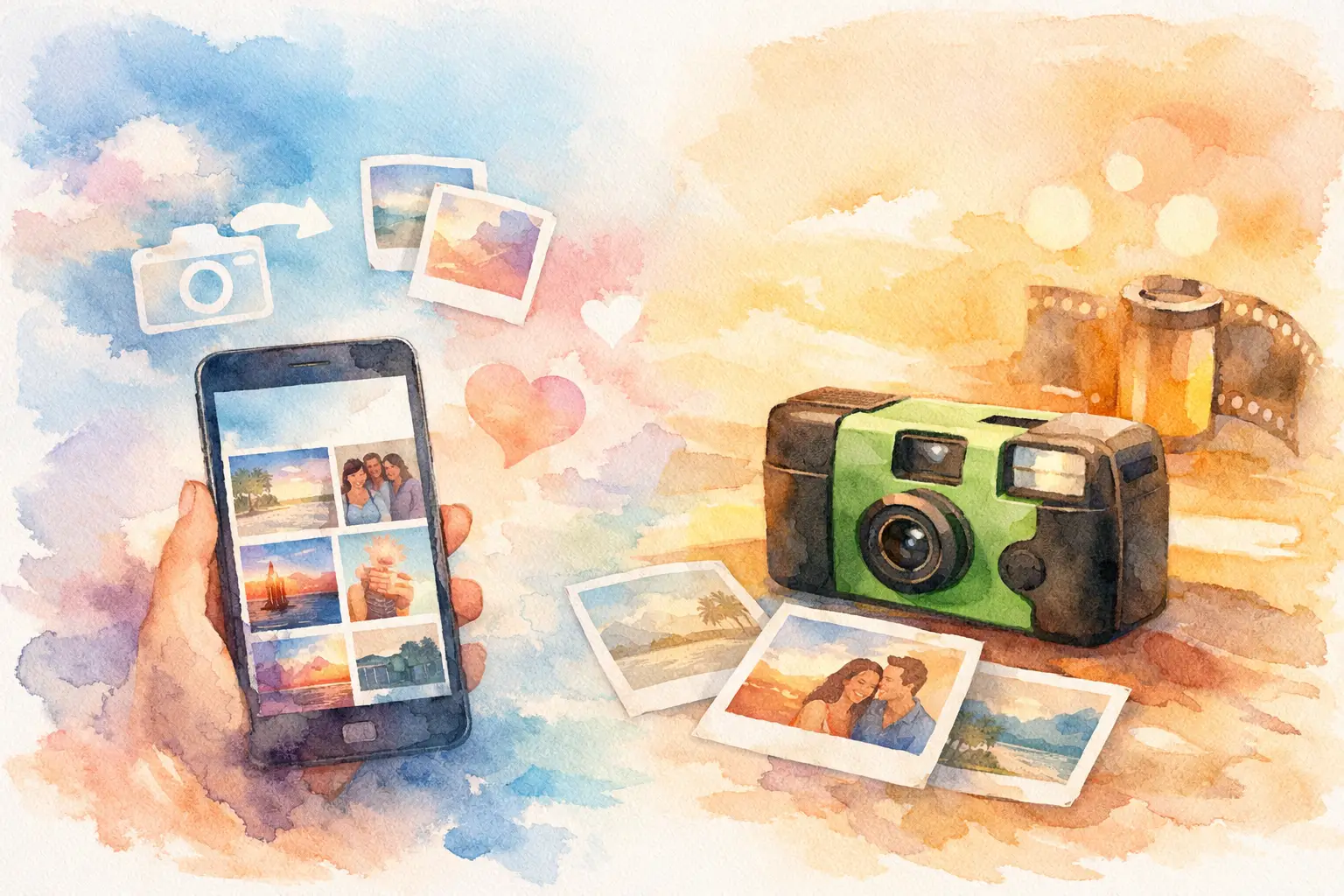
The group chat says, “Drop your pics here,” and then the photos never really arrive. A week later, one friend posts a dump on Instagram, someone else forgets entirely, and half the best moments live on strangers’ camera rolls forever. That’s the real tension in photo sharing vs disposable cameras - not just digital versus film, but whether your event memories actually make it back to everyone.
For weddings, birthdays, vacations, baby showers, and work events, both options promise something people want: candid moments from every angle. But they get there in very different ways. One leans nostalgic and unpredictable. The other wins on speed, scale, and participation. The better choice depends on what kind of event you’re hosting, how much friction your guests will tolerate, and whether you want a cute experience, a complete gallery, or both.
Photo sharing vs disposable cameras: what are you really choosing?
On paper, disposable cameras feel simple. Put a few on tables, let guests snap away, send them off for development, and wait for the surprise. That surprise is the appeal. Film captures the messy, imperfect energy people still love.
But disposable cameras are also limited in ways people forget until after the event. You have a fixed number of shots. Guests can’t see what they took. You may end up with duplicate photos of centerpieces, accidental finger-over-lens masterpieces, and a lot of missed moments because the camera wasn’t nearby when something funny happened.
Photo sharing flips that model. Instead of handing around a physical camera, you turn everyone’s phone into a contributor. In theory, that should solve everything. In practice, most photo-sharing methods create their own mess. Asking guests to text photos, upload them later, join a shared album, or download an app sounds easy until nobody does it.
That’s why the real question isn’t just analog versus digital. It’s friction versus participation. The easier it is to contribute in the moment, the more memories you actually collect.
The case for disposable cameras
Disposable cameras still have a vibe. They slow people down. They make each shot feel intentional. And for certain events, that’s exactly the point.
At a wedding with a film-forward aesthetic, disposable cameras can become part of the decor as much as the documentation. At a birthday or bachelorette, they add a tactile, playful element people instantly understand. No instructions. No tech setup. Just point, click, pass it on.
There’s also the delayed gratification factor. You don’t see the photos right away, which can make the reveal feel special. Film has texture. Flash looks different. Imperfections often make the final gallery more charming, not less.
Still, romance hides the trade-offs. Film and development add up fast, especially across large events. You’re paying for the cameras, processing, and usually a decent amount of waste from underexposed or blurry shots. Quality is part magic, part gamble.
There’s also a coverage problem. A few disposable cameras can only be in so many places at once. If the best dance floor moment happens while the camera is abandoned near the cake, that memory is gone. For events spread across multiple rooms, tables, or locations, physical cameras just don’t travel as well as people’s phones do.
Where digital photo sharing usually wins
Digital wins on access, volume, and convenience. That matters more than ever because guests already have the camera in their hand. You’re not asking them to do something new. You’re asking them to use behavior they already have.
When photo sharing works, it works beautifully. You get more angles, more candid moments, and more total coverage. The gallery feels alive because it reflects the event from inside the crowd, not just from one or two designated cameras.
You also avoid the cost and delay of film processing. Photos are high resolution, easier to save, easier to organize, and easier to revisit. For brand activations, conferences, and company events, digital is often the only realistic option because teams want usable photos quickly and at scale.
But standard digital sharing has one big weakness: people forget. They mean to upload later. They never do. Shared albums get buried. Download requirements kill momentum. Account creation kills even more of it. Every extra step loses people.
So if you’re comparing photo sharing vs disposable cameras honestly, digital only wins when the sharing part is actually frictionless.
Why participation is the whole game
Most hosts don’t need a theoretical way to collect photos. They need guests to actually contribute.
That’s where traditional disposable cameras have a strange advantage. They’re visible. They sit on the table and remind people to use them. A generic digital album, by contrast, is invisible unless someone keeps pushing it.
The best digital experiences borrow that same immediacy and make participation feel obvious. Guests scan once, join instantly, and start shooting. No app. No login spiral. No “I’ll send mine later” fantasy. That structure matters because contribution rates don’t improve through polite reminders. They improve when the system removes excuses.
This is also why digital disposable camera-style setups have become more popular. They keep the fun constraints people love - limited shots, nostalgic filters, delayed gallery reveals - while fixing the failure points of actual film. You get the energy of a disposable camera without the dead batteries, processing fees, or missing-camera chaos.
For social events, that can be the sweet spot. People want spontaneity, not admin. They want candid photos, not another task.
Cost, quality, and convenience aren’t equal priorities
If your main goal is aesthetic nostalgia, disposable cameras may still earn their place. Film has a look that digital filters imitate but don’t perfectly replicate. If a little unpredictability feels like part of the memory, the trade-off might be worth it.
If your goal is collecting the most moments from the most people, disposable cameras are rarely the best tool. They cap your coverage by design. You’ll likely get fewer photos, less consistency, and a higher cost per usable image.
Digital photo sharing usually gives you the opposite profile. More photos. Better reliability. Easier access. Lower waste. But the exact experience depends on the system you choose.
A bare-bones shared album is convenient for the organizer, not always for the guest. A good event photo-sharing setup is convenient for both. That difference sounds small until your event ends and you realize convenience for guests is what determines whether you get 20 photos or 500.
For professional events, convenience almost always beats nostalgia. Event planners, marketers, and internal teams need broad participation and organized output. They can’t rely on a handful of film cameras and hope the content turns out usable. For weddings and personal celebrations, the answer is more flexible. You may want some film for atmosphere and some digital for coverage.
The smartest choice is often not either-or
This doesn’t have to be a purity test. Plenty of hosts use disposable cameras as a detail and digital sharing as the actual collection system.
That mix works because each format handles a different job. Film creates mood. Digital captures volume. Film is a novelty. Digital is the archive. If you love the look of disposable cameras, you don’t need to give that up. You just probably shouldn’t expect it to carry your whole event photo strategy.
A wedding is a perfect example. A few disposable cameras at the reception can be fun, especially if they match the vibe. But if you want guest photos from getting ready, cocktail hour, the dance floor, and the after-party, you need something that follows the crowd. Phones already do.
The same logic applies to birthdays, graduation parties, vacations, and company offsites. Ask yourself one simple question: do you want a handful of charming surprises, or do you want a shared record of the full event? Both are valid. They just lead to different choices.
So which one should you choose?
Choose disposable cameras if the format itself is part of the experience, you’re comfortable with fewer total photos, and you genuinely like the unpredictability. They work best when nostalgia is the feature, not a side effect.
Choose digital photo sharing if your priority is collecting more moments from more people with less follow-up. It’s the stronger option for larger groups, fast-moving events, and anyone who has ever tried to chase photos after the fact and hated every second of it.
And if you want the throwback energy without the usual film problems, a digital disposable camera approach is hard to beat. That’s the lane Revel is built for - quick guest access, shared participation, and a reveal that still feels like an event.
The best event photos are rarely the most polished ones. They’re the ones people actually take, actually share, and actually get to relive together later.

A writer interested in connection, memory, and the everyday moments that matter more than we realize.
Tags: Disposable camera , Disposable camera app , Digital disposable camera , Photo sharing , QR photo sharing , Guest photo sharing