Day of Wedding Coordinator: What to Expect and How to Prep

Most weddings don’t go off the rails because the couple forgot something important. They drift because there is no single person whose job is to make 40 small decisions quickly, keep vendors moving, and protect the timeline.
That’s what a day of wedding coordinator is for.
This guide covers what you should realistically expect from day-of coordination, what you need to prep (and when), and how to set your coordinator up to run your wedding smoothly so you can actually enjoy it.
What a day of wedding coordinator really is (and isn’t)
“Day-of” is a slightly misleading name. In most markets, a day-of coordinator starts weeks before the wedding, not just the morning of. They step in after you have already booked your key vendors and made your big decisions, then they manage the handoff from planning to execution.
Think of them as your operations lead. They turn your plans into a clear run-of-show, confirm logistics with vendors, run the rehearsal, and then call cues on the wedding day.
What they usually are not:
- A full-service planner (designing, sourcing, booking, and managing the whole planning process)
- A decor production team for complex DIY installs (unless it’s explicitly included)
- A personal assistant for the couple, wedding party, or guests
If you are still choosing between planning tiers, it helps to read a clear breakdown of wedding planning services and what you really get in 2026.
What to expect: the typical day-of coordinator workflow
Every coordinator has their own process, but most solid “day-of” packages follow a predictable arc. Knowing the rhythm helps you prepare the right inputs and avoid last-minute scrambles.
1) An intake call that sets the definition of “success”
Expect a kickoff meeting where your coordinator asks:
- What matters most to you (on-time ceremony, long dance floor, family dynamics handled quietly)
- What you are worried about (late shuttles, weather, speeches going long)
- Who makes decisions if you are unavailable
This is also where you should clarify boundaries. For example, do they handle ceremony setup, manage vendor meals, or oversee teardown?
2) A timeline and run-of-show that’s actually usable
A coordinator typically creates or refines a “master timeline,” then converts it into versions for different audiences (vendors, wedding party, and a pocket version for quick reference).
If your reception timing is a stress point, use this as your baseline reference: a wedding reception timeline that actually runs on time.
3) Vendor confirmations and logistics alignment
This is where coordination pays off. Your coordinator will usually confirm arrival times, load-in details, contact info, payment status, and any special constraints with:
- Venue (access, security, noise rules, ceremony flip, rain plan)
- Catering and bar (timing, meal service, vendor meals)
- Photo/video (must-have moments, family formal workflow)
- DJ or band (mic needs, cue points, pronunciation notes)
- Florals, rentals, and decor (delivery windows, setup responsibilities)
4) Rehearsal leadership (and ceremony clarity)
A good day-of coordinator runs a rehearsal that is calm and fast. Expect them to:
- Set the processional order and spacing
- Explain where hands go, where eyes go, and when to move
- Solve “real world” ceremony questions (trains, veils, ring handoff, readings)
If your officiant is leading the rehearsal, your coordinator still often acts as the practical translator who turns ideas into exact movements.
5) Wedding-day show calling and problem solving
On the wedding day, expect your coordinator to:
- Be the main point of contact for vendors (so you are not answering texts)
- Keep the timeline moving and adjust on the fly
- Cue entrances, toasts, first dance, cake cutting, and other formalities
- Handle small emergencies quietly (a missing boutonniere, a late shuttle, a torn bustle)
This is also why they often bring an assistant for larger weddings. More guests, more spaces, more moving parts.
What coordinators usually need from you (the couple)
The biggest mistake couples make is assuming the coordinator will “just figure it out.” They can only run the day smoothly if you give them the right information in a clean handoff.
Here’s the simplest way to think about it: you provide decisions and details, they provide execution and control.
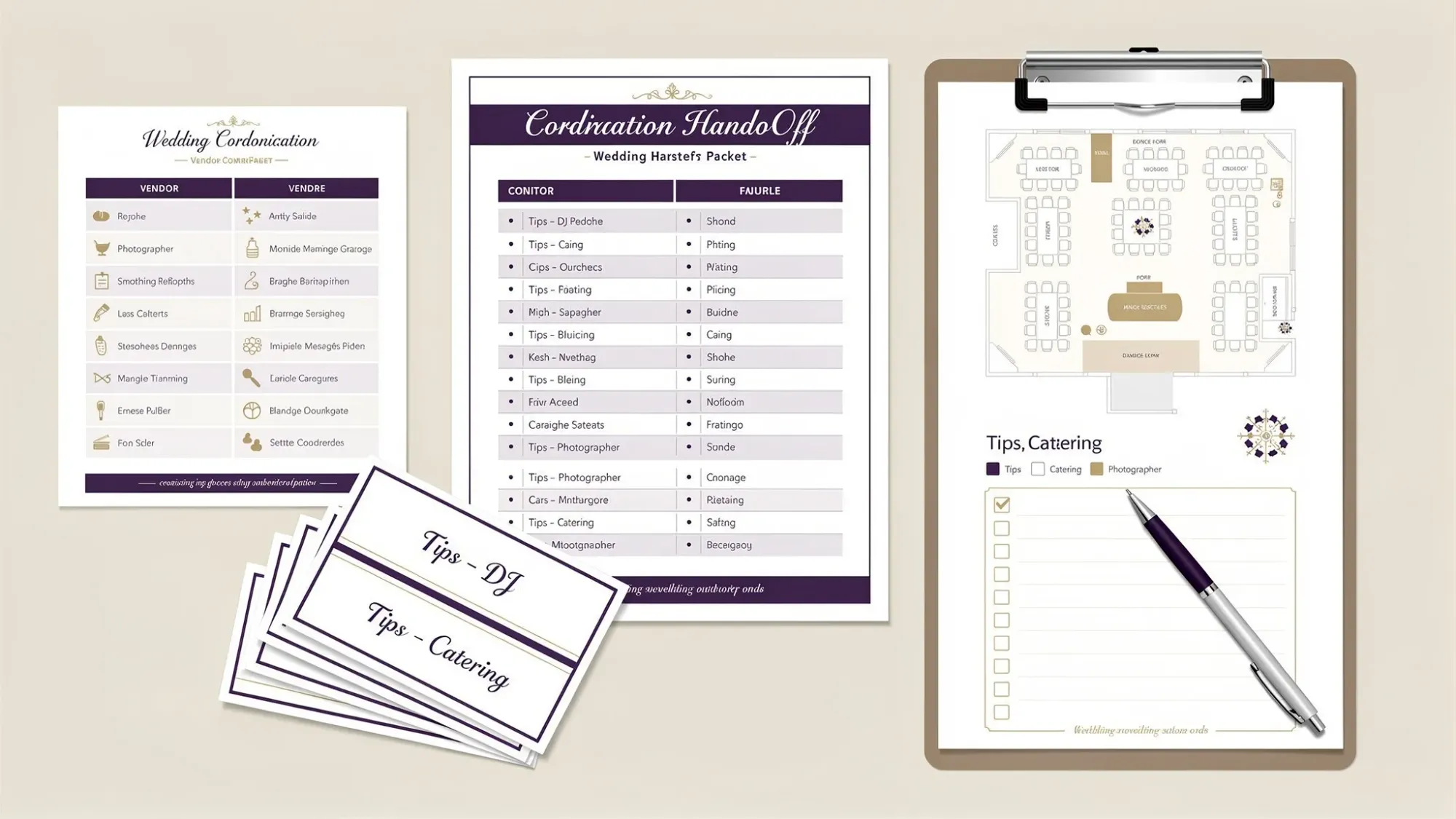
The “handoff packet” you should prep
A coordinator may call it a planning binder, final details packet, or wedding day worksheet. The name varies, but the contents are consistent.
| Handoff item | What it should include | Why it matters day-of |
|---|---|---|
| Vendor list | Company name, contact person, phone, email, role, arrival time, balance due | Your coordinator needs one source of truth for communication and escalations |
| Final timeline | Ceremony time, photo windows, dinner service plan, formalities, hard stops | The timeline is the wedding’s operating system |
| Layouts and floor plan | Ceremony seating, reception layout, sweetheart/head table, photo zones | Prevents last-minute “where does this go?” decisions |
| Decor plan | What items exist, where they go, who sets each item, teardown instructions | Avoids scope gaps and missing centerpieces |
| Payment and tips plan | Who pays whom, when, amounts, envelopes, designated payer | Keeps you from doing transactions in your wedding attire |
| Family and VIP notes | Divorced parents dynamics, must-include relatives, sensitive pairings | Helps the coordinator avoid preventable stress |
| Contingency plans | Weather plan, indoor ceremony plan, late shuttle plan, backup entrance | Makes pivots fast instead of chaotic |
A decision-maker who is not you
Even with a coordinator, someone must be empowered to make fast calls that you should not be bothered with.
Pick one:
- A trusted friend who is calm under pressure
- A sibling who knows your priorities
- A planner or coordinator assistant (if your package includes it)
Then set one rule: all questions route to the coordinator first, and only escalate if truly necessary.
How to prep in the weeks before the wedding (a practical timeline)
Use this as a planning cadence, not a rigid rule. The goal is to deliver clean inputs early enough that your coordinator can do their job.
| When | What you do | What your coordinator can do with it |
|---|---|---|
| 4 to 6 weeks out | Share vendor contracts, your rough schedule, and any venue rules | Build a realistic timeline and spot conflicts early |
| 3 to 4 weeks out | Finalize ceremony structure and reception formalities | Draft cue sheets for ceremony and reception |
| 2 to 3 weeks out | Provide decor inventory and setup responsibilities | Assign setup tasks and identify where you need extra help |
| 7 to 10 days out | Confirm final counts, seating plan, special meals, and access details | Lock vendor timing and reduce day-of questions |
| 72 hours out | Deliver tip envelopes, final payments plan, personal item drop list | Prevents last-minute errands and missing items |
| Day before | Rehearsal, final venue walk-through if needed | Confident execution with fewer surprises |
Questions to ask a day-of coordinator before you hire
Your coordinator is less about aesthetics and more about competence under pressure. Ask questions that reveal how they operate.
Ask about ownership and boundaries
You want crisp answers, not vague assurances.
- What exactly do you take over, and when do you take over?
- How many hours are included on the wedding day, and what triggers overtime?
- Do you manage setup and teardown, or only oversee?
- Who is the point of contact for vendors after you take over?
If you are pricing options, this breakdown helps you compare proposals and avoid surprises: wedding coordinator cost in 2026 (ranges, add-ons, red flags).
Ask about staffing and load
- Will you personally be onsite the whole time?
- Do you bring an assistant, and in what scenarios?
- How many weddings do you take in a weekend?
Ask how they handle real problems
A great coordinator has systems, not just good vibes.
- What’s your process if the ceremony starts late?
- What if a vendor is missing, delayed, or tries to change the plan?
- What’s your rain plan workflow?
- How do you communicate during the day (text, radio, in-person cues)?
How to prep your coordinator for wedding photos (so nothing gets missed)
Coordinators and photographers are different roles, but they overlap heavily on timing. The smoother your photo plan, the smoother your whole day.
Two things that prevent 80 percent of photo-day stress
First, appoint a family photo wrangler. This is not your coordinator’s best use of time during formals. It should be a relative or friend who knows faces and can move people quickly.
Second, define “must-not-miss” moments. Even if you have a full shot list, most couples only have 5 to 10 moments that would genuinely hurt to lose.
If you want a simple, tactical structure, this approach is reliable: wedding photos, a simple plan to avoid missing key moments.
Don’t forget the modern gap: guest photos and candid coverage
Even the best professional coverage has blind spots: parallel moments, table candids, late-night chaos, and everything happening while you are in another room.
If you want those memories without chasing 80 people after the wedding, treat guest photos as an operational workstream and hand it to your coordinator like any other.
A low-friction system your coordinator can run
Revel.cam is designed for this exact handoff. You create a private event called a Moment, then guests scan a QR code (or tap an NFC tag) to open a camera and upload automatically, with no signup and no app install.
On iPhone, this can launch as an Apple App Clip, which helps increase participation because guests can go straight to the camera.
Here’s what to decide before you hand it off:
| Decision | Recommendation for most weddings | Why it helps |
|---|---|---|
| Join method | QR code plus a backup link | Reduces guest friction when scanning fails in low light |
| Photo limits | Set a per-guest cap | Encourages intentional shots and reduces noise |
| End time | End after the main reception window | Prevents random late uploads and keeps the gallery clean |
| Moderation | Use host review if you want control | Protects privacy and avoids unwanted photos |
| Reveal timing | Reveal after the Moment ends | Creates a fun “morning-after” gallery experience |
If you want a step-by-step implementation checklist, use the guest photo collection plan (checklist + timeline).

A simple way to make your coordinator instantly more effective
If you do only one thing, do this: write a one-paragraph “success brief” and send it with your handoff packet.
It should include:
- Your top 3 priorities (what must happen, no matter what)
- Your top 3 sensitivities (what to avoid, or handle delicately)
- Your decision-maker if you are unreachable
This keeps your coordinator from guessing what you value when trade-offs happen, because trade-offs always happen.
The bottom line
A day-of wedding coordinator is not a luxury add-on for “type A couples.” They are the person who protects your timeline, takes heat from vendors and guests, and turns your planning into a wedding day that feels effortless.
Prep them with clear documents, clear owners, and clear priorities, and you get what you are really paying for: a day where you are present, not managing.

A writer interested in connection, memory, and the everyday moments that matter more than we realize.
Tags: Wedding planning , Affordable wedding planning , Wedding planning app , Wedding planning tool