Party Games for Adults: 45 Games Sorted by Crowd Size and Energy
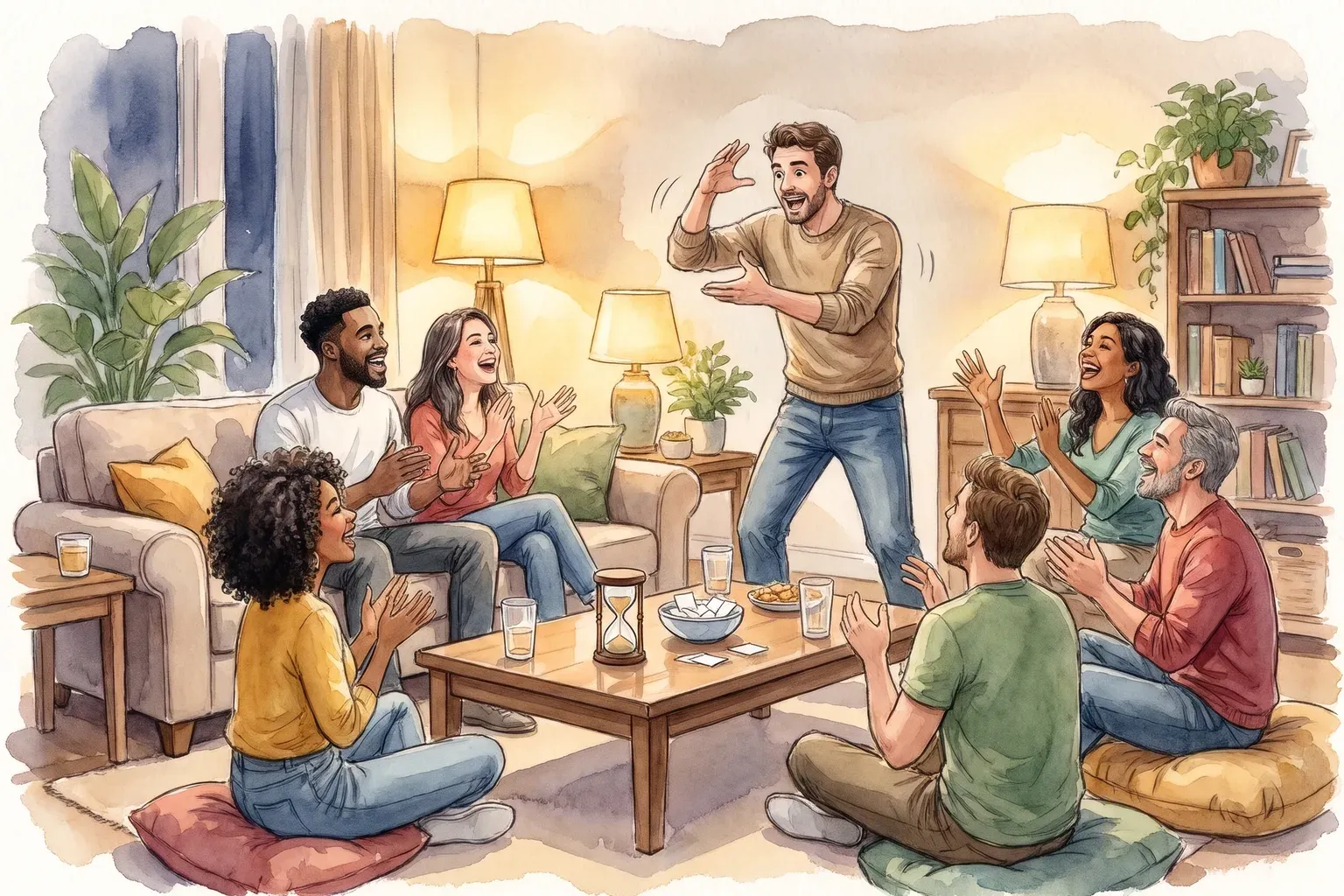
You've invited people over, and you'd like the night to have a bit more shape than "drinks in the kitchen until someone leaves." Maybe it's eight friends around a table. Maybe it's 25 people from three different parts of your life who have never met. Either way, a couple of good games turn a room of separate conversations into one party.
The trouble with most lists of party games for adults is that they're one long pile. A game that's great for six people at dinner falls apart with 30 people standing in a living room, and a game that needs everyone's attention dies in a loud room. So the 45 games below are sorted by crowd size and energy: the dinner table, the living room, boxed games for game night, the big mingling crowd, and the backyard. Each one lists players, time, props, and the way it usually goes wrong.
The short answer
The best party games for adults are simple to explain, need few props, and have a clear end. For 4 to 10 people, try Fishbowl, Two Truths and a Lie, or Codenames. For 20 or more, use games that run in the background, like Who Am I name tags or a photo scavenger hunt, plus one all-room game such as Wink Murder or a team quiz. Every game here works without alcohol.
"Adult" here means grown-up, not explicit. These are games for people who'd like to laugh together without anyone being embarrassed into it.
Pick games by crowd size and energy
Start with the row that matches your party, read that section first, and pick two or three games. Not ten.
| Your party | Best section | Games to start with | Prep |
|---|---|---|---|
| 4–10 people around a table | Dinner table | Question Jar, Hot Seat, Contact | 15 minutes |
| 6–15 people in a living room | Living room | Fishbowl, Charades, Mafia | 20 minutes |
| A game night with friends who like games | Boxed games | Codenames, Just One, Wavelength | Buy the box |
| 20–40 people, lots of strangers | Big mingling crowd | Who Am I name tags, Bingo, Wink Murder | 1 hour |
| A backyard, patio, or summer evening | Outdoor | Cornhole bracket, Sardines, Kubb | 30 minutes |
| A crowd with phones out anyway | Photo games | Team photo hunt, Limited Roll | 20 minutes |
Three rules hold for every crowd:
- Nobody has to drink to play. If drinking is the scoring system, the person who isn't drinking can't play. Use points.
- Opting out is free. Anyone can sit a round out, score, or judge, and nobody comments on it.
- Every game needs a clear end. A timer, a point total, or a last card. Games without an end fizzle while people wait for someone to call it.
Dinner table games for 4 to 10 people
At the table nobody wants to stand up, and conversation is already the main event. These games fit between courses or over dessert, and most need nothing at all.
1. The Question Jar. Players: 4–10. Time: as long as you like. Props: a jar of 20–30 folded questions. Each person draws a question, answers it, and can then hand a second question to someone else. Keep them light and specific: "What's the worst job you've ever had?" "What did you believe as a kid that turned out to be wrong?" How it fails: the questions are too deep for the mood. Keep them light, and let anyone swap a question they don't want.
2. Two Truths and a Lie. Players: 4–12. Time: 15–20 minutes. Props: none. Each person says three things about themselves, one invented. The table votes on the lie. One point for each correct guess, and one point for each person you fool. How it fails: people pick boring truths. Ask for stories, not facts: "I once got locked in a museum" beats "I have a cat."
3. Hot Seat. Players: 5–10. Time: 2–3 minutes per person. Props: a phone timer. One person is in the hot seat for two minutes, and everyone else asks them quick questions. They can pass on two. How it fails: a question goes somewhere personal. Set the rule before you start: no questions about money, exes, health, or bodies.
4. Contact. Players: 4–10. Time: 15 minutes or open-ended. Props: none. The "keeper" thinks of a word and says its first letter. Everyone else tries to pry out more letters: one player gives a clue to any word that starts with the letters so far. If another player gets it, they call "Contact" and the two count down from three and say the word together. If the keeper names that word before the countdown ends, the contact is blocked. If not, the keeper reveals the next letter. Guess the keeper's word to win the round. How it fails: it's hard to explain in words. Play one practice round instead.
5. Sticky-Note Who Am I. Players: 4–10. Time: 15 minutes. Props: sticky notes, a pen. Each person writes a famous person or fictional character on a sticky note and puts it on their left neighbor's forehead. Go around the table asking one yes-or-no question each. First to guess wins, but keep going until everyone's done. How it fails: someone writes a name only they know. Rule that the name must be someone everyone at the table would recognize.
6. Would You Rather. Players: 4–12. Time: 10 minutes. Props: a list of 15 questions. "Would you rather always be 10 minutes late or always be 20 minutes early?" Everyone answers at once by pointing left or right, then the minority defends their choice. How it fails: the questions are generic. Write a few about your actual friends' lives and in-jokes.
7. The Story Chain. Players: 4–10. Time: 10 minutes. Props: none. One person starts a story with a single sentence. Each person adds one sentence. The rule: every sentence must start with either "Fortunately" or "Unfortunately," alternating. How it fails: it rambles forever. End it after two laps of the table.
8. Guess the Year. Players: 4–10, in pairs. Time: 15 minutes. Props: a phone and a list of 15 songs or news events. Play the first 15 seconds of a song, or read a headline, and pairs write down the year. Closest guess gets a point, exact guess gets three. How it fails: the age range at the table is wide and one decade dominates. Spread the picks from the 1960s to last year.
9. One-Vote Whodunit. Players: 6–10. Time: 10 minutes. Props: playing cards. Deal one card each; whoever gets the ace secretly "stole the dessert." Everyone asks one person one question, then the table votes once. How it fails: the thief confesses early. Their only job is to survive one vote.
Living room games for 6 to 15 people
This is the classic house party zone: everyone fits in one room, people are standing or perched on sofa arms, and you can get the whole group's attention for 20 minutes. Start with something that has no losers, then move to team games.
10. Fishbowl. Players: 6–20, in two teams. Time: 30–45 minutes. Props: slips of paper, pens, a bowl, a phone timer. Also known as Celebrity, the Hat Game, or Salad Bowl. Each guest writes three to five names on slips: famous people, characters, or friends everyone knows. All slips go in the bowl. Round one, describe the name without saying it. Round two, one word only. Round three, act it out silently. Teams take 60-second turns, and the same slips get used every round, so the jokes build. How it fails: obscure names. Allow one skip per turn, and ask people to write names a room of adults would mostly know.
11. Charades. Players: 6–20, in two teams. Time: 20–30 minutes. Props: titles on slips, a timer. Everyone already knows the rules. Use movie, TV, book, and song titles, and give each actor 90 seconds. How it fails: the same three performers volunteer every time. Rotate strictly within each team.
12. Pictionary on a big pad. Players: 6–16, in two teams. Time: 20–30 minutes. Props: a large paper pad or whiteboard, markers, word cards. One person draws for their team for 60 seconds, with no letters or numbers. How it fails: the words are too hard and nobody scores. Mix in easy ones so every team gets a point early.
13. Taboo, homemade. Players: 6–16, in two teams. Time: 20 minutes. Props: index cards. Write a word on each card plus four banned words underneath: "Coffee" with "cup, morning, drink, bean." The clue-giver can't say any of them. The other team watches the card and calls out a banned word if they hear it. How it fails: making 50 cards is tedious. Make 30, and have each guest add one on arrival.
14. Mafia (or Werewolf). Players: 7–15 plus a moderator. Time: 30–45 minutes. Props: playing cards for roles. The game was created in the Soviet Union in the 1980s by a psychology student, Dmitry Davidoff, and later got a werewolf theme. A moderator secretly gives out roles: a few mafia, the rest villagers, and optionally a detective and a doctor. At "night" everyone closes their eyes and the mafia silently pick someone to eliminate. In the "day" everyone argues and votes someone out. The village wins by finding all the mafia. The mafia win when they equal the villagers. How it fails: people eliminated early sit bored for half an hour. Keep rounds quick, give eliminated players a job (they become the moderator's assistants, or they get snacks), and play several short games rather than one long one.
15. Wink Murder. Players: 8–20. Time: 15 minutes. Props: playing cards. Deal one card per person. Whoever gets the ace is the murderer, and they kill people by winking at them. A victim waits a moment, then dramatically "dies." Anyone who thinks they've spotted the murderer can make an accusation. A wrong accusation puts the accuser out. How it fails: the murderer winks too fast and the round ends in 20 seconds. Tell them to wait between kills.
16. The Name Game Circle. Players: 6–15. Time: 10 minutes. Props: none. Pick a category, like "cities" or "breakfast foods." Go around the circle and each person names one in three seconds. Repeat or freeze and you're out to judge the next round. How it fails: categories are too narrow. Use broad ones with hundreds of answers.
17. Celebrity Heads. Players: 6–15. Time: 15 minutes. Props: sticky notes. The standing version of game 5: three people at the front with names on their foreheads take turns asking the room yes-or-no questions, and a turn ends on a "no." How it fails: the audience gets bored. Three rounds, then stop.
18. Hum That Tune. Players: any number, in teams. Time: 15 minutes. Props: song titles on slips. One person hums a song, with no words, and teams race to name it. How it fails: a nervous hummer. Let pairs hum together.
19. Mr. and Mrs., for friends. Players: pairs who know each other well. Time: 20 minutes. Props: whiteboards or paper. Ask both people in a pair the same questions separately ("What would your partner order at a diner?") and see if the answers match. Works for couples, roommates, and old friends. How it fails: a question lands on something private. Write the questions in advance and keep them about habits, not secrets.
20. Pass the Story Picture. Players: 6–12. Time: 20 minutes. Props: paper and pens. A homemade version of the boxed game in game 25. Everyone writes a phrase at the top of a sheet and passes it. The next person draws it, folds the phrase over, and passes. The next person describes the drawing in words, folds, and passes, and so on. Unfold at the end and read them aloud. How it fails: people worry they can't draw. Say up front that bad drawings are the point.
Game night games: six boxed party games worth buying
If your friends like games, a boxed party game saves you prep, and the rules are already tested. These six play well with adults, work sober, and teach in five minutes. Prices vary by store, so they aren't listed here.
21. Codenames. Players: 4–8 or more, in two teams. Time: 15–30 minutes. Designed by Vlaada Chvátil and published by Czech Games Edition in 2015, it won the Spiel des Jahres (German game of the year) in 2016. Twenty-five words sit in a grid. Each team's spymaster gives one-word clues plus a number, trying to get teammates to pick their team's words while avoiding the other team's words and the one "assassin" that loses the game instantly. How it fails: spymasters think for five minutes. Use a sand timer.
22. Just One. Players: 3–7. Time: about 20 minutes. A cooperative game that won the 2019 Spiel des Jahres. One player guesses a secret word. Everyone else writes a one-word clue, and identical clues cancel out before the guesser sees them. So the obvious clue is often the one that gets deleted. How it fails: more than seven people. Play in two groups, or rotate players in.
23. Wavelength. Players: 2–12, in two teams. Time: about 30 minutes. Released in 2019. A card shows a scale between two opposites, like "underrated" to "overrated." One player secretly sees a target on the dial and gives a clue ("pineapple on pizza"), and their team tries to place the dial on the target. It starts arguments about opinions, not facts, so nobody feels stupid. How it fails: two people argue for every turn. Give the dial to a different teammate each round.
24. The Resistance (or Avalon). Players: 5–10. Time: 30 minutes or so. A hidden-role game like Mafia, but with no elimination, so nobody sits out. About a third of players are secret spies. Teams are sent on missions, and spies can quietly sabotage them. Avalon adds characters with special knowledge. How it fails: new players get lost in the voting rules. Play one practice mission with cards face up.
25. Telestrations. Players: 4–8 in the base game, up to 12 in the party edition. Time: 20–30 minutes. Published in 2009, it's the drawing telephone game (game 20) in a box, with dry-erase books so nobody needs scrap paper. How it fails: scoring slows it down. Skip the points and just reveal the books.
26. A trivia deck plus your own questions. Players: any number, in teams of 3–5. Time: 30 minutes. Props: any trivia card deck, answer sheets. Use the deck for most rounds, then add one round of questions you wrote about the people in the room. How it fails: one trivia buff answers for the whole team. One answer sheet and one pen per team, and the pen rotates.
Party games for large groups of 20 to 40
With a big group, games that need everyone's full attention compete with conversation, and you'll lose half the room. Use games that run in the background and let people drop in and out, and save one all-room game for the middle of the night.
27. Who Am I name tags. Players: everyone, as they arrive. Time: the first hour. Props: name tags with a famous name on each. Stick a name on each guest's back as they come in. They find out who they are by asking other guests yes-or-no questions, one question per person. It gives strangers a reason to talk, which is the point. How it fails: names nobody knows. Stick to ones most adults would recognize.
28. People Bingo. Players: 15–40. Time: runs in the background for an hour or so. Props: a printed card per guest. Each square is a trait: "has been to more than 10 countries," "can play an instrument," "was born in another state," "has met a celebrity." Guests find someone who matches each square and write their name in it. First full line wins a small prize, and each person can only sign one square per card. How it fails: squares that point at bodies, money, or relationships. Keep them about experiences and skills.
29. Classic Bingo. Players: up to 40 or so. Time: 20–30 minutes. Props: printed cards with different layouts, a list to call from, small prizes. Theme the words to your party or your friend group. Play a line, then four corners, then a full card. How it fails: identical cards, so ten people shout at once. Use a free card generator that shuffles each card.
30. The Team Quiz. Players: 20–40, in teams of 4–6. Time: 45 minutes. Props: answer sheets, a microphone or a loud voice, a scorekeeper. Five rounds of five questions: general knowledge, music, pictures, the people at the party, and a wild card. Have teams swap sheets to mark. How it fails: it's too long and the room drifts. Five rounds, a break in the middle, and announce the score after each round.
31. Wink Murder, big room. Players: 15–40. Time: 15 minutes. Props: one card per person. Game 15, played while mingling instead of in a circle. Victims "die" quietly and move to the edge of the room. How it fails: late arrivals don't know they're playing. Announce it once, loudly, with a set end time.
32. Minute to Win It stations. Players: teams of 4–6, rotating. Time: 30–40 minutes. Props: depends on stations. Set up four tables with a 60-second challenge each: stack 30 plastic cups into a pyramid, move candy from one bowl to another with a straw, bounce a ping-pong ball into a cup, unwrap a box wearing oven mitts. Each table has a helper and a scoresheet. Teams rotate on a whistle. How it fails: no helper, so scores get invented. Recruit four friends to staff the stations before the party.
33. Human Knot. Players: groups of 8–12. Time: 10 minutes. Props: none. Everyone stands in a circle, reaches across, and grabs two different hands. Then the group untangles into a circle without letting go. How it fails: it needs close physical contact, and not everyone wants that. Make it optional, and offer the other half of the room a different game at the same time.
34. Speed Friending. Players: 16–40. Time: 20 minutes. Props: a bell, a list of 10 questions. Two lines face each other. Pairs get two minutes on one question, then one line shifts along. Works well when the guest list mixes friend groups. How it fails: it feels like a work icebreaker. Make the questions fun ("What's the best thing you ate this year?") and stop at 10 swaps.
35. Assassin, slow version. Players: 15–40. Time: the whole party. Props: a slip per guest with a target's name and an object (a spoon, a coaster, a lemon). Each guest's mission is to get their target to take the object from them. If it works, the target hands over their own slip and you take on their mission. Last assassin standing or most "kills" at a set time wins. How it fails: people get paranoid and stop accepting drinks. That's half the fun, but end it at a set time.
Outdoor and backyard games
For a summer party, a patio, or a long evening in the yard. These work best when people can drift between a game and conversation. Watch for heat, dark corners, and uneven ground once the sun goes down.
36. Cornhole bracket. Players: 8–32, in pairs. Time: 1–2 hours in the background. Props: cornhole boards, bags, a bracket on a poster. Games to 11 to keep it moving. How it fails: with 16 teams, the final happens after half the guests have left. Use two sets of boards or cap it at 8 teams.
37. Kubb. Players: 2–12, in two teams. Time: 30–60 minutes. Props: a Kubb set. A throwing game where teams knock over each other's wooden blocks with batons, then the king. Easy to learn while holding a drink. How it fails: playing on a slope. Find the flattest patch of grass.
38. Sardines. Players: 6–20. Time: 15–20 minutes per round. Props: none. Reverse hide-and-seek. One person hides, and everyone else searches. When you find the hider, you squeeze in with them, quietly. The hiding place gets more cramped, and the last person to find the group hides next. Works in a house or a big yard at dusk. How it fails: someone hides in a room that's off limits, or near a pool. Name the out-of-bounds areas before the first round.
39. Giant Jenga. Players: any number, 2–6 at a time. Time: 10–15 minutes per game. Props: a giant tumbling-block set. It keeps a crowd watching. How it fails: the tower falls on someone's foot. Play on grass and keep kids and pets back.
40. Water balloon toss. Players: pairs, any number. Time: 10 minutes. Props: lots of filled balloons. Pairs face each other and step back after each catch. Last pair with a whole balloon wins. How it fails: broken latex all over the lawn, and latex allergies. Buy latex-free balloons if you can, and assign someone to pick up the bits.
41. Glow-in-the-dark ring toss or bocce. Players: 2–10. Time: open-ended. Props: glow sticks or a glow bocce set. Keeps the yard busy after sunset. How it fails: lost balls in the dark. Mark the edges of the play area with glow sticks too.
42. Backyard Olympics. Players: 12–30, in teams of 3–5. Time: 1–1.5 hours. Props: a scoreboard and supplies for 4–6 events. Combine some of the games above (cornhole, water balloon toss, Giant Jenga) with a relay or two. How it fails: it gets too competitive. Award points for team spirit too, not only for winning.
Two photo games that suit any house party
Photo games work at parties because phones are out anyway. They give quieter guests a job, they mix up friend groups, and you get pictures of the night as a side effect. We have a whole post of party photo challenges with prompts for any crowd, so here are just two formats to run them in.
43. Team photo scavenger hunt. Players: teams of 3–5. Time: 30–60 minutes, with a deadline. Props: one printed card per team. Each team gets a list of shots to take before the deadline: a photo with someone from every friend group at the party, a recreated album cover, the whole team in one mirror, a stranger's best party trick. Most completed shots wins, and the host breaks ties. Our free photo scavenger hunt generator makes printable cards sized to your crowd. How it fails: nobody sees the photos, so the hunt never really finishes. Show them all before you name a winner.
44. The Limited Roll. Players: everyone. Time: the whole party. Props: phones and a shared camera. Each guest gets a set number of shots for the night, say 10, like a disposable camera. Nobody sees the photos until the next morning, when the whole gallery opens at once and everyone votes for the best shot. The limit makes people choose, so you get fewer blurry duplicates and more real moments. This is the game Revel was built for: you can set a shot limit per guest, hide the photos until the reveal, and every shot lands in one shared gallery. More on how that works below. How it fails: people burn all their shots in the first 20 minutes. Tell guests the count at the door and remind them halfway through.
45. Caption the Night. Players: everyone. Time: 15 minutes at the end of the party, or the next day. Props: a screen or a shared gallery. Pick 10 photos from the night and put them up one at a time. Guests write captions, and the room votes for the best by applause. How it fails: a photo embarrasses someone. Let the people in each photo veto it before it goes on screen.
Two sample run-sheets
These are example plans built from the games above. Shift the times to fit your food, and drop any game that isn't landing. Nothing kills a party faster than a host pushing through a schedule.
8-person evening, 7:00 to 11:30pm
Say eight friends, most of whom know each other, dinner at the table, then the living room.
| Time | What happens | Game |
|---|---|---|
| 7:00 | Arrivals, drinks, snacks | Nothing yet, let people catch up |
| 7:45 | Dinner | Question Jar between courses |
| 8:30 | Dessert at the table | Two Truths and a Lie, one lap |
| 9:00 | Move to the living room | Fishbowl, two teams of four, three rounds |
| 9:45 | Break | Refill drinks, put on music |
| 10:00 | Second game | Codenames or Just One, best of three |
| 10:45 | Wind down | Contact or Would You Rather, for whoever's still up |
| 11:30 | Done | None |
With eight people, two games after dinner is plenty. If the conversation is better than the game, stop the game.
25-person house party, 8:00pm to 1:00am
Say 25 adults from three or four friend groups, grazing food, a mix of drinkers and non-drinkers.
| Time | What happens | Game |
|---|---|---|
| 8:00 | Arrivals | Who Am I name tags at the door; Limited Roll explained |
| 8:30 | People bunch up by friend group | People Bingo cards handed out, prize at 10:00 |
| 9:00 | Food out | Scavenger hunt teams formed, mixing friend groups, deadline 10:30 |
| 9:45 | The room is full | Wink Murder, one 15-minute round |
| 10:30 | Hunt deadline | Hunt photos on the TV, winners named, bingo prize |
| 11:00 | Main event | Team Quiz, five rounds of five, teams of five |
| 11:45 | Second wind | Mafia in the living room for whoever wants it; music elsewhere |
| 1:00 | Last call | None |
| Next day | The reveal | Limited Roll gallery opens, vote on the best shot |
With 25 people, the background games (name tags, bingo, the hunt) do the heavy lifting. Mafia runs in one room while the rest of the party carries on.
If you're hosting over the holidays, our Christmas party games post has 30 more, including white elephant rules. For New Year's Eve, see our NYE party ideas.
How to host games without it feeling forced
The game is rarely the problem. The setup usually is.
- Explain in under a minute. If a game takes longer to explain, demonstrate one round instead.
- Start with a game nobody can lose. Who Am I name tags or Would You Rather warm up a room. Save Mafia and quizzes for later.
- Ask, don't announce. "We're starting Fishbowl in the living room in five minutes if anyone wants in" works better than turning the music off and calling everyone in.
- Make teams for people. Count off or draw cards, so friends don't cluster and nobody gets picked last.
- Give everyone a way in that isn't performing. Scorekeeper, timekeeper, judge, and the person who reads the questions are all real jobs.
- Never make anyone the joke. No forfeits that embarrass, no questions about bodies, money, or exes, and nothing that pressures anyone to drink. Keep water and soft drinks as visible as the alcohol.
- Stop while it's fun. End a game when the laughter peaks, not when it has fizzled.
Getting the party photos in one place
The photo games above produce pictures on 25 phones. Usually a handful end up in a group chat and the rest stay where they were taken. Decide in advance where they'll go.
This is where we'd mention Revel, the shared event camera we make. You create a Moment for the party, then put the QR code on the fridge or the front door. Guests scan it and start shooting in their phone's browser, with no app download and no account. Every photo lands in one private gallery.
A few settings fit a house party. You can set a shot limit per guest, which is what makes the Limited Roll game work. You can hide the photos until the Moment ends, so set the end time for the next morning and everyone sees the whole gallery together, like film back from the lab. You can review and approve photos before the gallery opens, which helps if a late-night shot shouldn't be seen by everyone. And you can pick one film-style filter for the whole party, so 25 different phones produce one look.
Pricing is one-time per event in the US: free for up to 10 guests, $2.99 for up to 25, and $5.99 for up to 50 (checked November 2026; prices vary by country and can change). That covers both run-sheets above.
It's the wrong tool in a few cases. It doesn't do video, so if your game night highlight is someone's charades performance, film it on your own phone. Camera-roll uploads only accept photos taken during the Moment, so it's not for collecting old pictures. And if your friends have a phones-away rule for game night, keep it.
Party games for adults FAQ
What are some fun party games for adults?
Fishbowl, Two Truths and a Lie, Mafia, Wink Murder, and Codenames work for most adult groups. They need few or no props, they work in teams, and none of them depend on drinking. Choose two or three that suit your crowd size rather than planning ten.
What are good party games for large groups?
For 20 or more, use background games that run while people mingle: Who Am I name tags, People Bingo, a photo scavenger hunt, or the slow Assassin game. Add one all-room game in the middle of the night, such as a team quiz or Wink Murder. Avoid games where one person performs while 30 people watch.
What games can you play at a house party with no supplies?
Two Truths and a Lie, Contact, Wink Murder, Would You Rather, Hum That Tune, and Sardines need nothing but people. Keep one or two in reserve for when a planned game falls flat or the room goes quiet.
How do you get adults to play party games?
Keep the explanation under a minute, start with a game nobody can lose, and invite people in rather than announcing it. Make teams by drawing cards so nobody is picked last. Give shy guests jobs like scorekeeper or judge, and end each game while it's still fun.
What are good game night games for adults?
Codenames, Just One, Wavelength, Telestrations, and The Resistance are easy to teach and play well with groups of 4 to 10. For a homemade game night, Fishbowl and a trivia quiz with a round about the people in the room cost almost nothing.
Try it before the party
If you'd like to run the Limited Roll or the photo hunt, set up a free Moment for up to 10 people and test it with a couple of friends first: scan the QR code, take a few shots, and watch the reveal. You'll know in five minutes whether it suits your party. Get Revel on the App Store or Google Play. Bigger parties are a one-time purchase in the app, with no subscription. More on hosting with it on our housewarmings page.

A writer interested in connection, memory, and the everyday moments that matter more than we realize.
Tags: Party planning , Group activities , House party ideas