Family Reunion Ideas for 30 to 150 Relatives, From Planning to the Group Photo
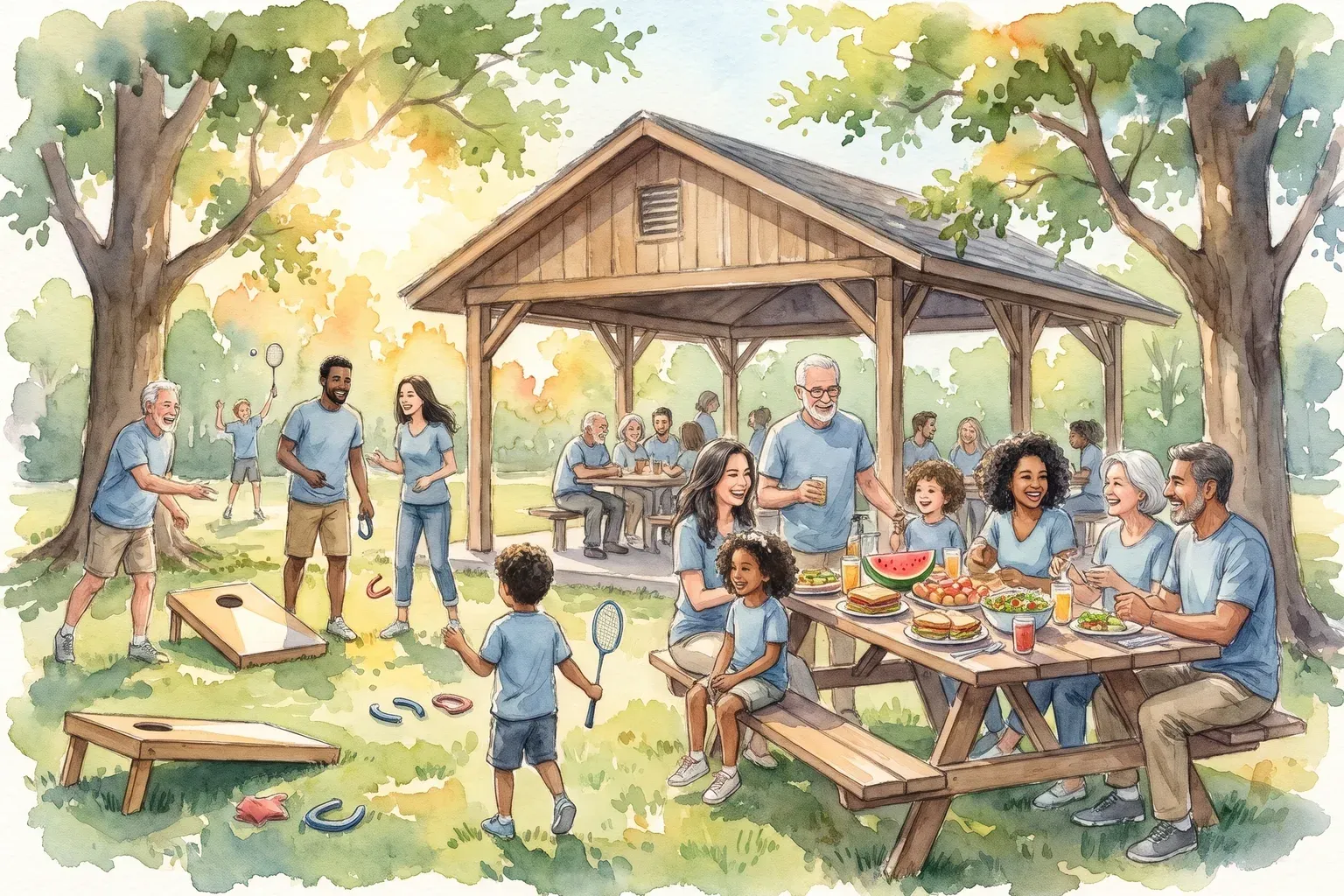
Somebody had to organize the family reunion, and at the last one everyone looked at you. Now you're responsible for 30 to 150 people, aged 1 to 90, from four states and three branches of the family who haven't all been in one place since a funeral.
Here's the short version. The family reunion ideas that work for a big, mixed-age group are the boring structural ones: a date set 9 to 12 months out, a venue with shade and bathrooms, a fair way to split the cost, one place where all the information lives, and a schedule with a few fixed points and lots of open time. Games and t-shirts matter less than you'd think. The group photo matters more.
Below: a planning checklist, venues with real prices, money, 35 activities by age and mobility, games with their failure points, a family history station, food, t-shirts, the 100-person photo, and two sample schedules.
Family reunion planning checklist: a 12-month timeline
Start early. Group campsites, pavilions, and big rental houses go to whoever books first, and your guests need to request vacation time.
| When | What to do |
|---|---|
| 12 months out | Recruit two or three co-planners, ideally one from each branch. Build the contact list. Send a short survey on dates, budget and format. |
| 10–11 months | Pick the date and format. Book the venue and pay the deposit. Send a save-the-date. |
| 8–9 months | Set the price per person or per family. Open registration. Set up the main communication channel. |
| 6 months | Book catering or plan the potluck. Reserve tents, tables and chairs if the venue doesn't supply them. Assign activity leads. |
| 4 months | Start the family history project: request old photos, documents and stories. Choose the t-shirt design. |
| 3 months | Registration deadline. Chase stragglers by phone. Order t-shirts with sizes from the registration form. |
| 6 weeks | Confirm vendors. Write the schedule. Buy game supplies. Line up the group photo spot and a ladder. |
| 2 weeks | Final headcount to the caterer. Print name tags, signs and the schedule. Send the "what to bring" message. |
| Week of | Pick up shirts, ice, and supplies. Confirm who opens the venue and who cleans up. |
| Day of | Hand the run sheet to a co-planner. Do the group photo early. |
If you're reading this in spring and the reunion is this summer, compress rather than panic. Book the venue this week, open registration the next, and drop anything on the list that depends on a vendor's lead time (custom catering, a cruise). A park pavilion and a potluck can come together in eight weeks.
Choosing a date and a venue
The date
Three-day weekends make travel easier, but they're also when campsites and pavilions go first and prices peak. The 2027 federal holidays that fall in reunion season, per the US Office of Personnel Management, are Memorial Day on Monday, May 31; Juneteenth, observed Friday, June 18 (June 19 is a Saturday); Independence Day, observed Monday, July 5 (July 4 is a Sunday); and Labor Day on Monday, September 6.
A non-holiday weekend in late June or early August is often easier to book and cheaper. Ask the survey question as a ranked choice ("which of these three weekends could you make?") rather than an open one, or you'll get 40 different answers.
The venue
Pick the venue by headcount, the age spread, and how many nights you want, in that order. The prices below are examples from sources we opened, checked November 2026. They vary a lot by state and county, so treat them as a starting point for your own search.
| Venue | Good for | Example price (checked Nov 2026) | Watch out for |
|---|---|---|---|
| County or city park pavilion | One-day reunion, any size | Palm Beach County, FL: $55 weekday, $155 weekend or holiday, plus tax. Pennsylvania state parks: $15 to $350 a day depending on the pavilion | Booking windows (Palm Beach opens 90 days out), no lodging, weather |
| State park group camp | Budget weekend, 40 to 150 people | Pennsylvania organized group tenting for 61–100 people: $79 to $102 a night. Group cabin camps for 51–125 people: $108 to $180 a night | Rustic facilities, hard on older relatives |
| National park group site | Smaller, outdoorsy families | Capitol Reef group campsite: $125 a night, 40 people maximum (children count), 10 vehicles, reservable 12 months ahead | Strict caps on people and cars |
| Private campground | Mixed tents, RVs and cabins | KOA locations offer group tent sites, RV sites, and cabins, and many have pavilions. Rates are set by each campground, so call | Deposit and cancellation rules differ by location |
| Large rental house | 15 to 40 people, multi-night | One rental company's own example: a 10-bedroom home at $3,000 a night that sleeps 20. It puts its 30-plus homes at about $75 to $100 per person a night | Cleaning fees, minimum stays, stairs |
| Cruise | Families who'd rather not cook | Royal Caribbean gives a cruise credit for every 8 staterooms (minimum 16 guests). Only 4 staterooms can be booked online, so groups go by phone or agent | Everyone pays a full fare, and not everyone can afford it |
| Someone's backyard or church hall | Under 60 people, low budget | Free or a donation | One household carries all the work |
A few practical checks for any venue:
- Bathrooms and shade. For a group with toddlers and 85-year-olds, these beat any amenity.
- Parking and walking distance. How far is the pavilion from the lot? Can a car drop someone at the door?
- Power. You need it for a slow cooker, a speaker, and phone chargers.
- Rain plan. An enclosed hall, a second pavilion, or a rented tent.
- Cell signal. Campgrounds and state parks often have weak coverage, which affects everything from payments to photo sharing. Check it on a visit if you can.
How to split the cost and keep everyone informed
Per head, per family, or a mix
There are two common ways to charge, and both have a fairness problem.
Per person is fairer to small households and harder on big ones. A family of six paying the same rate as six single adults will feel it.
Per family (a flat fee per household) is simple, but a couple pays the same as a family of seven.
The middle ground that tends to work: a per-person rate for adults, a lower rate for kids, and free for babies. For example, with purely hypothetical numbers, if your fixed costs (venue, tent, insurance, supplies) are $1,800 and food is $15 a head, you might charge $30 per adult, $15 for ages 5 to 12, and nothing under 5. Run the numbers with your expected headcount, then add 10 percent as a cushion, because someone always cancels after you've paid the caterer.
What keeps money from turning into drama:
- Separate shared costs from optional ones. Everyone pays toward the venue and food. T-shirts, the boat trip, and the cabin upgrade are pay-if-you-want.
- Collect a deposit early. You'll need cash for the venue deposit months before most people pay.
- Let people quietly pay more. Add a line on the registration form: "Want to cover a cousin who can't? Add any amount here." Nobody has to know who used it.
- Use one payment method and one spreadsheet. A payment app or checks, logged by one person, with a column for each household's status.
- Raise money for next time. KOA's reunion guide suggests a silent auction or white elephant sale to fund the next event, which also makes a good evening activity.
Pick one source of truth
With 100 people you'll get 100 questions about parking. Send them all to one place.
| Channel | Good for | Weak at |
|---|---|---|
| Group chat | Quick reminders, excitement, day-of updates | Details get buried in 300 messages; muted by many |
| Official info: dates, price, deadlines | Lands in spam; some relatives never check it | |
| Simple website or shared doc | The schedule, address, payment link, FAQ | Someone has to keep it updated |
| Phone tree and mail | Older relatives who don't text | Slow; needs one caller per branch |
The setup that works for most large families: a simple page or shared document holds the facts, email announces each change and links to it, the group chat is for chatter, and one person per branch phones the relatives who aren't online. Mail the oldest generation a printed invitation for the fridge.
35 family reunion ideas for activities, sorted by age and mobility
The trick with a 1-to-90 age range is to run a few things at once, so nobody is stuck watching someone else's activity. Each idea below is tagged with the mobility it needs: seated, light (short walks, standing), or active.
Little kids (about 1 to 6)
- Bubble station. Seated or light. Put it near the grandparents.
- Sidewalk chalk family tree. Kids draw themselves, older relatives write the names. Light.
- Sprinkler or splash pad. Active. Bring towels and a change of clothes rule.
- Sand or water table. Light.
- Story time with a great-grandparent. Seated. A real family story beats any book.
- Toddler parade. Wagons, scooters and a lap of the pavilion. Light.
Kids and teens (about 7 to 17)
- Water balloon relay. Active. Fill the balloons the night before.
- Kickball, cousins vs. parents. Active. Every age past 7 can play.
- Photo scavenger hunt. Light. Teams of mixed ages chase prompts like "oldest and youngest person together" or "someone wearing a shirt from the last reunion." The free reunion photo scavenger hunt generator makes printable cards.
- Interview a grandparent. Seated. Teens get five questions and a phone to record the answers.
- Tie-dye station. Light. Messy, so set it on grass, away from the food.
- Game corner. Seated. A tent with a TV keeps teens out of the car.
- Talent show. Seated audience, active performers. Cap it at three minutes per act.
- Teen-run snack stand. Light. Teens price and sell snacks, and the money goes to next year's reunion.
Adults
- Cornhole bracket. Light. Print the bracket on a poster so people can see who's up.
- Card tournament. Seated. Pick the game your family actually plays. Spades, euchre or Uno all work.
- Recipe swap. Seated. Everyone brings one family recipe card for a future cookbook.
- Cooking competition. Light. Best chili, barbecue sauce, or pie, judged blind.
- Group hike or nature walk. Active. Offer a short loop and a long loop.
- Golf, fishing, or a boat trip. Varies. An optional Saturday-morning add-on.
- Silent auction. Seated. Homemade quilts, signed baseballs, a weekend at someone's lake cabin. Proceeds fund next year.
- Late-night campfire. Seated. Stories, s'mores, and someone's guitar.
Older relatives and anyone with limited mobility
- The memory table. Seated. Old photos, yearbooks and objects to look at and talk about. See the family history station below.
- Name-the-photo session. Seated. Elders identify faces in unlabeled old photos while someone writes the names on the back.
- Recorded oral history. Seated. A quiet corner, a phone on a stand, and a grandchild asking questions.
- Bingo. Seated. Make family-themed cards ("has been to every reunion," "born outside the state").
- Dominoes or checkers. Seated.
- Front-row seats at the games. Seated. Put chairs in the shade with a view of kickball. Watching counts as participating.
- Award presenter. Seated. Let the oldest relatives hand out the prizes.
All ages together
- Family trivia. Seated. Questions about the family, written in advance from relatives' answers.
- Memorial and welcome moment. Seated. Name the relatives who died since the last reunion and introduce the babies and new spouses. KOA's guide suggests both. Ten minutes, before lunch.
- Family talent auction. Seated. Relatives offer a skill (a haircut, a fishing lesson) instead of an object.
- Heritage dinner. Seated. Food, music and a short talk about where the family came from.
- Group photo. Light. Covered in its own section below.
- Time capsule. Seated. Everyone writes a note to the next reunion. Seal it and name who keeps it.
Family reunion games that work (and where they go wrong)
With 80 people and mixed ages, the setup decides whether a game works.
Cousins vs. parents tug of war
How: Split by generation, with grandparents as judges. A heavy rope, a flag in the middle, two lines on the grass. Where it goes wrong: Someone gets dragged or rope burn. Use gloves, play on grass, and limit each team to adults and teens over 12. Keep small children watching.
Family trivia
How: Two months out, send a short survey ("Who got lost at Disney World in 1998?"). Turn the answers into 20 questions. Play in teams mixed across branches. Where it goes wrong: One branch dominates because the questions all come from them. Make sure each branch contributes at least four questions. And don't ask anything that would embarrass someone who's in the room.
Cornhole tournament
How: Doubles, bracket on a poster, games to 11 to keep it moving. Where it goes wrong: With 32 teams, it takes all day. Limit it to 16 teams and run two sets of boards.
Water balloon toss
How: Pairs face each other and step back after each catch. Where it goes wrong: The balloons run out in 4 minutes, or broken latex ends up all over a public park. Fill 200 more than you think, and assign a kid crew to pick up the pieces.
Two truths and a family lie
How: Each person states three facts about themselves and the group guesses the false one. Where it goes wrong: It drags with more than 15 people. Run it at tables, not as a whole group.
Family Feud, reunion edition
How: Survey everyone beforehand ("Name something Grandpa always says"). Two teams, a buzzer or a table slap, top answers on a poster board. Where it goes wrong: The host doesn't prepare and reads answers off a phone. Write the boards ahead of time.
Photo scavenger hunt
How: Teams of four, each with at least one kid and one older adult, get 20 prompts and an hour. Where it goes wrong: The photos end up scattered across 25 phones and nobody can judge them. Decide in advance where teams submit their shots, and judge at dinner.
Set up a family history and ancestry station
This takes the longest to prepare, so start four months out.
What goes on the table:
- A large printed family tree, at least four generations, with blank spaces for people to fill in. A big roll of paper and markers works.
- Old photos, printed or in albums, with sticky notes for names and dates.
- Documents: immigration papers, marriage certificates, military records, the deed to the old farm. Copies only, never originals near a potluck.
- Heirlooms: the quilt, the recipe box, the pocket watch, with a card saying whose it was.
- A map with pins showing where each branch lives now and where the family came from.
FamilySearch suggests framing activities around a few ideas: eat what they ate, walk where they walked, touch what they touched, and hear what they heard. That last one is the easiest to add: a quiet chair where a grandchild records an older relative's stories. Its list also includes a handprint family tree, which suits little kids.
Staff it. A table nobody tends becomes a coffee coaster. Put one family historian there for an hour at a time, and bring a phone or flatbed scanner so relatives can leave prints with you to digitize.
Collect the scans in the right place. Old photos and documents belong in a shared folder on a service your family already uses, such as Google Drive or iCloud, or in a genealogy site. An event camera app is the wrong place for them, including ours (more on that below). Our shared albums comparison covers the trade-offs of those tools.
Food: potluck, catered, or a hybrid
| Approach | Cost | Work for you | Works best when |
|---|---|---|---|
| Full potluck | Lowest | High (coordination) | Under 60 people, most guests live nearby |
| Catered | Highest | Low | Lots of people traveling, older hosts |
| Hybrid | Middle | Medium | 60 to 150 people, a mix of locals and travelers |
The hybrid is usually right for a large family reunion: pay a caterer or a barbecue place for the mains, and run a potluck for sides and desserts. Travelers can't bring a casserole on a plane, and they shouldn't have to.
For the potluck part:
- Assign categories by last name or by branch. "A to H bring a side, I to P bring a salad, Q to Z bring dessert." SignUpGenius suggests assigning dish categories, and this is the reason.
- Use a sign-up sheet so you don't get 14 pasta salads.
- Ask for labels with the dish name and main allergens.
- Plan the cold chain. Coolers, ice, and someone whose job is to put food away after an hour in the sun.
- Assign each weekend meal to a household, breakfast included.
- Ask about allergies on the registration form, not on the day.
Family reunion t-shirt ideas and the 100-person group photo
Shirts make a group photo work, and the photo is why most families order shirts.
T-shirt ideas
- One color per branch. Grandma's five children each get a color, and their descendants wear it. In the group photo, you can see the branches at a glance.
- Surname and year. "The Johnson Family Reunion 2027." Classic for a reason.
- The founding couple. "Descendants of Walter and Mae," with their wedding year.
- The family hometown. The name of the town, county, or the country the family came from.
- A family saying. The thing Grandpa always said. Everyone will know it.
Order with sizes collected on the registration form, including kids' and toddler sizes. According to Custom Ink's bulk-order guide (checked November 2026), the per-shirt price drops at roughly 12, 24, 48, 72 and 144 pieces, and standard delivery takes about 14 days, with rush options as fast as 7 days for an extra charge. Order three months out anyway. Someone will need a reprint.
How to shoot a group photo of 100 people
A 100-person photo is a logistics problem first and a photography problem second.
- Schedule it early. Do it within an hour of the official start, before anyone leaves, gets sunburned, or spills barbecue sauce on the shirt. Announce the time in the schedule and again in the morning.
- Pick the spot in advance. You need open shade or a slightly overcast sky, a background without parked cars, and room for five or six rows.
- Get up high. SLR Lounge's tips for large groups recommend shooting from a ladder or a chair so the back rows aren't blocked. For 100 people, use a sturdy stepladder held by someone, a balcony, or a second-floor window.
- Build rows. Small kids sit on the ground in front, elders sit on chairs in the second row, and standing rows go behind, tallest at the back. Put the oldest generation in the center and build outward.
- Use a wrangler. One person who isn't in the photo arranges people and calls out names while the photographer stays on the ladder.
- Shoot lots of frames. With 100 faces, someone is always blinking. Take many shots, then a few silly ones to finish.
- Then do branches. Each family branch gets one quick shot of its own, which takes under a minute each if you call them in order.
- Get the photographer in. Use a tripod and a timer, or ask a passing park visitor for the last frame.
Budget 15 to 20 minutes for the whole thing. That's a planning number, not a promise, and it gets longer if you skip the wrangler.
Sample schedules: one day and a full weekend
Keep the fixed points few: arrival, the photo, a meal, and one shared moment. Everything else is optional.
One-day reunion at a park pavilion
| Time | What happens |
|---|---|
| 9:00 a.m. | Setup crew arrives: tables, signs, coolers, family history table |
| 10:30 a.m. | Check-in: name tags with branch colors, t-shirt pickup |
| 11:15 a.m. | Group photo, then branch photos |
| 11:45 a.m. | Welcome, memorial moment, introduce new babies and spouses |
| 12:00 p.m. | Lunch |
| 1:00 p.m. | Activities in parallel: kids' games, cornhole bracket, card tables, family history station |
| 2:30 p.m. | Photo scavenger hunt in mixed-age teams |
| 3:30 p.m. | Family trivia or Family Feud, all ages |
| 4:30 p.m. | Dessert, awards, announce next reunion's hosts and date |
| 5:30 p.m. | Cleanup crew takes over |
Weekend reunion at a campground or rental house
| Day | Time | What happens |
|---|---|---|
| Friday | 3:00 p.m. | Arrivals, check-in, room or site assignments |
| Friday | 6:30 p.m. | Simple dinner (pizza or a taco bar), name-tag icebreaker |
| Friday | 8:00 p.m. | Campfire, card games, teens' talent show rehearsal |
| Saturday | 8:00 a.m. | Breakfast, cooked by one assigned household |
| Saturday | 9:30 a.m. | Optional outings: short hike, long hike, fishing, or the history station for those staying put |
| Saturday | 11:30 a.m. | Group photo in matching shirts |
| Saturday | 12:00 p.m. | Catered lunch with potluck sides |
| Saturday | 1:30 p.m. | Quiet time for naps and older relatives; water games for kids |
| Saturday | 3:30 p.m. | Games: tug of war, cornhole bracket, water balloons |
| Saturday | 6:00 p.m. | Heritage dinner, memorial and welcome moment, silent auction closes |
| Saturday | 8:00 p.m. | Talent show, then s'mores |
| Sunday | 9:00 a.m. | Breakfast, worship service if your family has one, time capsule |
| Sunday | 11:00 a.m. | Pack up, checkout, the "who hosts next" vote |
The Saturday afternoon quiet block is the most important line in the weekend plan. Without it, grandparents go home early and toddlers melt down at dinner.
Getting everyone's photos into one place
By Sunday night, the weekend's photos are spread across dozens of phones. We wrote a whole post on family reunion photo sharing that works, covering why shared albums stall and where to put QR codes, so we'll keep this to the practical fit.
This is where we should say that we make Revel, a shared event camera. You create a Moment for the reunion and set its end time to Sunday afternoon. Relatives scan a QR code at check-in, or tap a link or NFC tag, and shoot straight away in their phone's browser, with no app download and no account. Every photo lands in one private gallery for the whole weekend. You can hide the photos until the Moment ends, so everyone sees the full gallery at once on the drive home, or show them live on a screen at dinner. The host can approve every photo before the gallery goes live, which helps when there are kids in the pictures. A per-guest shot limit makes it feel like a disposable camera, and a single film filter gives the whole weekend one look.
The campground question. Guests can keep shooting with no signal, and the photos sync when they're back in range. The first scan needs a connection, so put the QR code at check-in where there's Wi-Fi or a decent signal, and have people join there.
Pricing for a reunion (US, one-time per event, no subscription, checked November 2026): up to 100 guests is $19.99, and up to 175 is $34.99. Free covers up to 10 guests. Prices vary by country and can change. Size it by the people likely to join with a phone, which for a family with lots of small children is fewer than your headcount.
Where Revel is the wrong tool:
- Old photos and ancestry scans. Camera-roll uploads only accept photos taken between when the Moment was created and when it ends. Grandma's 1962 wedding photo and your scanned census records can't go in. Use a shared folder for those.
- Video. It doesn't do video, so the talent show needs someone filming on a phone.
- Relatives without smartphones or who won't scan a QR code. A few disposable cameras on the elders' table cover them.
- A small, close family that already has an active group chat may not need anything else.
Revel is also new: it has about 17 ratings on the US App Store. More reunion details are on our family reunions page.
Family reunion FAQ
How far in advance should you plan a family reunion?
Nine to 12 months for a reunion of 50 or more people, especially if you need group campsites, a large rental house, or a cruise. Some group campsites, like Capitol Reef's, open reservations 12 months ahead. A one-day park reunion with a potluck can be done in two to three months if the pavilion is available.
How much should you charge per person for a family reunion?
Add up your fixed costs (venue, rentals, supplies) and divide by the expected number of adults, then add food per head and a 10 percent cushion. Most families charge adults full price, children a reduced rate, and babies nothing. Keep optional extras like t-shirts and outings separate, so the base price stays low.
What do you do at a family reunion for adults?
Card tournaments, cornhole brackets, a cooking competition, a silent auction, and a late-night campfire. Naming faces in old photos at the history station is popular too. Leave unscheduled time, since catching up is the main event for most grown-ups.
How do you make a family reunion fun for teenagers?
Give them a job and a space. Teens can run the snack stand, record grandparent interviews, or lead the scavenger hunt teams. A tent with games and a charger keeps them around, and the talent show lets them perform for their cousins rather than watch adults talk.
Who usually pays for a family reunion?
In most families, each household pays its own share through a per-person or per-family fee. Some families add an optional "cover a cousin" contribution, or raise money through a silent auction for the next reunion. The organizer should never quietly absorb the shortfall.
What are good large family reunion ideas for 100 or more people?
Run activities in parallel instead of one big program, use branch-colored shirts so people can find their relatives, and give each branch a lead who handles its own RSVPs and money. Hire catering for the mains. Do the group photo early and from up high.
Try the camera before the reunion
Set up a free Moment for up to 10 people at your next planning call or family dinner, scan the QR code, take a few photos, and watch the reveal. If it works for your aunts, it'll work for the reunion. Get the host app on the App Store or Google Play. Larger reunions are a one-time purchase in the app, with no subscription.

A writer interested in connection, memory, and the everyday moments that matter more than we realize.
Tags: Family reunion , Event planning , Group activities