What Is a Shared Event Album for Your Party?
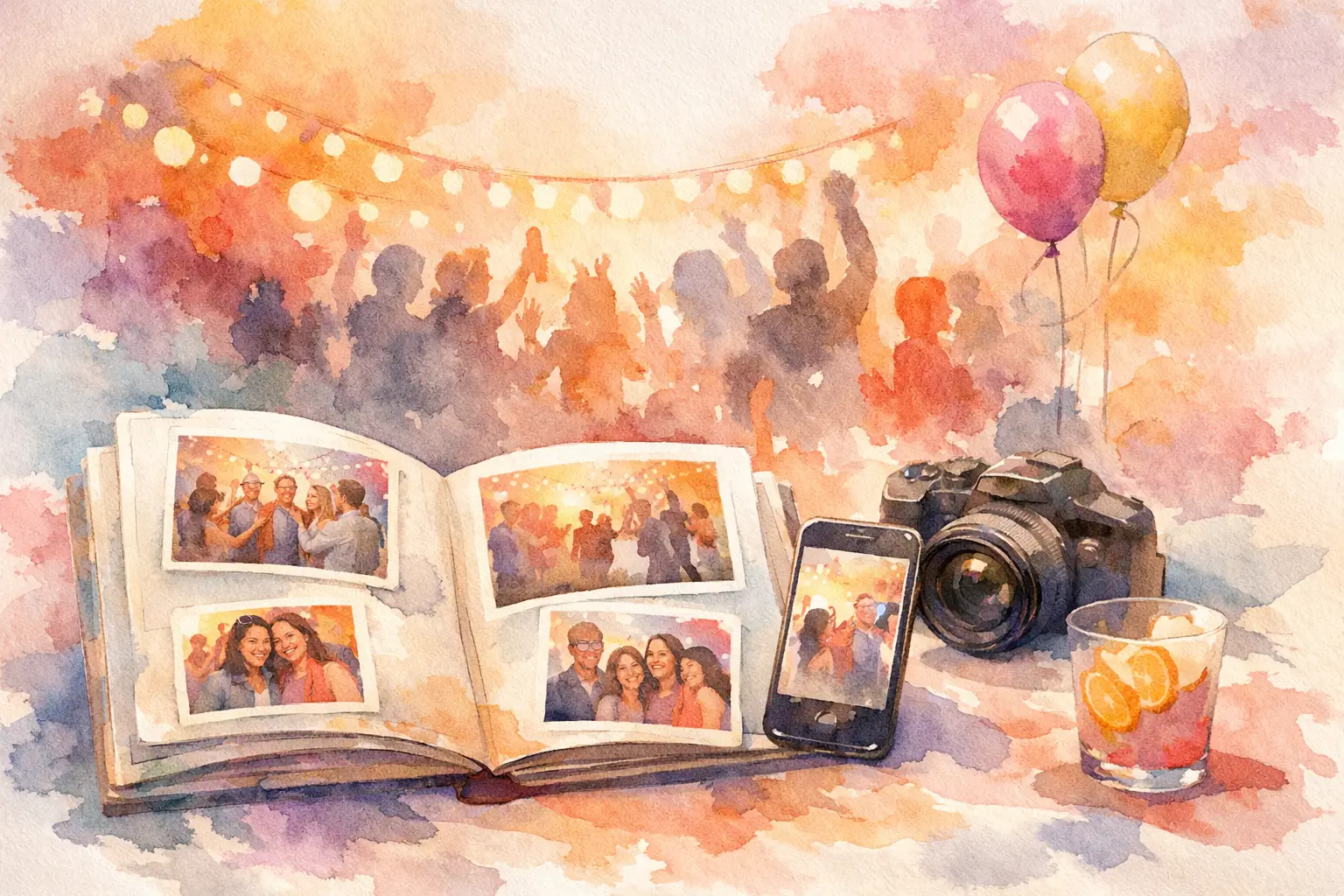
Your friend got the candid dance-floor photo. Your cousin caught the speech that made everyone cry. Someone else has the one group shot where nobody blinked. The problem? Those photos are now trapped in six camera rolls, a group text, and one Instagram Story that disappears tomorrow. So, what is a shared event album? It is one private place where everyone at an event can add, view, and relive the photos they took together.
A shared event album turns photo collecting from a post-party chore into part of the experience. Instead of asking, “Can everyone send me their pics?” three weeks later, guests join the same gallery while the memory is still happening. The host gets a fuller picture of the event. Guests get to see the night from angles they missed.
What is a shared event album, exactly?
A shared event album is a digital photo gallery created for one specific gathering. The host sets it up, then invites guests to contribute their photos and videos. Depending on the platform, guests may join through a link, a QR code, or an invitation. The gallery stays private to the people invited, rather than becoming another public social post.
Think of it as the modern version of passing around disposable cameras at a wedding reception. Everyone gets a chance to capture something real: the cocktail cheers, the terrible dance move, the surprise hug, the behind-the-scenes moment the photographer could not possibly catch. But instead of developing a stack of cameras and hoping for the best, every contribution lands in one organized album.
The best shared event albums make joining almost embarrassingly easy. A guest scans a QR code, opens their camera, and starts contributing. No app download. No account creation. No hunting for a folder name after two glasses of champagne.
That low-friction setup matters more than it sounds. The harder it is to participate, the fewer people will. A shared album only works when it feels like part of the party, not homework from the host.
Why one shared gallery changes the event
A professional photographer captures the big picture beautifully. A shared album captures the heartbeat of the room. Together, they tell a much better story.
At a wedding, guests might photograph the couple’s first look from the back row, the flower girl’s pre-ceremony chaos, and the late-night snack everyone lined up for. At a birthday, friends catch the inside jokes that never make it into a posed photo. At a company offsite, the album can include the polished keynote, sure, but also the team’s victorious trivia-table selfie.
Those perspectives are not duplicates. They are the moments people actually remember.
A shared gallery also solves the awkward after-event chase. Hosts often spend days sending messages, checking cloud folders, and scrolling through social feeds to find images. Meanwhile, guests mean to send their photos but forget. A single album gives everyone a clear destination from the start.
For organizers, that means less admin. For guests, it means their photos do not disappear into the void. For the group, it means there is a collective record of the day instead of a pile of disconnected camera rolls.
How a shared event album works at a real event
The experience should be simple enough to explain in one sentence: scan, shoot, share.
Before the event, the host creates the album and chooses how guests will access it. A QR code can go on table cards, signage, invitations, or a screen near the bar. It works especially well at events where people arrive in waves, because every new guest can join on their own without needing a personal invite from the host.
During the event, guests use their own phones to take photos or upload images they already captured. Some platforms let guests contribute in real time. Others add a twist with a delayed reveal, so everyone shoots freely but sees the full gallery later.
That reveal changes the mood. Instead of immediately checking and posting every image, people stay present. Then, after the event, the gallery opens and the group gets a second hit of the fun: “Wait, who took this?” “I missed that!” “Please send me the one of Grandma on the dance floor.”
Revel uses that digital disposable camera energy with limited shots, nostalgic filters, and a timed gallery reveal. It gives guests a playful prompt to capture the moment while keeping the final gallery feeling like a shared surprise, not a live feed to obsess over.
Shared albums are not all the same
A basic cloud folder can technically be a shared event album. It lets people upload photos, and that is useful for small groups that already know the tools. But it can feel clunky at a party. Guests may need an account, permission, an app, or enough motivation to find the upload link later.
A group chat is even more familiar, but it is not built for collecting memories. Photos get buried between reactions, directions, and “what time are we meeting?” messages. Quality can drop, downloads are messy, and nobody wants to scroll back 400 messages to find one photo.
Social media makes sharing easy, but it is public by default and incomplete by nature. Not everyone posts. Not everyone wants to post. And the best candid photos are often the ones people would rather keep within the group.
A purpose-built event album does more than store files. It creates a participation loop: guests know where to go, understand what to do, and have a reason to contribute. That is the difference between collecting a handful of photos and building a gallery people actually want to revisit.
The features that make guests actually participate
The most useful shared event album features are not always the flashiest ones. They are the ones that remove the tiny points of friction that stop people from joining.
Fast, account-free access
If guests have to download something, create a password, verify an email, and remember why they started, many will bail. QR-based access is built for the real world: a crowded venue, weak attention spans, and people who would rather be at the party than configuring software.
Private sharing and clear control
Events can be intimate, personal, or client-facing. A private album gives the host control over who joins and where the content lives. That is particularly valuable for weddings, baby showers, internal company events, and brand activations where public posting may not fit the moment.
High-quality uploads
The photo someone took from across the room might become the one you print, frame, or use in a recap. An album should preserve quality instead of compressing every image into a blurry afterthought.
Offline capture and later syncing
Reception venues, festivals, and conference halls are not famous for reliable Wi-Fi. Guests should be able to keep taking photos even when their connection is spotty, then have those photos sync when service returns. Otherwise, the best moments are exactly the ones that get lost.
A reveal worth waiting for
Real-time galleries are great when the goal is live energy, such as a brand activation or conference social wall. A delayed reveal is better when you want anticipation and a little mystery. Neither approach is universally better. It depends on whether the event should feel like a live broadcast or a collective time capsule.
When should you use one?
A shared event album earns its place whenever more than a few people are taking photos and the organizer wants those images in one spot. Weddings are an obvious fit, but they are far from the only one.
Use one for a birthday where you want the funny, unfiltered version of the night. Use one on a group vacation so no one has to beg for photos after everyone flies home. Use one at a graduation, engagement party, or baby shower to collect family moments across generations. For company events, it gives organizers usable candid content without assigning someone to chase photos afterward.
For brand events, the payoff is both emotional and practical. Guests feel invited to participate rather than just observe, while the event team gets a richer record of what people saw, did, and loved. Just be clear about photo expectations and permissions when the gathering includes employees, customers, or the public.
A shared album may be overkill for a quiet dinner with three people who already share photos constantly. But once a guest list gets bigger, the value rises quickly. More people means more perspectives, and more perspectives mean more memories worth keeping.
How to get more than five photos in the gallery
Even the best tool needs a little event-stage presence. Put the QR code where people naturally pause: near the entrance, on tables, by the guest book, or beside the dessert. Mention it once early, then make the ask specific. “Take the best photo you get tonight” works better than “Feel free to upload photos.”
Give guests a reason to play. At a wedding, suggest they capture a candid the couple will not see themselves. At a birthday, ask for the funniest dance-floor shot. At a company event, invite teams to document their best moment. A little direction prevents the album from becoming 30 nearly identical selfies.
Then let the gallery do its thing. The magic is not in getting every single image. It is in seeing the event become bigger than any one person’s camera roll. Put the code where the moment happens, make contribution effortless, and give everyone something good to reveal together.
A writer interested in connection, memory, and the everyday moments that matter more than we realize.
Tags: Shared album , Shared event photos , Private shared album , Shared folder , Shared photo album , Shared photo gallery