Private Photo Sharing Guide for Real Events
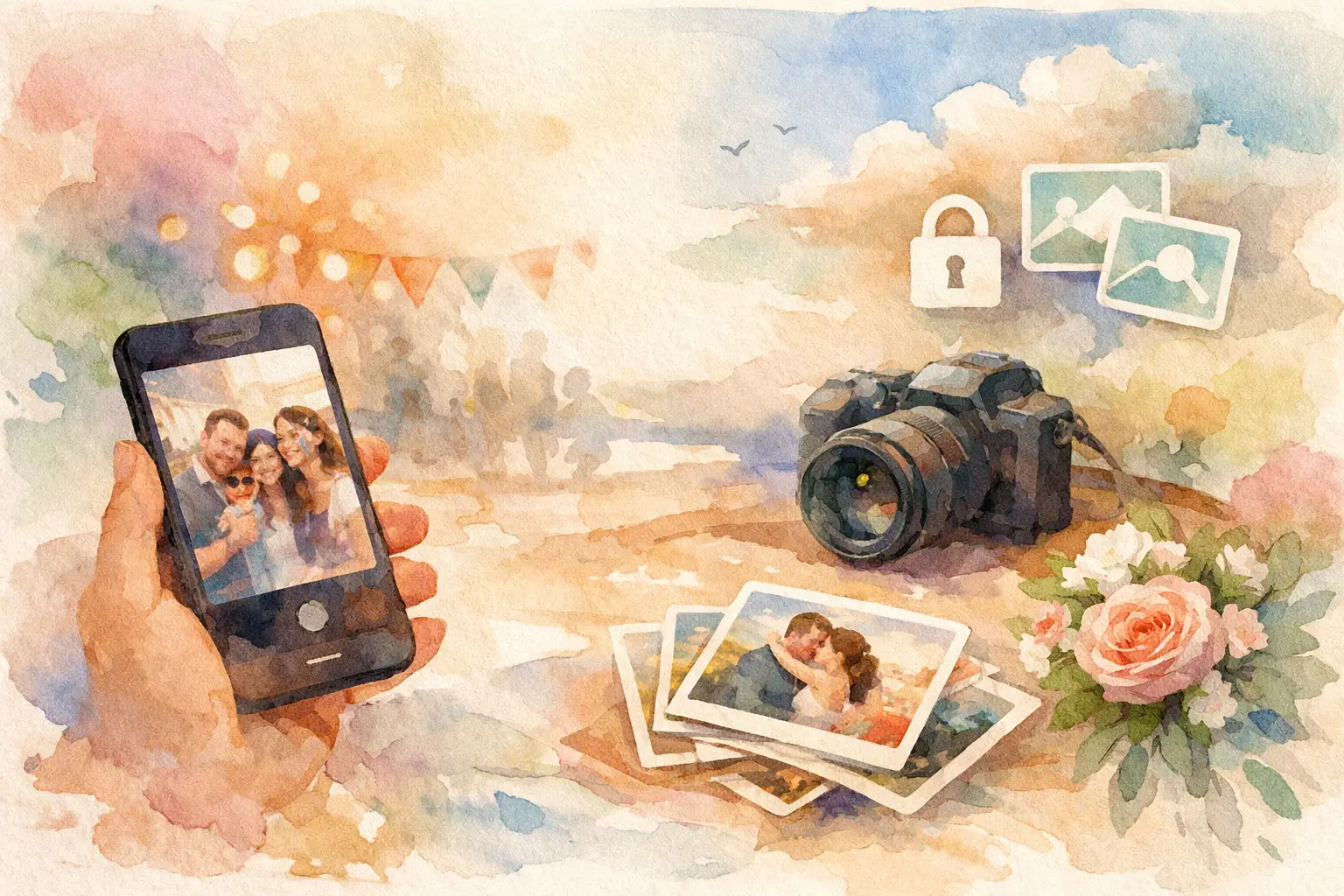
You know the pattern. The event was great, everyone took photos, and then the memories vanished into 14 camera rolls, three group chats, two Instagram stories, and one person who swears they’ll send the album later. A good private photo sharing guide fixes that mess before it starts.
This is not really a question of whether people take photos. They do. The problem is whether they actually share them, whether the sharing feels private enough for the moment, and whether the final gallery feels like one event instead of a digital scavenger hunt. If you want more candid shots, better participation, and less follow-up work, the setup matters more than most hosts realize.
What a private photo sharing guide should actually solve
Most photo-sharing tools promise convenience. Plenty of them still create friction. Guests have to download something, make an account, remember a password, find the upload button, or sort through permissions that feel way too serious for a birthday dinner.
That’s where participation dies.
For private events, the best system does three things well. It keeps the gallery closed to the right people, it makes joining almost instant, and it captures photos while the energy is still high. If any one of those pieces is clunky, people stop bothering. And when guests stop bothering, you get the same handful of photos from the same two organized friends.
Privacy also means different things depending on the event. At a wedding, it often means keeping guest photos away from the public internet and giving the couple control over when everyone sees them. On a vacation, it might mean a shared space just for the group. At a company event, it can mean tighter control over who contributes and who can access the final gallery. So yes, private matters - but the exact version of private depends on the room.
How to choose a private photo sharing setup
If you’re comparing options, don’t start with storage limits or feature overload. Start with behavior. Ask one simple question: will people actually use this in the moment?
The strongest private photo sharing guide starts there because event photos are a participation problem, not just a file-management problem. The more steps you add, the fewer photos you collect. That sounds obvious, but a lot of tools are built like admin software wearing a party hat.
Friction is the whole game
For social events, the sweet spot is dead simple access. A QR code works because it meets people where they already are - on their phones, moving fast, not looking to create an account just to upload three dance-floor photos.
That’s especially true when your guest list spans different comfort levels with tech. Some people will happily join anything. Others will opt out the second they hit a login screen. If your system needs instructions longer than one sentence, expect drop-off.
Private does not have to mean complicated
A private gallery should feel easy, not locked inside a maze. Guests should be able to join quickly, contribute without overthinking it, and trust that the photos are staying within the group. If you need to manually chase access requests all night, the tool is working against you.
For hosts, control still matters. You want a clear participant boundary and a clean final album. But there’s a difference between secure and annoying. The best event tools keep the barrier low for invited guests and high for everyone else.
The best formats for private event photo sharing
Not every format fits every event. This is where trade-offs matter.
Shared cloud folders are familiar, but they’re rarely fun, and they usually rely on people remembering to upload later. That is optimistic at best. Messaging apps are fast, but photo quality can drop, threads get messy, and retrieval becomes a nightmare the second anyone asks, “Wait, who has that one from dinner?” Social platforms are easy for public moments, but they’re a bad fit when the whole point is keeping things intimate.
Event-specific photo sharing works better when you want one place, one flow, and one gallery tied to a specific moment. That’s especially true for weddings, birthdays, showers, reunions, and brand events where contribution volume matters. Instead of hoping people send things afterward, you build the sharing into the event itself.
A digital disposable camera format is especially smart if you want candid energy. Limited shots make people more intentional. Nostalgic filters make the gallery feel cohesive. A delayed reveal adds anticipation and keeps people present instead of instantly reviewing every image like they’re editing content for the feed. It changes the vibe from “upload your files” to “we’re making this memory together.”
Private photo sharing guide for different event types
A wedding needs softness, simplicity, and enough structure that guests of all ages can participate. The best setup lets people join in seconds and keeps the full gallery private until you want everyone to see it. Couples usually don’t need more reminders after the reception. They need a system that quietly collects the good stuff while the night is happening.
For birthdays and house parties, speed matters most. People are moving, talking, eating, dancing. Nobody wants an onboarding flow. A QR-code-based gallery near the entrance, bar, or table setup works because it catches people early and doesn’t ask much from them.
Trips and group vacations need a slightly different kind of private. Everyone is already taking tons of photos across several days, and those images tend to scatter even faster than event shots. Here, the best system is one shared destination that people can keep using throughout the trip without extra effort. Bonus points if it handles weak signal well and syncs later.
Work events and brand activations need more control and more consistency. The photo-sharing method has to be simple enough for broad participation but polished enough that the final gallery feels usable, not chaotic. Organizers often care about both employee engagement and post-event content. That means the tool has to support quick contributions without turning the gallery into a clutter pile.
What guests will actually do versus what you hope they do
This is the part hosts get wrong all the time.
Guests will scan a code if it’s fast and obvious. They will take photos if the experience feels light. They will contribute more if there’s no app download, no account creation, and no weird setup friction. They will not come home from your event and cheerfully spend 25 minutes sorting uploads unless they are unusually organized or emotionally invested.
So build for real behavior.
Make access visible. Put the join point where people naturally pause. Mention it once early. Keep the instructions short. If the platform allows instant capture, even better. That removes the mental gap between taking a photo and deciding where it should go.
This is also why timed gallery reveals work so well. Instead of everyone half-watching the event and half-curating their own camera roll, the photos become a shared payoff later. Capture together. Reveal together. That small delay can make the experience feel more collective and a lot less transactional.
Features that matter more than they sound
High-resolution uploads matter because blurry or compressed memories are a letdown later. Broad device compatibility matters because your event is not made of identical phones on identical settings. Offline capture syncing matters because receptions, retreats, and crowded venues are not famous for perfect service.
Just as important, the gallery has to feel unified. Random upload systems tend to create random results. If you can shape the experience with features like limited exposures, event-specific access, and a clean shared reveal, you get a better story out of the gallery, not just more files.
That’s the real difference. More participation is great. Better participation is what makes the album worth revisiting.
When simple beats feature-heavy every time
There’s always a temptation to over-engineer this. More controls, more settings, more ways to customize the workflow. Sometimes that’s useful. Often it just creates hesitation.
A strong private photo-sharing setup should feel almost invisible during the event. Guests should understand it immediately. Hosts should not have to babysit it. And the final gallery should feel like a payoff, not a cleanup project.
That’s why tools built around live events tend to outperform generic storage tools for this job. They’re designed for a specific moment, a specific group, and a very human reality: people will contribute when it’s easy, fun, and clearly private enough.
If you want the short version of this private photo sharing guide, it’s simple. Pick a system people can join instantly, trust privately, and actually use while the event is still alive. The easier you make it to participate, the more your memories stop depending on who remembers to text them later.
And if your gallery can make guests feel like they were part of making the memory, not just sending over leftovers, you’re not just sharing photos. You’re keeping the night intact.
A writer interested in connection, memory, and the everyday moments that matter more than we realize.
Tags: Photo sharing , Guest photo sharing , QR photo sharing , Wedding photo sharing , Event photo sharing , Corporate photo sharing