What Wedding Planner Charges Include (and What They Don’t)

Wedding planner pricing can feel confusing because you are not just buying “hours.” You are paying for a professional to design decisions, vendor coordination, timeline engineering, guest experience logistics, and day-of problem solving so your wedding runs like a production, not a group project.
This guide breaks down what wedding planner charges typically include, what they usually do not include, and how to read proposals so you can compare options without getting surprised by add-ons.
Start here: a planner’s fee is not your wedding budget
A common misunderstanding is treating a planning fee like it will “cover” wedding expenses. In most cases, planner pricing is a professional service fee, separate from:
- Vendor invoices (venue, catering, photo/video, florals, rentals)
- Hard costs (printing, postage, decor purchases)
- Travel and staffing beyond what is in the contract
Some planners also offer design production or handle rentals and decor purchasing, but those costs are still usually passed through to you (sometimes with a management fee). The only way to know is to look for what your contract calls included services versus reimbursable expenses.
The most common ways wedding planners charge
Different pricing models can be equally “normal.” What matters is how clearly the scope is defined.
| Pricing model | What it usually covers | Good fit for | Watch-outs to clarify |
|---|---|---|---|
| Flat fee (fixed price) | A defined scope and set of deliverables | Most couples who want predictable costs | Exact number of planning meetings, planning start date, day-of hours, and staffing |
| Percentage of wedding spend | Planning fee tied to overall budget (often a percentage) | High-complexity weddings where scope expands with spend | What counts as “spend” (pre-tax? service charges? attire? rings?), and whether there is a minimum fee |
| Hourly | Time-based planning and coordination | A la carte help, short runway weddings, consult-only | How hours are tracked, minimum blocks, and how quickly hours can accumulate |
| Retainer + monthly or phased payments | Service fee paid over time | Couples who want cash-flow consistency | What happens if you pause planning or reschedule |
If you want benchmarks and typical ranges, consumer resources like The Knot’s planner cost overview can be helpful, but proposals in your city and venue tier matter more than national averages.
What wedding planner charges usually include
Most planner packages are a mix of strategy, coordination, communication, and documentation. Here is what is commonly included (even if the wording varies).
1. Planning direction and decision support
You are often paying for a decision framework, not just vendor emails. That can include:
- Building a realistic planning roadmap based on your date and priorities
- Keeping you on track with deadlines, dependencies, and “what matters next”
- Translating inspiration into an executable plan (what is doable in your venue, season, and budget)
2. Vendor sourcing and booking support (sometimes full, sometimes partial)
Depending on scope, planner charges may include:
- Vendor recommendations aligned with your style and budget
- Managing inquiries, availability, and quote comparisons
- Scheduling meetings and helping you evaluate fit
- Reviewing proposals for scope gaps (overtime, travel, service charges)
Important: Not every package includes full vendor sourcing. Some planners only manage vendors after you book them, especially in coordination-only offerings.
3. Contract and logistics review
Even planners who are not acting as legal advisors often help you spot operational risk, such as:
- Load-in and load-out constraints, especially for rentals and florals
- Power requirements for bands, lighting, and production
n- Rain plans and weather contingencies - Parking, shuttles, and guest flow
4. Timeline creation (and making it workable)
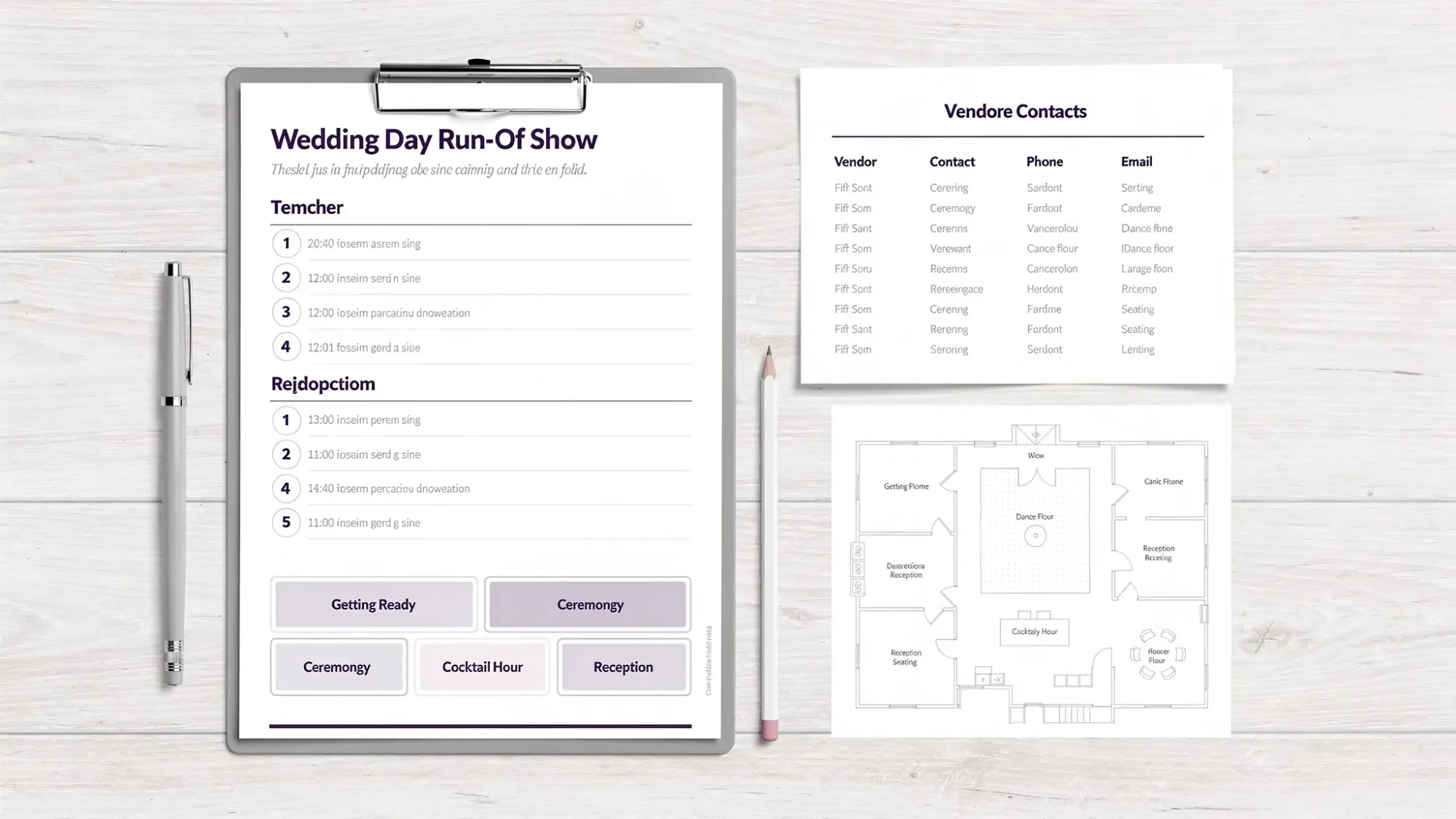
A strong planner turns a “schedule” into a run-of-show that vendors can execute. This commonly includes:
- Ceremony timing and processional planning
- Photo timing coordination (buffers matter)
- Cocktail hour and reception pacing
- Cue-based moments (grand entrance, first dance, toasts)
5. Layouts, flow, and guest experience details
Many planners support operational design, for example:
- Floor plan input (dinner, dance floor, lounge, bar placement)
- Guest journey and signage needs
- Accessibility considerations and comfort planning
6. Week-of and day-of coordination
Even when the package is called “month-of,” much of the value lands in the final weeks when details converge. Typical inclusions:
- Final confirmations with vendors
- Distribution of the timeline and key contacts
- Leading the rehearsal (or coordinating ceremony logistics)
- Being the point person on wedding day, so you are not answering texts
- Managing timing, cues, and small issues before they become big ones
7. Basic wedding-day problem solving
This is hard to list in a proposal because it is reactive by nature, but it is real value. A professional coordinator solves issues like missing boutonniers, timing slips, miscommunications between teams, and last-minute layout changes.
What wedding planner charges often do not include
This is where couples get surprised. Many “extras” are reasonable, but you want them visible before you sign.
Reimbursable expenses and pass-through costs
A planner fee often does not include out-of-pocket expenses required to do the job. These are commonly billed separately.
| Common non-included item | Why it is often excluded | How it is usually billed |
|---|---|---|
| Travel (mileage, flights, hotel) | Especially for destination weddings or distant venues | Reimbursable expense or a pre-set travel fee |
| Additional assistants | Larger guest counts and complex installs need more hands | Per assistant, per hour, or flat add-on |
| Printing, postage, shipping | Invitations, place cards, signage, mailings | Reimbursement (sometimes with a handling fee) |
| Decor purchasing | Buying candles, frames, baskets, props | Reimbursement and sometimes an administration fee |
| Vendor meals | Required by many vendor contracts | Paid by couple as part of catering |
| Overtime on wedding day | If the day runs long or schedule shifts | Hourly rate after included hours |
Design production (as opposed to design direction)
Many planners help define the look and feel (colors, mood, priorities). That does not always mean they are physically producing the design. These are different scopes.
Design production can include sourcing rentals, building install plans, purchasing decor, assembling items, transporting materials, and supervising setup and teardown. If you want your planner to act as a design producer, ask for that explicitly.
Setup, teardown, and “hands-on labor”
Some planners coordinate setup, others do not physically set anything up. Common examples that may be excluded unless specified:
- Assembling favors
- Building welcome bags
- Setting up table decor (especially if complex)
- Transporting items between getting ready locations, ceremony, and reception
- Packing everything at the end of the night
Even if a planner is willing to do this work, it often requires additional staffing or labor hours.
Guest-facing admin that looks small, but takes time
These tasks can be included in some packages and excluded in others:
- RSVP management and guest list updates
- Managing guest travel questions
- Seating chart creation
- Website edits
If you expect your planner to handle these, get it in writing, because they can consume significant time.
The add-ons that most often change the final price
Many couples sign a proposal for a single wedding day, then later expand to a weekend. That is normal, but it changes scope.
Common scope expanders include:
- Welcome party, rehearsal dinner, farewell brunch, or cultural events
- Multiple venues (ceremony and reception in different locations)
- Large DIY builds or complex installs
- Tight turnaround venues (short setup windows)
- Guest counts that require a bigger coordination team
None of these are “bad.” They just need staffing, time, and planning hours.
How to read a planner proposal like a buyer (not just a couple in love)
A beautiful PDF is not a scope. Before you book, look for clear answers to these operational questions.
Define the deliverables, not just the vibe
Instead of “unlimited communication” or “full support,” look for specifics:
- When planning begins (immediately, 6 months out, 8 weeks out)
- Estimated number of meetings and what they cover
- Vendor categories included (all vendors vs only a few)
- Who creates the timeline and who approves it
- Who manages the rehearsal
- How many on-site hours are included on wedding day
- How many team members are on-site
If something matters to you, ask to have it added to the scope. Clear scope protects both you and the planner.
Clarify boundaries and response expectations
You are hiring a human team with capacity limits. It is reasonable for a proposal to define:
- Communication channels (email, text, calls)
- Response time windows
- Emergency definitions
This is not a red flag. It is usually a sign they run a professional operation.
Ask how changes are handled
Weddings evolve. A good contract explains what happens when you:
- Add events
- Increase guest count significantly
- Change venues
- Postpone or reschedule
Look for change-order language or an addendum process, so “small changes” do not become tense conversations.
A simple way to compare planner proposals apples-to-apples
To compare quotes fairly, standardize the scope in your own notes. Here is a practical matrix you can copy into a doc.
| Scope area | Planner A | Planner B | Planner C |
|---|---|---|---|
| Planning start date | |||
| Vendor sourcing included (which categories) | |||
| Number of planning meetings | |||
| Timeline + run-of-show creation | |||
| Rehearsal included | |||
| Wedding-day hours included | |||
| On-site team size | |||
| Setup/teardown included (what, exactly) | |||
| Overtime rate | |||
| Travel policy | |||
| Reimbursables and admin fees |
When you do this, you often discover the “higher” fee is actually more complete (more staff, more hours, more events), or the “lower” fee assumes you will do meaningful work yourselves.
What good transparency looks like (and what to be cautious about)
Transparent planning proposals typically include an itemized scope, a payment schedule, and clear policies for overtime and expenses.
Be cautious when:
- The scope is vague but the price is high
- The contract is silent on reimbursables, overtime, or travel
- “Unlimited” language appears everywhere without boundaries
- You cannot tell how many people will actually be working your wedding day
None of these automatically mean a planner is wrong for you, but they are prompts to ask better questions.
Where a planner fee can save you money (without promising discounts)
Planners cannot magically make every vendor cheaper, and reputable pros are careful about promising discounts. The real financial value is usually in:
- Preventing expensive mistakes (wrong rental quantities, missed deadlines, overtime)
- Avoiding logistical chaos that triggers rush fees
- Right-sizing the plan to what your venue can actually execute
If you want to negotiate, it is often more productive to adjust scope (fewer events, fewer installs, simpler floor plan, tighter rental list) than to pressure a planner to cut their fee.
A modern “included vs not included” area couples forget: photo collection logistics
Even with a great planner and a great photographer, guest photos tend to scatter across phones and group chats. Many planners now treat guest photo collection as its own micro-workstream because it reduces post-wedding chasing and helps preserve candid moments.
If you want an app-less, low-friction approach, tools like Revel.cam are designed specifically for events:
- Guests scan a QR code or tap an NFC tag to open the camera instantly (no signup, no app install)
- Photos upload automatically to one private event gallery (a Revel.cam “Moment”)
- Hosts can set per-guest photo limits, set an end time, and review shots before sharing
This can complement your professional coverage without adding complexity for guests. If you are already working with a planner, it is an easy win to ask who will own “guest photo collection,” where signage will go, and when the gallery will be shared.

If you want a deeper operational checklist, Revel also has a detailed guide on building a guest photo collection plan.
Bottom line: you are buying scope, staffing, and risk reduction
When you evaluate what wedding planner charges include, ignore labels and focus on execution:
- What will they produce (documents, timelines, layouts)?
- What will they manage (vendors, logistics, communication)?
- Who is on-site, and for how long?
- What costs are separate, and how are they approved?
Once you have those answers, pricing comparisons become much clearer, and you can choose the level of support that matches your wedding’s complexity and your own capacity.

A writer interested in connection, memory, and the everyday moments that matter more than we realize.
Tags: Wedding planning , Wedding planning app , Wedding planning tool , Affordable wedding planning