Wedding Venue on a Budget: Negotiation Tips That Work
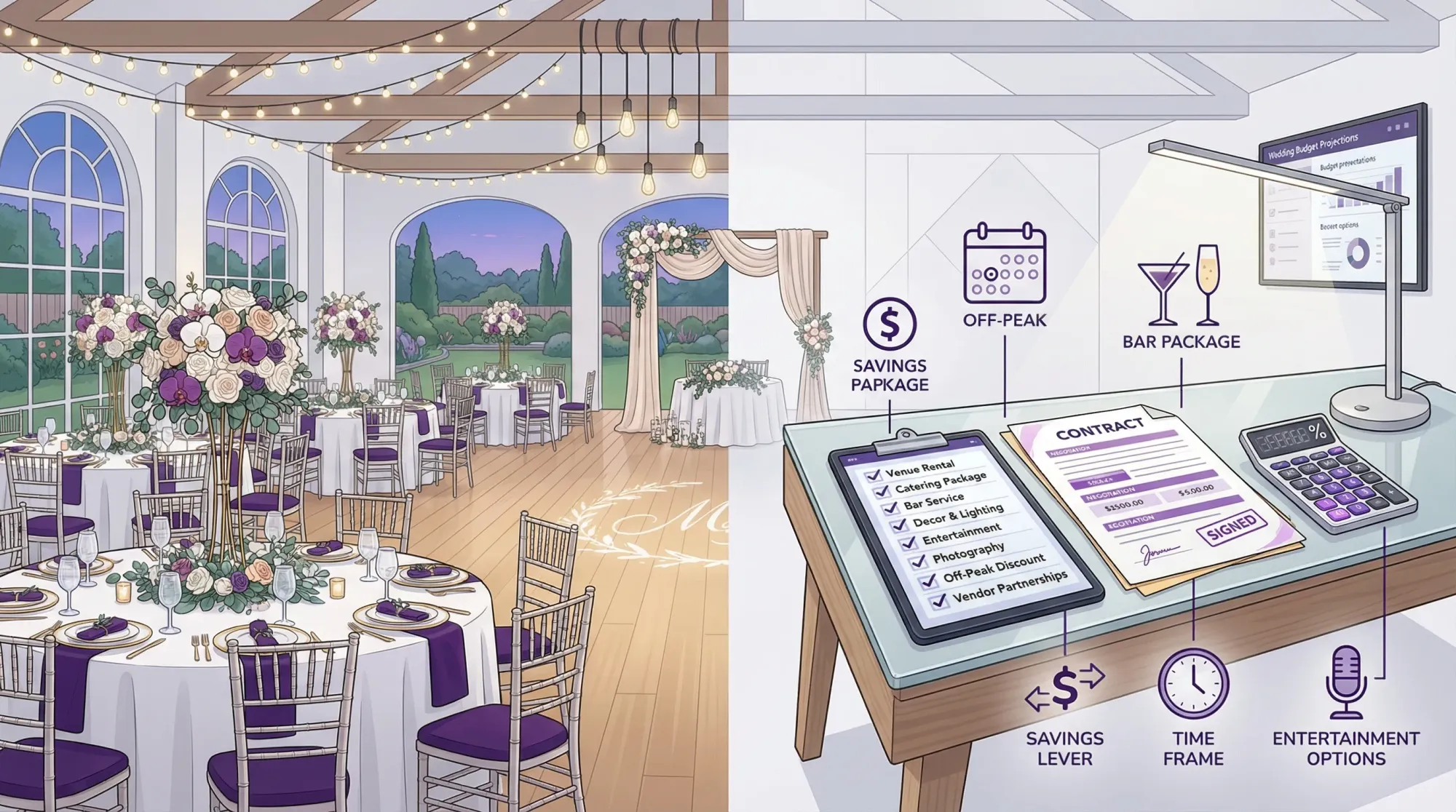
Venue costs can make a “reasonable” wedding budget feel impossible fast, because the venue often bundles multiple big-ticket items into one quote: space, food and beverage, staffing, rentals, and a long list of fees. The good news is that venues negotiate more often than couples expect, just not always in the form of a simple discount.
This guide focuses on negotiation tactics that actually work when you’re looking for a wedding venue on a budget: where the leverage is, what to ask for, and how to structure an offer so the venue can say “yes” without breaking their business model.
Know what venues are really selling (so you negotiate the right thing)
Most venues operate on a few core profit levers:
- Date demand (Saturday in peak season is expensive because it sells itself)
- Minimum spend (especially if catering and bar are in-house)
- Operational complexity (setups, flips, extra rooms, late-night staffing)
- Risk and policies (cancellations, outside vendors, insurance)
That means the easiest win is often not “take $3,000 off,” but “reduce the minimum,” “shift the date,” or “swap add-ons you don’t value for ones that cost them little.”
If you only remember one rule: negotiate the total cost and the terms, not just the sticker price.
Step 1: Set a target number using the “all-in venue cost”
Before you negotiate, define what “on a budget” means in dollars.
Many couples compare base venue fees and get surprised later by service charges, taxes, staffing, mandatory rentals, security, valet, and overtime. Ask every venue for an all-in estimate for your guest count and your likely timeline.
A simple target framework:
- Your max all-in venue cost (what you can truly spend without borrowing from other essentials)
- Your must-haves (capacity, location, rain plan, accessibility)
- Your flex points (day of week, season, start time, bar style, rentals)
If you want a reality check on why this matters, industry surveys regularly show venue and catering are among the largest wedding expenses, and average total wedding spend in the US sits in the tens of thousands. For example, The Knot’s 2023 Real Weddings Study reported an average wedding cost of $35,000 in the US, with major variation by region and guest count.
Source: The Knot Real Weddings Study
Step 2: Time your negotiation for when venues are most flexible
Venues are usually more open to concessions when you reduce uncertainty for them.
Best times to negotiate
- Off-peak months in your region (often winter, but it varies)
- Weekdays and Sundays
- Short lead time dates (a venue wants to fill an open calendar)
- When you can sign quickly (after you’ve done your homework)
What to say
Try a direct, respectful version of this:
“We love the space and we’re ready to book. If we choose the Sunday date, could you reduce the food and beverage minimum or include the ceremony space at no additional cost?”
This works because it ties a concession to something the venue cares about: filling a less competitive date.
Step 3: Ask for an itemized quote (and treat it like a negotiation map)
If you get a single package number, you can’t see where the budget is leaking. Ask for an itemized proposal that includes:
- Venue/site fee
- Food and beverage minimum (and what counts toward it)
- Per-person catering estimate
- Bar package details and duration
- Staffing (captains, bartenders, security)
- Rentals included (tables, chairs, linens, glassware)
- Setup/strike fees
- Ceremony fee
- Admin fees, service charges, and estimated taxes
- Overtime rates and time thresholds
A useful phrase:
“Can you send an itemized estimate that shows the total cost after service charges and taxes, so we can compare apples to apples?”
Negotiation levers that work (and what to ask for instead of a discount)
Most venues guard their published prices, but they can often adjust structure.
Here are the levers that typically have the highest chance of success.
| Lever | Why it works | What to ask for | Tradeoff to consider |
|---|---|---|---|
| Day or season shift | Helps them fill lower-demand inventory | Lower site fee or reduced minimum | Guests may travel, Friday logistics |
| Minimum spend | Changes your all-in cost more than small discounts | Reduce minimum, or let more items count toward it | You might lose premium inclusions |
| Bar format | Alcohol cost can balloon quickly | Switch to beer and wine, limited cocktails, shorter hosted bar | Decide what matters to your crowd |
| Timeline and hours | Late hours increase staffing and overtime | Earlier end time, no after-party add-on | Less late-night party time |
| Included rentals | Venues can partner with rental companies | Include tables/chairs/linens or waive delivery fees | Limited style options |
| Ceremony fee | Often more flexible than core F&B | Waive ceremony fee with full reception booking | May require earlier access |
| Friday hold or soft hold | Helps you make decisions without pressure | 48 to 72 hour courtesy hold | Not always available |
| Payment schedule | Not a “discount,” but helps cash flow | Smaller initial deposit, more milestones | Check cancellation terms |
| Vendor flexibility | Outside vendors can reduce cost | Allow outside dessert, outside coordinator, outside bar service | May add fees or insurance requirements |
The highest ROI question: “What’s easiest for you?”
Venues want a smooth event. Ask:
“If our goal is to get the total cost under $X, what changes would be easiest on your side? Date, minimum, bar structure, or inclusions?”
This reframes the conversation from “give us a discount” to “help us design a version you can support.”
Scripts that get “yes” more often
Use your budget number, but pair it with flexibility.
Script 1: Budget cap with a specific counteroffer
“We’re aiming to keep venue plus catering around $X all-in. If we book this date, could you reduce the minimum to $Y or include the ceremony space and standard rentals?”
Script 2: Quick-sign incentive
“We’re ready to sign this week. If we sign by Friday, can you waive the room flip fee or include an extra hour of bar service?”
Script 3: Ask for an upgrade that costs them less than cash
“Instead of reducing the site fee, would you be open to including the cocktail hour appetizers package or extending the end time by 30 minutes at no charge?”
Script 4: Protect the budget against surprise fees
“Can we add language that overtime is only billed in 30-minute increments, and that any staffing increases require our written approval?”
The last one is underrated: budget weddings get derailed by terms, not just rates.
What’s often negotiable vs. not negotiable
Every venue is different, but patterns are common.
| Usually negotiable | Often fixed |
|---|---|
| Ceremony fee, flip fee, admin fee | Local taxes |
| Minimum spend structure | Some service charge policies |
| What counts toward the minimum | Fire code capacity |
| Included rentals and setup | Required insurance amounts |
| Bar duration and format | Noise ordinances and hard curfews |
| Booking on less popular dates | Deposits (sometimes) |
If something is “fixed,” try negotiating a compensating benefit elsewhere.
Hidden-cost traps to watch for (and how to negotiate them)
1) Minimum spend that excludes key items
Ask exactly what counts toward your minimum. If it excludes service charges, staffing, or rentals, your “minimum” can feel misleading.
What to ask:
“Can any rentals, staffing, or ceremony costs count toward the minimum, or is it strictly food and beverage?”
2) Overtime that kicks in earlier than your timeline
Venues may define access hours differently than your photographer or planner. If you need setup time, clarify it now.
What to ask:
“How many hours of vendor access are included, and when does overtime start? Is it based on guest departure or contracted end time?”
3) Mandatory preferred vendors
Preferred lists are normal. Exclusivity is what can raise costs.
What to ask:
“Are we required to use your catering, bar, rentals, or coordinator? If yes, can you share typical price ranges so we can budget accurately?”
4) Cancellation and rescheduling terms
Negotiating a lower price is less helpful if the contract is harsh.
What to ask:
“If we need to reschedule due to illness or emergency, what happens to the deposit? Can deposits roll to a new date within 12 months?”
If they won’t move on money, sometimes they will move on flexibility.
A practical negotiation plan (that doesn’t waste your time)
Do this before you tour
- Get clear on guest count range (a 20-person swing changes everything)
- Decide your top 2 date options (one prime, one value)
- Bring a one-page summary: guest count, preferred timeline, budget ceiling
Do this after the tour
- Ask for the itemized quote
- Compare to 2 other venues (even if you love this one)
- Make one counteroffer with 2 to 3 options
A clean counteroffer example:
“We’re choosing between a few venues this week. If you can do either (1) reduce the minimum to $Y, or (2) keep the minimum but include ceremony + standard rentals, we’d love to move forward and sign.”
You’re not asking them to invent money. You’re offering them ways to win.
Use “value swaps” to keep guest experience high on a smaller budget
A budget venue decision can ripple into guest experience, but you can offset it with smart, low-friction upgrades that don’t cost venue-level money.
Examples couples often choose instead of bigger venue add-ons:
- Shorter hosted bar, better signature drinks (quality over hours)
- A great DJ for energy instead of extra decor
- Lighting choices (string lights, uplighting) that transform basic spaces
- A simple, centralized guest photo plan so you actually receive guests’ candids
That last point matters because couples frequently spend on “photo moments” (like a photo booth) just to get pictures from friends and family.
If your goal is to collect guest photos without renting extra equipment, a tool like Revel.cam can turn your wedding into a shared camera: guests scan a QR code or tap an NFC tag, then snap and upload instantly with no app install or signup. You can set photo limits and control when the gallery is revealed, which is useful when you want the “disposable camera” vibe without the film cost and logistics.
If you’re planning that piece, this guide is a good next step: Wedding guest photos: the best way to collect them fast.
A venue negotiation checklist you can copy into your notes app
Use this as your call sheet when you’re comparing venues.
| Question | Why it matters |
|---|---|
| “What is the total estimated cost all-in, including fees and taxes?” | Prevents budget surprises |
| “What counts toward the minimum spend?” | Minimums can be narrower than you think |
| “What dates are priced lowest in the next 6 to 12 months?” | Reveals true demand and flexibility |
| “What’s included in the site fee?” | Some venues include rentals and staffing, others do not |
| “What access time is included for vendors?” | Overtime can be a hidden cost |
| “Are there required vendors or exclusive agreements?” | Determines whether you can shop around |
| “What are the rain plan and indoor backup options?” | Avoids renting a tent last minute |
| “What are the payment schedule and cancellation terms?” | Protects cash flow and risk |
The mindset that closes deals: be easy to book
Venues remember couples who are organized, responsive, and realistic. You do not need to be pushy to negotiate effectively.
What helps you win concessions:
- You have two date options, including one that’s easier to sell
- You can give a clear yes/no timeline
- You’re negotiating one step at a time, not rewriting the entire contract
- You frame requests as tradeoffs, not demands
If you approach the conversation like a partner solving a math problem together, you’ll usually get further than couples who lead with “What’s your best price?”
If you want, share your guest count, city, and the type of venue you’re considering (hotel, winery, blank-slate space, restaurant, backyard). I can suggest the 3 to 5 negotiation levers that are most likely to work for that venue type.

A writer interested in connection, memory, and the everyday moments that matter more than we realize.
Tags: Wedding planning , Affordable wedding planning , Wedding planning app , Wedding planning tool , DYI wedding photography , Wedding photo gallery , Wedding photography costs , Wedding photo sharing