Wedding Reception Planner: A Timeline That Actually Runs On Time
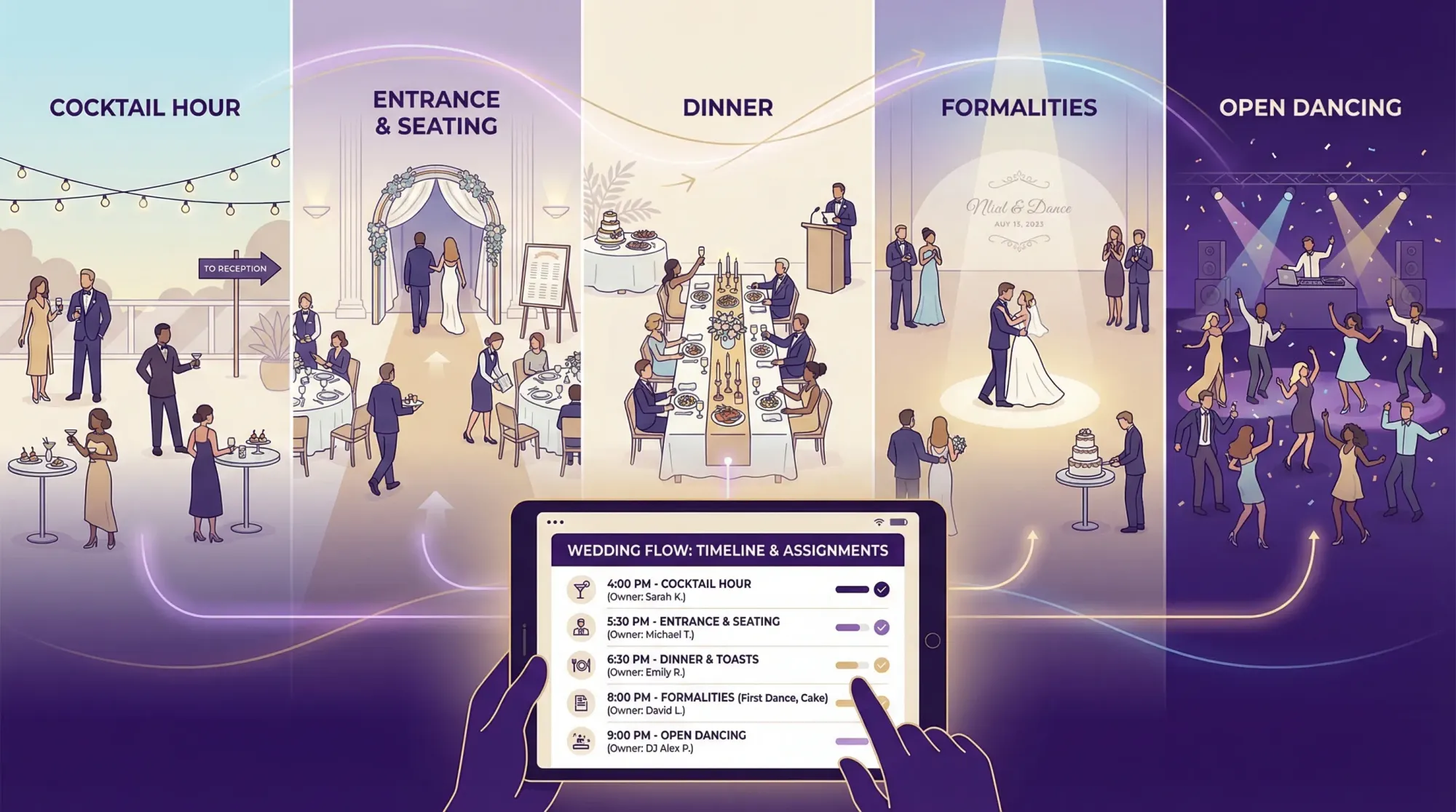
A wedding reception that runs on time is not about being rigid. It is about protecting the moments you paid for (great food, great photos, great dancing) by making transitions easy and responsibilities obvious.
If you are acting as the wedding reception planner (whether you are a couple, a coordinator, or a friend helping), the fastest way to reduce stress is to treat the reception like a simple live production: one timeline, clear owners, and built-in buffers.
What “on time” actually means (and what it doesn’t)
Most receptions “run late” because the schedule is written like a wish list. An on-time reception is different:
- The room flips and guest flow happen without confusion.
- Vendors get cues early enough to execute (DJ, catering, photo/video).
- The couple is not constantly being pulled away to make decisions.
- You can slip by 5 to 10 minutes without it cascading into losing an entire activity.
A realistic goal is on-time by blocks, not by the minute. Protect three anchor points and let everything else flex:
- Dinner service (your biggest operational constraint)
- Toasts (your biggest unpredictability)
- Open dance floor (your biggest energy lever)
If those land well, the night feels smooth even if smaller items move.
The reception timeline framework that planners actually use
Think in five blocks, with one job: move the room from “arriving” to “celebrating” with minimal dead space.
Block 1: Cocktail hour (60 minutes typical)
This block is where you absorb early/late variations from ceremony, photos, transportation, or weather.
Key planner moves:
- Make cocktail hour the buffer zone (build it to be enjoyable, not just filler).
- Confirm the DJ/band can start background audio immediately.
- Ensure the bar and passed apps open fast, nothing kills momentum like a long first line.
Block 2: Seating + grand entrance (10 to 20 minutes)
This is your first “hard transition.” If it drags, everything after it drags.
Make it easy:
- Tell guests exactly what to do (not “find your seats soon,” but “please take your seats now for the entrance”).
- Decide in advance if tables are released at once or by section.
- Put the couple somewhere private for 3 minutes before the entrance (water, breath, quick reset).
Block 3: Dinner (60 to 90 minutes)
Dinner is the anchor because catering has real constraints: firing courses, clearing plates, staffing, and timing.
The biggest reception timeline decision:
- Toasts before dinner: guests are seated and attentive, kitchen can fire right after.
- Toasts during dinner (between courses): often best for pacing, but requires strong coordination.
- Toasts after dinner: easiest for catering, riskiest for energy (people get restless).
If you want the night to feel “on time,” align toasts to the catering plan, not the other way around.
Block 4: Formalities + dance floor open (15 to 30 minutes)
Formalities include first dance, parent dances, cake cutting, bouquet/garter (if doing), anniversary dance, etc.
Two rules that keep this block tight:
- Keep the formalities back-to-back once you start.
- If you open the dance floor, avoid pulling everyone off again unless you have a strong reason.
Block 5: Open dancing + late-night (90 minutes or more)
This is where you protect vibe. Plan only a few “interruptions,” then let the party breathe.
Good late-night touchpoints:
- A late-night snack drop
- A last-call cue
- A final song and exit (or “soft exit” if you are not doing a send-off)
If you want a helpful reference, Brides has a solid overview of common reception timeline structures and pacing considerations: Brides: Wedding Reception Timeline.
A sample 5-hour reception timeline (that stays realistic)
The example below assumes:
- 5:00 pm cocktail hour start
- 6:00 pm reception doors open / guests seated
- 10:00 pm end
Adjust to your actual start time, venue rules, and cultural traditions.
| Time | What happens | Who “owns” it | Notes that prevent delays |
|---|---|---|---|
| 5:00 | Cocktail hour begins | Venue + catering + music | Bar open immediately, background music already on |
| 5:45 | 10-minute warning to seat | Planner or DJ/MC | Clear language: “Please find your seats now” |
| 6:00 | Guests seated, doors closed | Planner + venue | Confirm mics are on and tested |
| 6:05 | Grand entrance | DJ/MC | Keep it short, get everyone cheering |
| 6:10 | First dance (optional here) | DJ/MC + photo/video | If skipping, go straight to welcome |
| 6:15 | Welcome + blessing | Couple or parent | 60 seconds max keeps energy |
| 6:20 | Dinner service begins | Catering captain | This is your anchor, protect it |
| 6:50 | Toasts (2 to 3 speakers) | DJ/MC | Pre-collect mics, set a time cap |
| 7:05 | Toast buffer + reset | Planner + catering | Allows plate clear and coffee pour |
| 7:15 | Parent dances (or special dance set) | DJ/MC | Back-to-back, then open the floor |
| 7:25 | Dance floor opens | DJ/MC | First 2 songs should be easy crowd-pleasers |
| 8:15 | Optional: cake cutting | Planner + catering + photo/video | Do it near the dance floor to avoid losing the room |
| 8:20 | Dance set continues | DJ/MC | Avoid extra announcements |
| 9:00 | Late-night snack drop | Catering | Announce once, then keep dancing |
| 9:45 | Last call (if applicable) | Bar + DJ/MC | Align with venue rules |
| 9:55 | Final song | DJ/MC | Tell photographers 10 minutes prior |
| 10:00 | Reception ends | Planner + venue | Exit plan should be written and shared |
The hidden reason most timelines fail: no “show caller”
If you want a timeline that runs on time, one person must be responsible for calling cues. In weddings, this is usually:
- A professional planner/coordinator, or
- The DJ/MC (with the planner supporting), or
- A trusted, organized friend if you do not have pro coordination
What the show caller does:
- Keeps the timeline visible and updated.
- Checks that the next vendor is ready before announcing transitions.
- Makes micro-decisions fast (skip a song, move a toast, extend cocktail by 10).
Without a show caller, the couple becomes the default decision-maker, and that is how small delays turn into a late dinner and a shortened dance floor.
Build buffers that actually work (without making the night feel slow)
A good wedding reception planner uses buffers like shock absorbers:
Use “transition buffers,” not “dead time”
Instead of adding 30 minutes of vague flex, add 5 to 10 minutes after each high-friction moment:
- After seating (people wander)
- After toasts (people get up)
- After dinner (bathroom rush)
- Before the final song (bar tabs, goodbyes)
These buffers are where you:
- Reset the room
- Confirm the next cue
- Keep guests comfortable
Keep toasts short by designing them, not by hoping
If you are worried about speeches running long, fix it upstream:
- Limit to 2 to 3 speakers.
- Ask speakers to aim for 2 to 3 minutes.
- Have the DJ/MC introduce toasts confidently and keep the energy moving.
If you want a more detailed guide for photo-related timing tradeoffs, Revel’s post on avoiding missed moments pairs well with reception planning: Wedding Photos: A Simple Plan to Avoid Missing Key Moments.
Common reception delays and how to prevent them
Here are the issues that most often cause a “we’re 45 minutes behind” feeling.
| What causes the delay | What it looks like in real life | Prevention that works | In-the-moment fix |
|---|---|---|---|
| Couple still taking photos | Guests seated, nothing happening | Schedule golden hour photos with a hard stop | Start dinner service, then do couple photos later |
| Toasts go long | Guests restless, dinner pacing breaks | Set speaker count and time expectations | DJ/MC moves directly into a dance set to reset energy |
| Catering is behind | Courses lag, staff scrambling | Align timeline to catering plan, not vice versa | Push formalities later, open dance floor earlier |
| Room flip runs late | Ceremony ends, guests wait | Over-communicate flip timing with venue | Extend cocktail, add one interactive element (guestbook, photo prompt) |
| Mic/sound issues | Toasts stall, awkward silence | Test mics in the actual room pre-guest | Have a backup handheld mic ready |
| Bar bottleneck | Lines dominate cocktail hour | Add second bar point or batch signature drinks | Announce a second bar location if available |
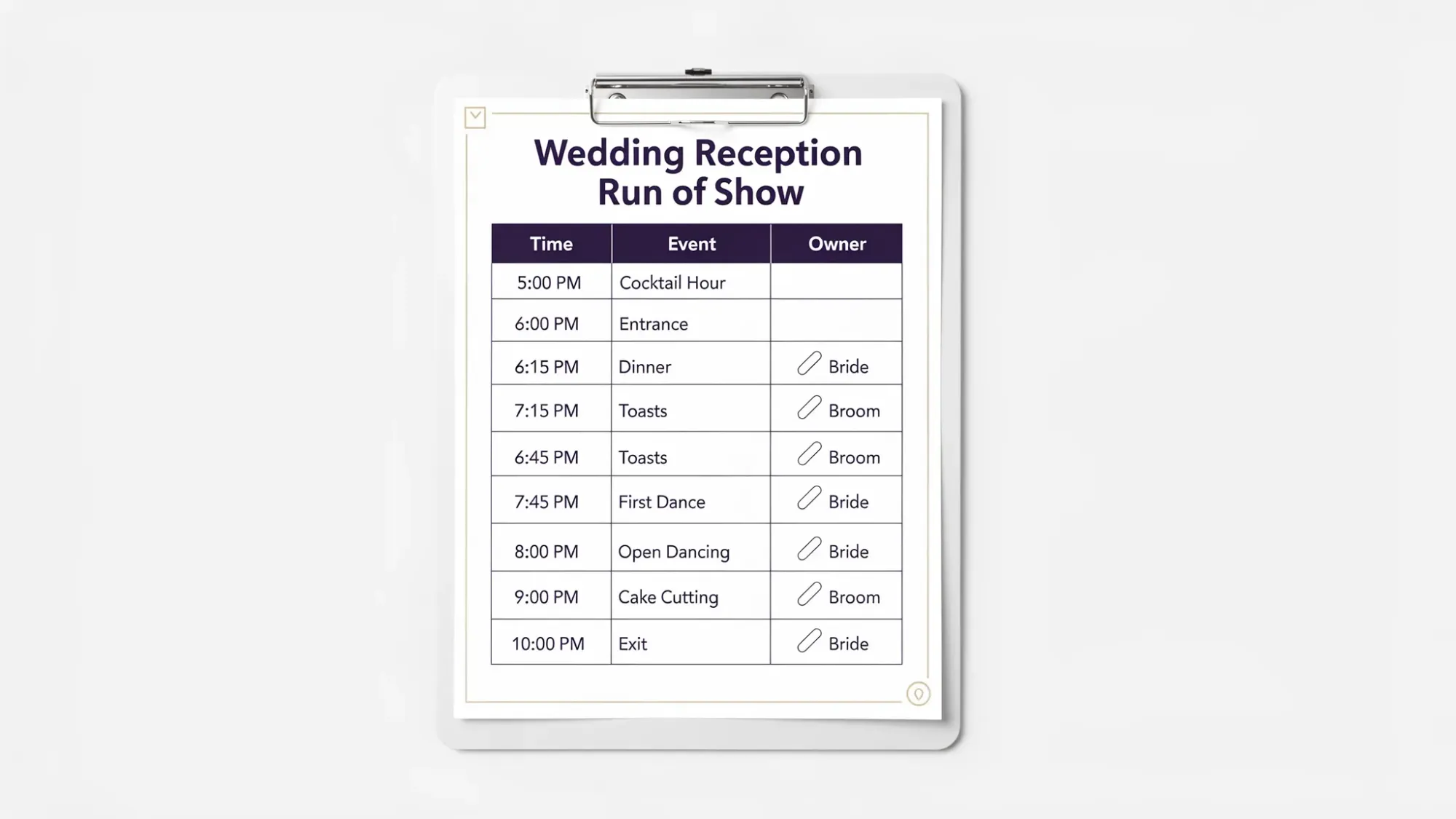
A simple run-of-show document (one page) that keeps everyone aligned
Your timeline should not live only in a planning app. Print or export a one-page run-of-show and send it to:
- Venue manager
- Catering captain
- DJ/MC or band leader
- Photo/video
- Planner/coordinator (or your point person)
Include:
- Start and end times for each block
- Owner for each block
- Where key people should stand (toasts location, entrance door)
- Micro-notes (which song, which mic, which cue)
This is also where you can place your guest photo plan so it is executed smoothly instead of being an afterthought.
Where guest photos fit into a reception timeline (without adding chaos)
Guest photos should not require a new app, a login, or a “remind me later” upload step. If it does, it will compete with the flow of your night.
A clean approach is to make guest photos part of natural phone-out moments:
- Cocktail hour (people are arriving and mingling)
- Table time (people already have phones in hand)
- Dance floor (high energy, candid content)
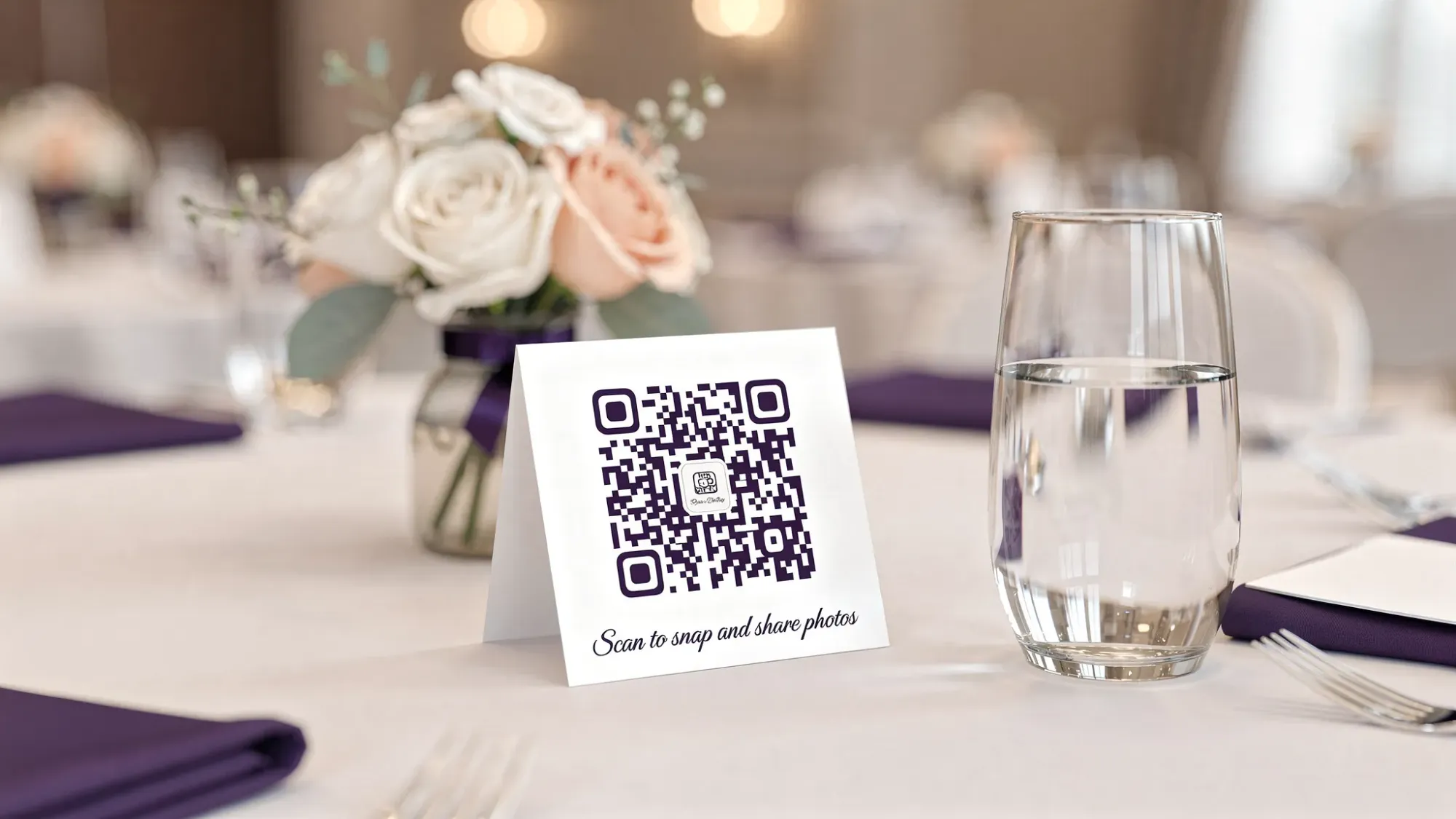
With Revel.cam, you can create a private event “Moment” and let guests join instantly by scanning a QR code or tapping an NFC tag, no signup required. Photos upload automatically to one gallery, and you can set an end time so uploads stop when the reception ends.
Practical placement that works:
- A QR sign at the bar (highest traffic)
- Small table cards (steady reminders)
- One sign near the dance floor (captures the best candids)
If you want deeper signage and placement ideas, this guide is a good companion: QR Photo Sharing Made Simple for Weddings and Parties.
Frequently Asked Questions
How long should a wedding reception be? Many receptions run 4 to 6 hours including cocktail hour, but the right length depends on venue rules, meal style, and whether you are doing formalities.
What’s the best order for reception events? In most cases: cocktail hour, seating/entrance, dinner, toasts, special dances, open dancing, cake or late-night moment, final song. The best order is the one that matches your catering service plan and avoids stopping the dance floor repeatedly.
How do I keep toasts from making the reception late? Limit the number of speakers, set expectations (2 to 3 minutes each), and assign the DJ/MC or coordinator to manage the handoff, microphone, and pacing.
Should we do the first dance before or after dinner? Before dinner works well if you want a “kickoff” moment and your couple is ready right after the entrance. After dinner can work too, but it often delays the dance floor if dinner runs long.
How can I collect guest photos without slowing down the reception? Use a scan-and-shoot flow (QR or NFC) that opens instantly and uploads automatically, so guests do not have to install an app or remember to share later.
Capture the reception as it actually happened
A timeline that runs on time helps you feel present. A photo system that runs in the background helps you remember what you missed.
If you want a simple way to collect everyone’s reception photos into one private gallery, you can create a Moment on Revel.cam. Guests scan a QR code (or tap an NFC tag) and start snapping immediately, with optional photo limits, moderation, and a gallery reveal when the Moment ends.

A writer interested in connection, memory, and the everyday moments that matter more than we realize.
Tags: Wedding planning , Affordable wedding planning , Wedding planning app , Wedding planning tool , DYI wedding photography , Group wedding photos , Wedding photo gallery , Wedding photography , Wedding photography costs , Wedding photos , Wedding photo sharing