Wedding Planning Companies: Service Levels and What You Get
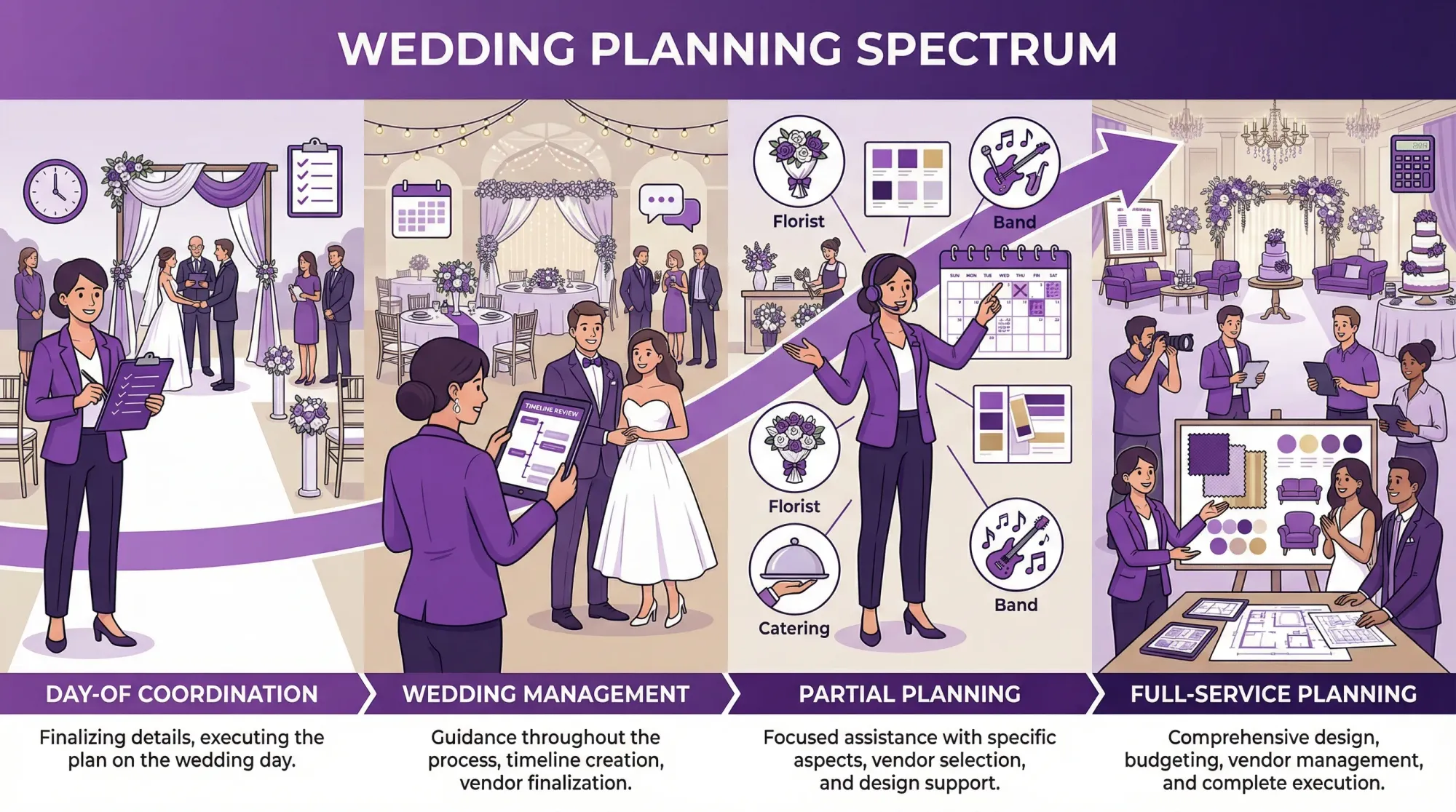
Most couples search for wedding planning companies because they want fewer decisions, fewer surprises, and a wedding day that runs without constant texting, tracking, and “Wait, who’s handling that?”
The catch is that planning companies use overlapping labels (full service, partial, month-of, day-of, wedding management, coordination) that can mean very different things depending on the team, the market, and the type of wedding.
This guide breaks down the most common service levels, what you typically get at each tier, what’s often excluded, and how to compare proposals so you can hire the right level of support.
What counts as a “wedding planning company” (and why it matters)
A “wedding planning company” can be a solo planner with a polished brand, or a multi-planner studio with associates, assistants, and weekend teams. That structure changes how work gets done.
Here are the most common models you’ll run into:
- Boutique studio (small team): Often design-forward, highly personalized, with a lead planner plus an associate.
- Large planning company (multi-team): More process-driven, clearer systems and backups, sometimes less “one-person” intimacy.
- Venue-affiliated coordination: Coordination focused on venue operations (timing, rules, access, staffing) with limited vendor scope.
- Planning platforms with human support: Tech-forward, template-heavy, usually lighter-touch than a traditional planner.
None of these are inherently better. They simply fit different weddings.
Wedding planning service levels (and what you actually get)
Titles vary, but the work usually falls into a few predictable tiers. Use the tier descriptions below as a baseline, then confirm exact deliverables in writing.
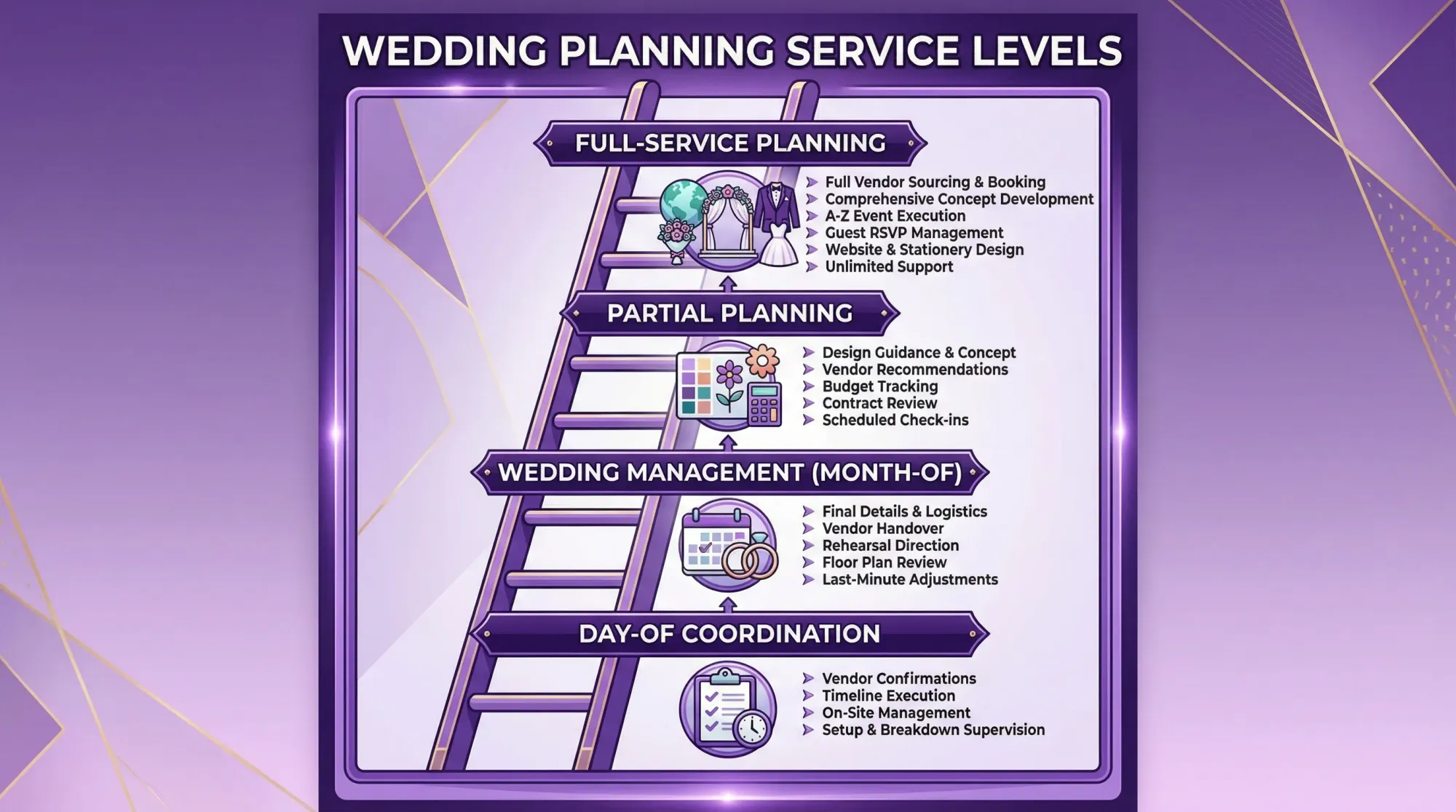
Full-service planning
Best for: Complex weddings (multiple venues, lots of vendors, custom builds), busy careers, destination weddings, or couples who want expert ownership from start to finish.
What you typically get:
Full-service teams usually guide the entire planning lifecycle: budget strategy, vendor sourcing, contract reviews, timeline architecture, guest experience planning, design direction, logistics, and day-of execution.
Common deliverables include:
- A planning roadmap and meeting cadence
- Budget creation and ongoing tracking (often with payment schedules)
- Vendor discovery, outreach, and shortlist curation
- Contract review support and negotiation guidance (not legal advice)
- Design concept development and sourcing recommendations
- Layout planning and coordination with venue and rental partners
- Run of show and vendor communication
- Rehearsal leadership and wedding-day show calling
What to watch for: In a company setting, ask who your day-to-day contact is and who will be physically on-site (lead planner vs associate team). “Full-service” can still be delivered by different staffing models.
Partial planning
Best for: Couples who want to do some planning themselves but want expert guidance for the highest-stakes pieces.
What you typically get:
Partial planning tends to cover a defined set of workstreams (often vendor sourcing for a few categories plus logistics and timeline). It can be very high value if the scope is clear.
Typical inclusions:
- Budget review and reality-checking
- Vendor recommendations and introductions for select categories
- Planning check-ins (monthly or milestone-based)
- Timeline and logistics development later in the process
- Vendor confirmations and handoff into event execution
- Day-of coordination or wedding management in the final stretch
What to watch for: Partial planning proposals can be vague. Ask, “Which vendors are included in sourcing, and which are not?” and “How many reviews of my timeline/layout are included?”
Wedding management (often called “month-of coordination”)
Best for: Couples who already booked most vendors but want a professional to take over logistics and execution so they can stop managing.
What you typically get:
Wedding management is usually a structured handoff, typically starting 4 to 8 weeks before the wedding (varies by company). The planner steps in to consolidate details, pressure-test the plan, and run the day.
Typical inclusions:
- Intake of your vendor contracts and key decisions
- A vendor contact sheet and communication plan
- Timeline refinement into a vendor-ready run of show
- Final confirmations and coordination of arrivals, load-in, and cues
- Ceremony rehearsal coordination (often)
- On-site management for the wedding day (sometimes with an assistant)
What to watch for: “Month-of” should not mean “show up and wing it.” A solid wedding management package includes real prep time, a real run of show, and proactive vendor coordination.
Day-of coordination
Best for: Very simple weddings where most decisions are already made, vendors are minimal, and you still have a strong DIY point person (or a venue team that covers a lot).
What you typically get:
Despite the name, day-of coordination often includes some pre-work (sometimes limited). The coordinator’s job is to execute an existing plan, not build it.
Typical inclusions:
- A final walkthrough or call
- A simplified timeline and cue list
- Vendor arrivals and basic issue management
- Ceremony and reception flow management
What to watch for: “Day-of” can leave a gap if nobody is responsible for building the plan that’s being executed. If you feel anxious reading this, you may actually want wedding management.
Design-only (or design plus production)
Best for: Couples who have planning under control but want a cohesive, elevated visual direction, or who want a designer to lead rentals, florals, and layout.
What you typically get:
Design services vary widely. Some companies offer moodboards and sourcing guidance only. Others offer “design + production,” meaning they also manage rentals, installs, and styling on site.
Clarify whether your design proposal includes:
- A design deck (colors, materials, inspiration, key vignettes)
- Rental sourcing and ordering support
- Styling of details (welcome table, escort display, lounge areas)
- Installation management and strike oversight
What to watch for: Design-only does not always include timeline ownership, vendor comms, or full day-of management. Some companies sell design and coordination separately.
A-la-carte planning help
Best for: Couples who mostly want DIY planning but need targeted expert review.
This might include consulting hours, a timeline audit, vendor contract review support, or a planning “power session.”
A-la-carte can be efficient, but you need to be organized enough to implement what you’re advised.
Quick comparison table: service level vs responsibilities
Use this as a starting point, then confirm scope line-by-line in the proposal.
| Service level | When they typically start | Core focus | You still own | Best fit |
|---|---|---|---|---|
| Full-service planning | Early planning (often 9 to 15+ months out) | Strategy, vendors, design, logistics, execution | Big decisions, approvals, payments | Complex or high-stakes weddings, limited time |
| Partial planning | Mid planning (varies) | Guidance plus defined vendor/logistics scope | Some vendor sourcing, many tasks | Couples who want help but still want to drive |
| Wedding management (month-of) | Final stretch (often 4 to 8 weeks out) | Consolidate, confirm, run the day | Most planning decisions already made | DIY planning, pro execution |
| Day-of coordination | Very late (sometimes 1 to 3 weeks out) | Execute an existing plan | Planning, timelines, many logistics | Simple weddings with strong vendor/venue structure |
| Design-only / design + production | Varies | Visual cohesion, rentals, styling | Logistics unless bundled | Couples who care deeply about aesthetic execution |
What wedding planning companies often do not include (unless you add it)
Many frustrations come from assuming something is “standard” when it’s actually an add-on. These are common exclusions across planning companies, unless explicitly written into the agreement:
- Unlimited meetings and texting: Many teams cap calls or define office hours and response windows.
- RSVP chasing and guest customer service: Some planners will handle guest comms, many won’t.
- Addressing invitations and printing: Often handled by the couple or stationery vendor.
- Assembling DIY favors and crafts: A frequent scope creep area.
- Extensive setup/teardown labor: Some companies coordinate it, but labor may require assistants, venue staff, or a rentals team.
- Vendor payment handling: Many planners track schedules, but couples pay vendors directly.
- Cleanup, trash removal, end-of-night packing: Sometimes included, often not.
This is not a red flag. It’s normal. You just want clarity before you rely on it.
Company structure: why “who shows up” matters as much as “what’s included”
When comparing wedding planning companies, the biggest practical difference is often staffing and continuity.
Lead planner vs associate planner
Ask directly:
- Who is my day-to-day contact during planning?
- Who writes the run of show?
- Who is on-site on the wedding day?
- If someone is sick, what is the backup plan?
A multi-planner company may offer stronger backup coverage, but you want to understand how handoffs work so details don’t get lost.
Assistant hours and on-site staffing
A proposal might say “coordination included,” but the experience changes dramatically depending on whether you have one person on-site or a small team.
Staffing matters more when:
- The venue has tight load-in/load-out rules
- You have multiple spaces (ceremony in one place, reception in another)
- There are many vendors needing cues (band, lighting, rentals, specialty bars)
- You want detailed styling and room flips
How to compare proposals from wedding planning companies (apples to apples)
A good comparison is less about the label and more about whether every critical workstream has an owner.
Here’s a practical matrix you can copy into a doc and use during consults.
| Workstream | What to look for in the proposal | Notes to clarify |
|---|---|---|
| Budget | Creation vs review, tracking cadence, payment schedule support | Do they track actuals or only estimates? |
| Vendor sourcing | Which categories are sourced, how many options provided, contract support | Is outreach included, or just referrals? |
| Design | Moodboard/design deck, rentals, styling, install/strike management | Is it “design-only” or “design + production”? |
| Timeline | Guest schedule, vendor run of show, buffers, cueing plan | Do you get a true run of show document? |
| Logistics | Layouts, rain plan, transport, load-in/out, rehearsal plan | Who owns permits and venue rules? |
| Communication | Response time, meeting cadence, planning portal/tools | How are decisions captured and approved? |
| Day-of execution | On-site hours, assistant count, setup/teardown responsibilities | Who handles end-of-night packing? |
| Post-wedding wrap | Returns, lost and found, final vendor tips, content handoff | Is anything included after the event? |
If a company can answer these clearly, it’s usually a sign they operate with strong systems.
The consult questions that reveal service level fast
Most consult calls are friendly. They are also sales calls. The goal is to get past generic promises and into specifics.
Instead of asking “What do you include?”, try questions that force scope detail:
- “When do you take over vendor communication, and what does that look like?”
- “What documents do you deliver, and when?” (timeline, run of show, floor plan, contact sheet)
- “What do you need from us before you can run the wedding day confidently?”
- “What’s your process for handling changes the week of the wedding?”
- “If something runs late, who has authority to make timeline decisions?”
You are listening for a real operational method, not just reassurance.
A modern “hidden workstream”: guest photos and content capture
Many couples assume their planner, photographer, or guests will naturally “take care of photos beyond the pro coverage.” In reality, guest photos usually fail for one reason: there’s no system.
If you care about candid guest perspectives (getting ready extras, cocktail hour side moments, table laughter, after-party chaos), treat it like a workstream and decide:
- Who owns guest instructions and signage?
- What’s the single destination for uploads?
- Is the gallery private by default?
- Do you want moderation before sharing?
- Do you want a timed “reveal” after the event?
If your planning company doesn’t provide a guest-photo workflow, you can add one without adding a ton of work.
Revel.cam, for example, is designed as a shared event camera: guests scan a QR code (or tap an NFC tag), take photos, and uploads go straight to one private gallery with no app install or signup required. Hosts can set photo limits, end time, and review before sharing. You can explore how it works at Revel.cam.
Choosing the right tier: a simple decision filter
If you’re stuck between levels, use this filter:
Choose full-service planning if the wedding has meaningful complexity (multiple venues, lots of custom vendors, destination logistics), or if decision fatigue is already high.
Choose partial planning if you like planning but want an expert to steer vendor decisions, refine logistics, and protect you from expensive mistakes.
Choose wedding management (month-of) if you’re comfortable booking vendors, but you want a pro to turn your plans into an executable show.
Choose day-of coordination if your wedding is truly simple and your venue and vendors already provide structure.
The bottom line
Wedding planning companies are not selling a vibe, they’re selling an execution system. The fastest way to choose well is to ignore labels and compare:
- Who owns each workstream
- What documents you get (and when)
- Who is on-site (and for how long)
- What’s excluded unless added
Once you have that clarity, the “right” service level becomes obvious, and you can hire with confidence instead of hoping you interpreted the package correctly.

A writer interested in connection, memory, and the everyday moments that matter more than we realize.
Tags: Wedding planning , Event planning , Party planning