Wedding Planning Companies Near Me: How to Compare Fast
If you’re searching “wedding planning companies near me”, you usually want two things at the same time: a local expert who can actually execute, and a way to compare options quickly without getting lost in vibes, Instagram, and vague packages.
This guide gives you a fast, repeatable comparison method, the exact questions that surface real differences, and a simple scoring table so you can choose with confidence.
What “wedding planning company” can mean (so you compare correctly)
Different businesses use similar titles, and that’s where couples waste time.
A local “wedding planning company” might be:
- A solo planner (one lead planner, sometimes with assistants on the wedding day)
- A planning studio (a brand with multiple planners, you’re assigned a lead)
- A coordination-focused team (wedding management, month-of, or day-of execution)
- A design-first company (aesthetics, sourcing decor, styling, production)
Before you compare pricing, make sure you’re comparing the same scope.
If you want a clearer breakdown of titles and overlap, see: Wedding Planner and Coordinator: Do You Need Both?
The 10-minute prep that makes comparisons easy
Before you contact anyone, write a one-page “planning brief.” This prevents you from getting mismatched quotes and saves back-and-forth.
Include:
- Date (or date window) and venue status (booked, touring, undecided)
- City and venue type (hotel ballroom, backyard, winery, destination)
- Estimated guest count range
- Budget range (even if rough)
- Top 3 priorities (guest experience, food, design, music, photo coverage, etc.)
- What you want help with (vendor sourcing, design, logistics, day-of execution)
- Any complexity flags (multiple locations, cultural ceremonies, tenting, tight setup windows)
You’ll use this same brief to request proposals and compare apples-to-apples.
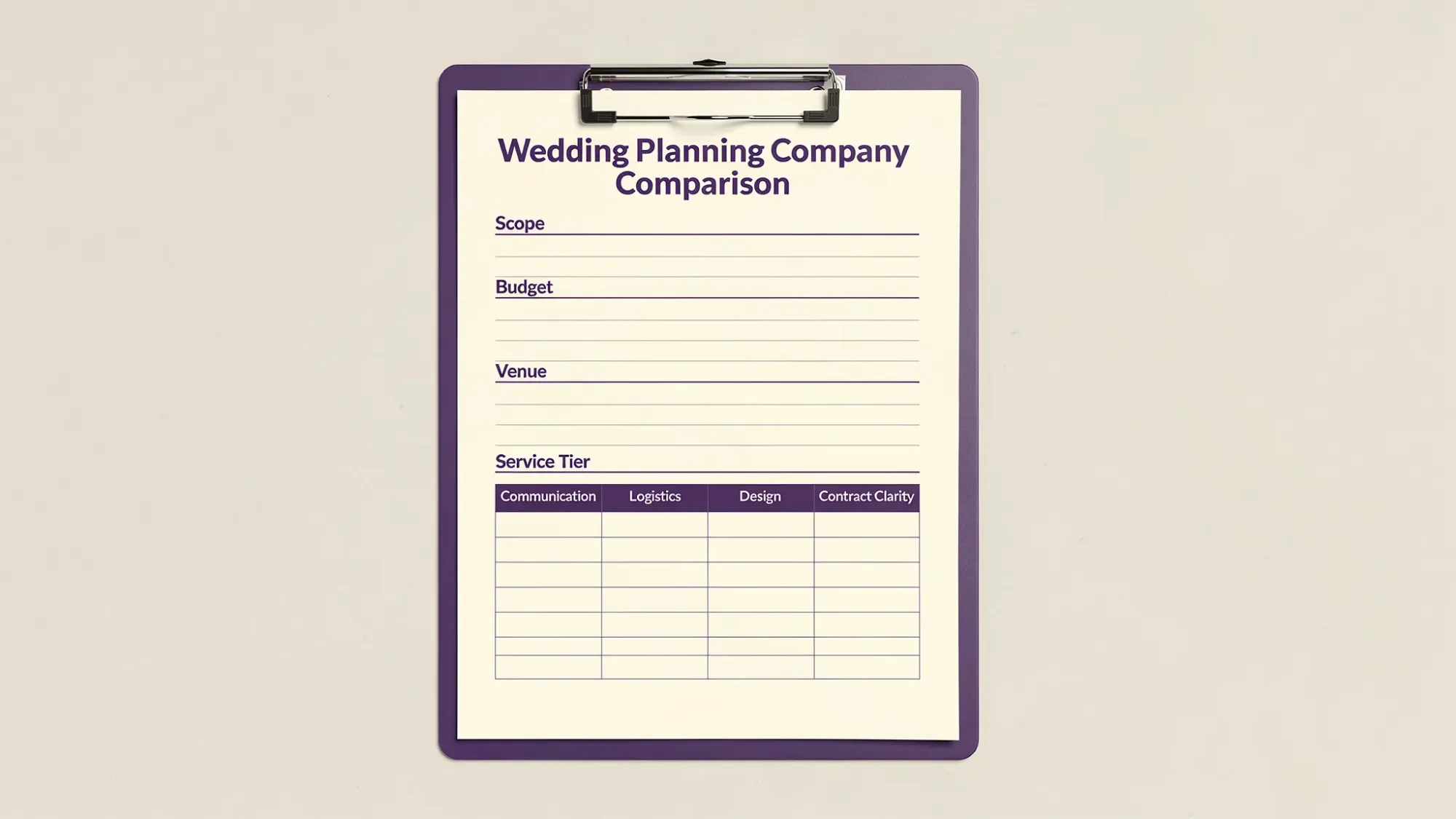
Step 1: Pick the right service tier (the biggest price driver)
Most “wedding planning companies near me” offer some mix of these tiers:
Full-service planning
Best if you want a partner from early planning through the wedding weekend, including vendor sourcing, contracts, budget oversight, and full logistics.
Partial planning
Best if you’ve started, booked a few key vendors, and want an expert to tighten decisions, prevent mistakes, and run execution.
Wedding management (often called month-of coordination)
Best if you planned it yourselves but want a professional to take over timeline, vendor confirmations, and day-of show calling.
Day-of coordination
Sometimes valuable, but often misunderstood. Many “day-of” packages still require weeks of prep to be effective.
For a 2026-specific breakdown of what’s typically included, use: Wedding Planning Services: What You Really Get in 2026
Step 2: Build a shortlist fast (without doom-scrolling)
Instead of opening 25 tabs, use sources that signal operational credibility.
High-signal shortlist sources:
- Your venue’s preferred list (often reflects who’s reliable on-site)
- Recommendations from photographers and caterers you trust
- Professional associations (membership is not a guarantee, but it can help)
- Reviews where couples describe process details, not just “she was amazing”
Two directories some planners use:
- WIPA (Wedding International Professionals Association)
- Association of Bridal Consultants
Aim for 3 to 6 companies for calls. More than that usually reduces decision quality.
Step 3: Use a “same email to everyone” inquiry (so responses are comparable)
Send the same message to each company. You’re testing responsiveness, clarity, and fit.
Copy and paste:
Hi! We’re looking for planning support for a wedding in [City] on [Date or Date Window]. Guest count is about [Range]. Venue is [Booked / Shortlisted].
We’re interested in [Full / Partial / Management] planning. Our top priorities are [3 priorities].
Can you share:
Your service options and starting pricing for this tier
What deliverables are included (timeline, vendor management, design, weekend events)
Who would be our lead planner and who is on-site day-of
Your next steps for a consult call
Thank you!
You’re not trying to negotiate here. You’re checking who communicates like a pro.
Step 4: Compare fast with a simple scoring matrix
Here’s a practical comparison table you can use immediately. Adjust weights based on what matters most to you.
| Category | What to look for | How to score quickly (1 to 5) |
|---|---|---|
| Scope clarity | Clear deliverables and boundaries, not vague “support” | Proposal lists outputs, timelines, and what’s excluded |
| Logistics strength | Run of show, vendor comms, setup/teardown realism | They talk in timing, owners, and contingency plans |
| Vendor process | How they source, vet, and manage contracts | They explain how decisions get made and documented |
| Communication | Response speed, organization, decision guidance | Clear next steps, structured calls, calm tone |
| Team + coverage | Who is actually on-site, for how long | Names, hours, assistant roles, handoff process |
| Contract + fees | Overtime, travel, assistants, reimbursement policy | Transparent fee structure and change policy |
| Local fit | Venue familiarity, regional vendor network | They can name common constraints in your area |
| Personality fit | You trust them under pressure | You feel calmer after the call |
Tip: after each call, write three bullets: “Strength,” “Risk,” “Question to clarify.” That keeps you out of decision paralysis.
Step 5: Ask questions that reveal real competence (not sales polish)
A great planner is part strategist, part producer. These questions surface whether they can actually run the day.
Questions for any service tier
“Walk us through how you build and run the timeline.”
Good answer: they describe drafts, vendor inputs, buffer strategy, and who calls cues.
“What does a smooth wedding day look like to you?”
Good answer: they mention guest flow, transitions, communication, and contingency planning.
“What’s your plan when something runs late?”
Good answer: calm triage, protects ceremony and dinner, communicates to vendors, makes tradeoffs.
Questions that protect you from scope gaps
“What’s explicitly not included in this package?”
This is one of the most important questions. Many surprises live here.
To go deeper, compare against: What Wedding Planner Charges Include (and What They Don’t)
“Who is on-site, and what time do they arrive and leave?”
You’re looking for staffing reality, not brand promises.
Questions that test their systems
“How do you manage vendor communication in the final month?”
Good answer: confirmations, load-in plans, contact sheet, a single channel, decision deadlines.
“What are the most common issues you see at our type of venue?”
Good answer: specifics (sound restrictions, lighting, parking, rain plan, flip timing).
If you’re hiring coordination specifically, you may also want: Wedding Coordinator Near Me: Questions to Ask Before You Book
Step 6: Vet proof, not just portfolios
A pretty feed doesn’t prove operational skill. When evaluating wedding planning companies near you, ask for evidence that matches your needs.
Reviews: what to look for
High-value reviews mention:
- Timeline realism
- Vendor communication
- Problem-solving under pressure
- Setup and teardown execution
- How issues were handled (weather, delays, missing items)
If you want a structured method, use: Wedding Planners Near Me: How to Vet Reviews and Portfolios
References: how to ask (without being awkward)
Ask for:
- One couple from a similar venue type
- One vendor reference (photographer, venue manager, caterer)
Vendor references can be especially revealing because they see professionalism across many events.
Step 7: Proposal and contract checks (the “hidden difference” zone)
Two companies can feel similar on a call, then look wildly different in writing.
Red flags to pause on:
- Deliverables that are described as “as needed” without specifics
- No stated number of planning meetings or planning window
- Vague staffing (no named lead, no assistant clarity)
- Unclear expense policy (travel, meals, printing, rentals pickup)
- Overtime terms that could surprise you
If you’re comparing wedding management vs planning, this guide can help you map responsibilities cleanly: Wedding Management Services vs Planning: Key Differences
Step 8: A fast decision rule that works
When you’re stuck between two strong options, use this:
- Choose the planner who is clearest in writing.
- Choose the planner who makes you feel more calm about logistics, not more excited about décor.
- Choose the planner who can describe tradeoffs without getting defensive.
In practice, the “best” wedding planning company near you is usually the one with the best operating system for your specific wedding.
Bonus: One overlooked comparison point, your “memories workflow”
Most couples evaluate planners on venue, vendors, and timeline. Fewer evaluate whether the planner has a plan for collecting guest photos and sharing them without chaos.
A solid planner will at least have an answer to:
- Where guests should put photos (one destination, not 10 threads)
- Whether guests need accounts or apps
- Whether you can moderate before sharing
Even if your planner doesn’t provide a built-in system, you can add a simple, app-free layer.
Revel.cam, for example, lets guests scan a QR code (or tap an NFC tag) to open a camera and upload photos to a private event gallery, with host-set limits and optional review. If you want the concept and setup details, start here: QR Photo: The Complete Guide to Collecting Wedding Photos From Guests
Frequently Asked Questions
How many wedding planning companies near me should I contact? Most couples get the best results contacting 3 to 6. Fewer can limit options, more usually creates decision fatigue and weaker comparisons.
Is it okay to hire a planning company that hasn’t worked at my venue? Yes. Venue familiarity is helpful, but strong planners can adapt quickly if they run structured walkthroughs, ask the right vendor questions, and build a realistic timeline.
What’s the difference between wedding planning and wedding management (month-of)? Planning usually starts earlier and includes vendor sourcing and major decision support. Management typically focuses on final logistics, vendor confirmations, timeline, and day-of execution.
What should be in a planning proposal so I can compare fairly? You want deliverables, planning start date, number of meetings, communication method, staffing and on-site hours, overtime rates, travel/expense policy, and what’s excluded.
Can I still collect great guest photos if my planner doesn’t offer anything? Yes. The key is using one destination that guests will actually use, ideally a camera-first flow that does not require logins or app installs.
Make one part of planning instantly easier: collecting guest photos
While you compare wedding planning companies near you, lock in a simple “memories plan” that doesn’t depend on chasing guests after the wedding.
Create a private Moment on Revel.cam and share it via QR code, NFC tag, or link so guests can snap and upload photos instantly, no signup or app install required. When your Moment ends, you can review and reveal a beautiful gallery that tells the full story from every perspective.

A writer interested in connection, memory, and the everyday moments that matter more than we realize.
Tags: Wedding planning , Affordable wedding planning , Wedding planning app , Wedding planning tool