Wedding Planner and Coordinator: Do You Need Both?
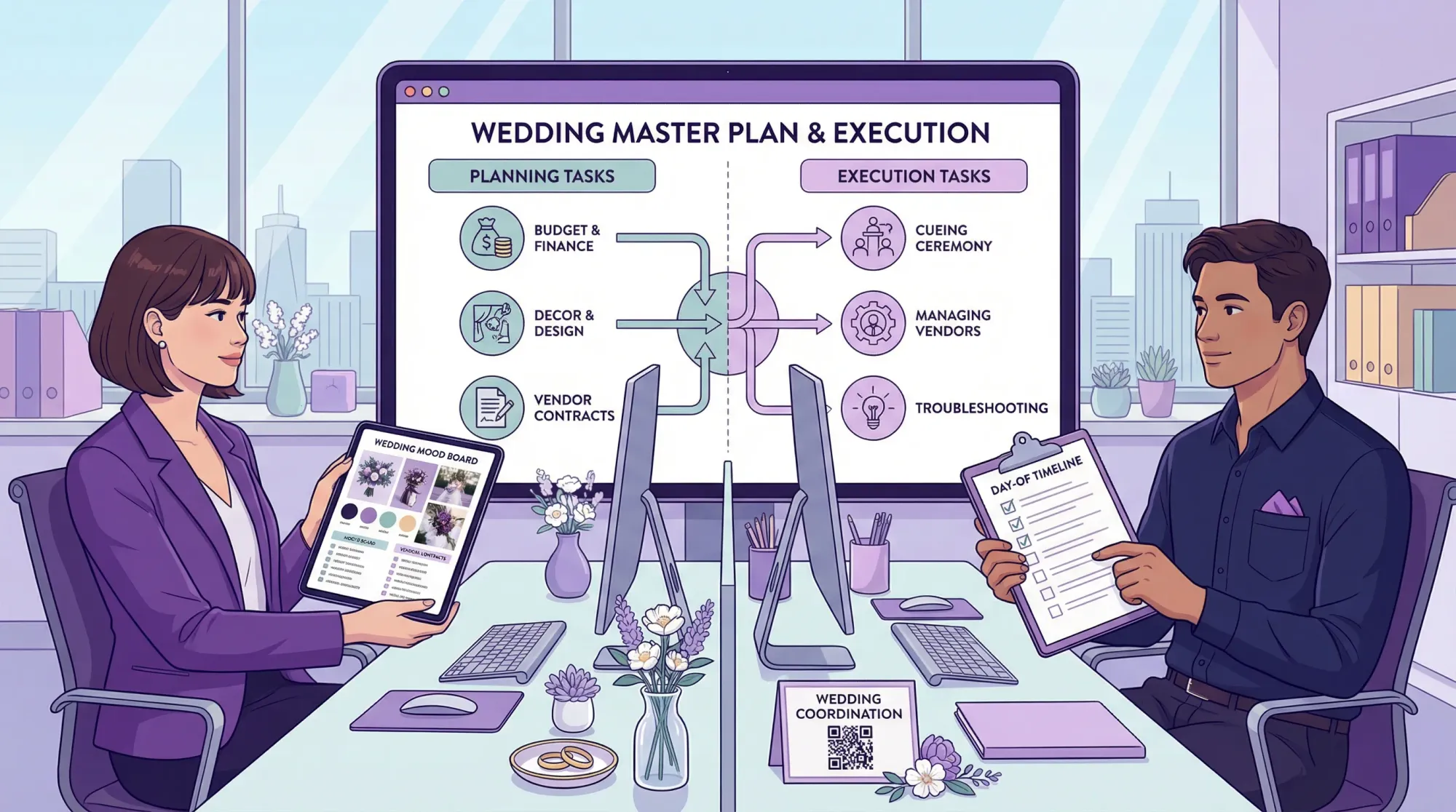
Most couples start with one simple question: “Do we need a wedding planner, a coordinator, or both?” The confusion is normal because the industry uses overlapping labels. Some companies bundle planning and coordination in one package, others split them, and venues often provide an on-site “venue coordinator” who is not the same as an independent wedding coordinator.
This guide breaks down what a wedding planner and coordinator actually do, where the roles overlap, and how to choose the hiring setup that matches your wedding (and your stress tolerance).
Wedding planner vs wedding coordinator: the simplest definition
Think of it like building and running a live show.
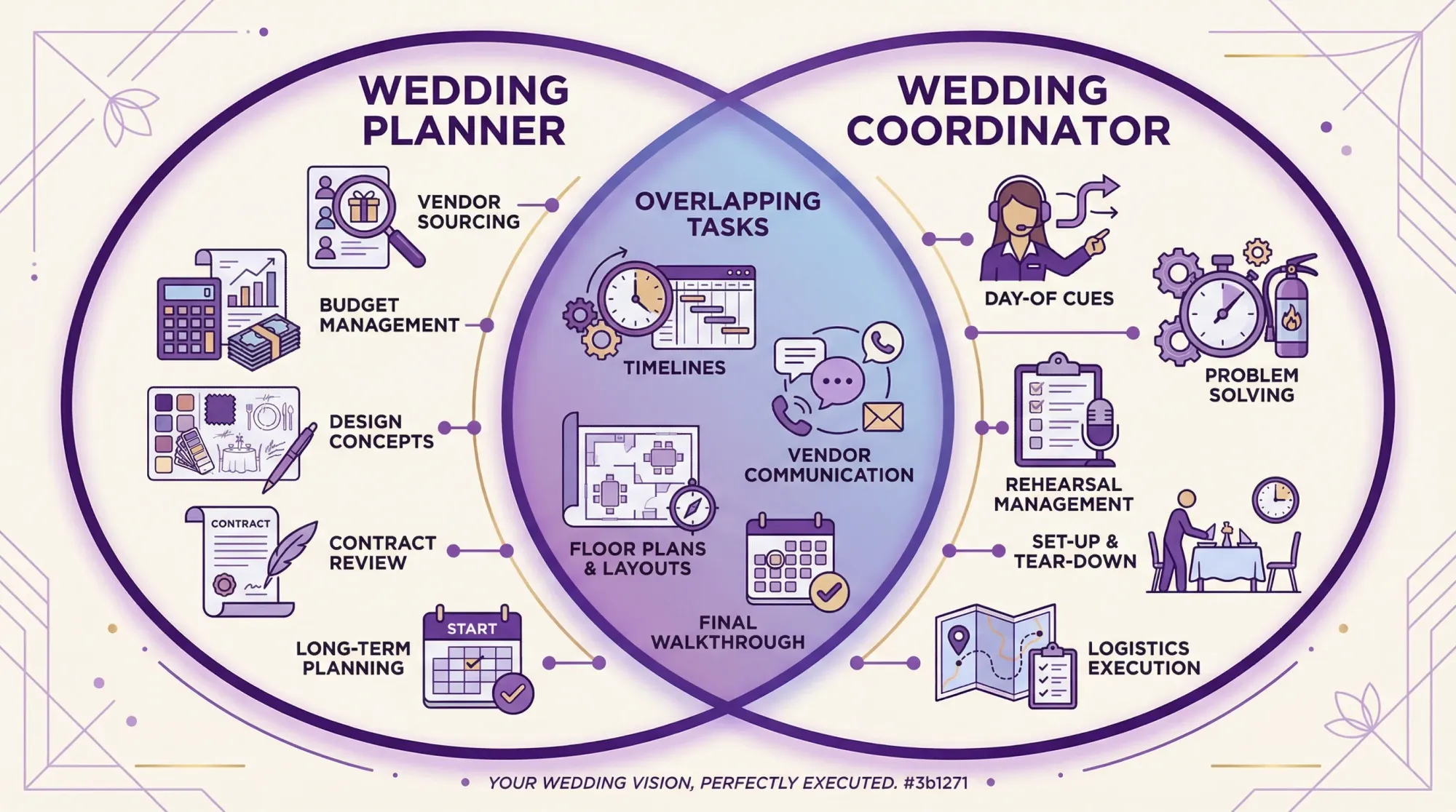
- A wedding planner helps you design and build the show: priorities, budget, vendor team, logistics, decisions, and the overall plan.
- A wedding coordinator runs the show: confirms details, manages the timeline, cues vendors, solves problems, and keeps the day moving.
In practice, many “planners” also coordinate. Many “coordinators” provide limited planning. That is why the contract scope matters more than the title.
What a wedding planner typically does
A planner is most valuable when you need help making decisions, organizing the process, and reducing risk over months.
Common planner responsibilities include:
- Building and managing your budget and priorities
- Venue search support (sometimes) and vendor recommendations
- Vendor communication, comparing proposals, and contract review guidance
- Design direction, mood boards, rentals and layout planning
- Creating (and iterating) the master timeline
- Guest experience planning (flow, signage, comfort, accessibility)
- Logistics planning (transportation, load-in/load-out, weather Plan B)
- Keeping you on track with deadlines and decision-making
If you want a detailed breakdown of what’s usually included and excluded in proposals, Revel.cam has a deeper guide here: What Wedding Planner Charges Include (and What They Don’t).
What a wedding coordinator typically does
A coordinator is most valuable when you already have your wedding planned (or mostly planned) and you need a professional to execute it.
Common coordinator responsibilities include:
- Taking over vendor communications in the final weeks (often 4 to 8 weeks out)
- Confirming arrival times, setup requirements, final counts, and cue points
- Running the rehearsal (or supporting it)
- Managing the wedding day timeline (the “show calling” work)
- Solving problems quietly (late shuttle, missing boutonniere, weather pivot)
- Directing ceremony and reception transitions
- Managing personal items and key handoffs (rings, vows, tips, late payments)
- Overseeing teardown and end-of-night wrap
If you want a realistic look at what “day-of” really means, read: Day of Wedding Coordinator: What to Expect and How to Prep.
The overlap (and why couples get stuck)
Here’s where things blur:
- Both may create timelines.
- Both may communicate with vendors.
- Both may build floor plans.
- Both may help with rehearsal and ceremony details.
The difference is when and why they do it.
- Planning work is decision-heavy and strategic.
- Coordination work is execution-heavy and operational.
A helpful rule: if you still need help deciding what should happen, you need planning. If you know what should happen and need someone to make it happen, you need coordination.
Quick comparison table: planner vs coordinator
| Category | Wedding planner (typical) | Wedding coordinator (typical) |
|---|---|---|
| Best for | Couples who want guidance and structure over months | Couples who want a smooth wedding day without managing it themselves |
| Timeline | Often starts 6 to 18+ months out | Often starts 4 to 8 weeks out (plus wedding day) |
| Core value | Decision support, vendor team building, risk reduction | Execution, communication, and timeline control |
| Key outputs | Budget plan, vendor shortlist, design direction, master plan | Final confirmations, run-of-show, cueing, problem solving |
| Day-of presence | Sometimes, depending on package | Yes, that’s the point |
| Who they manage | The planning process and vendor selection (varies) | The wedding day operations and vendor arrivals |
So, do you need both?
You need “both” only if planning and coordination are sold separately in your market or by your chosen provider.
In many cases, you do not need to hire two different people because:
- A full-service planner often includes coordination (sometimes called “planning + management”).
- A partial planner may include coordination, or may require you to add it.
- A coordination package might be enough if your venue and vendor team are strong and you are comfortable planning.
The real question is not “both,” it’s: Do you have both planning coverage and execution coverage?
You probably only need a coordinator if:
- You enjoy planning and you’re already booking vendors confidently.
- Your wedding is logistically straightforward (one venue, few moving parts).
- You have time to build a solid plan and documents.
- You want someone else to run the rehearsal and wedding day.
You probably need a planner (and coordination included) if:
- You feel stuck making decisions (budget, venue, vendor selection, style).
- You have a complex event (multiple locations, tight turnaround, major decor install).
- You are planning from out of town.
- You have high-stakes family dynamics and need a neutral professional.
- You want a cohesive design and guest experience, not just a schedule.
You may need separate planner + coordinator if:
- Your planner is “design and planning only” and does not offer day-of management.
- Your wedding spans multiple days and needs staffing coverage.
- Your venue requires a dedicated coordinator and your planner will not serve that role.
- You are hiring a specialist planner (destination, cultural weddings, luxury design) and you want a local operations lead.
The common trap: assuming the venue coordinator replaces your coordinator
Many venues provide an on-site coordinator. This person is essential, but their job is usually venue-first.
A venue coordinator typically focuses on:
- Venue rules and timing (load-in, ceremony start, noise limits)
- Venue staff, bar, catering (if in-house), and room flips
- Protecting the venue’s space, schedule, and liability requirements
They usually do not:
- Manage your photographer’s timeline
- Line up your wedding party
- Cue your processional music
- Run your vendor team across categories
- Handle personal items, family issues, or decor details beyond venue scope
You can absolutely have a great venue coordinator and still need an independent coordinator.
4 common hiring setups (and when each works)
| Setup | What it looks like | Best for |
|---|---|---|
| Coordinator only | You plan it, they run it | Confident planners, simpler weddings |
| Partial planner + coordination | You share planning tasks, they manage the finish and day | Couples who want guardrails, not full takeover |
| Full-service planner (includes coordination) | One team from strategy to execution | Complex events, busy couples, high expectations |
| Planner + separate coordinator | Two pros with clearly split scope | Multi-day, destination, or “design-only planner” situations |
If you want a more detailed service-level breakdown (full, partial, management), this pairs well with: Wedding Planning Services: What You Really Get in 2026.
How to decide in 10 minutes: the “decision load” test
Ask yourself these five questions. If you answer “yes” to 3 or more, you are likely a planning candidate (not just coordination).
- Are we unsure how to build a realistic budget and trade-offs?
- Are we overwhelmed choosing vendors or comparing proposals?
- Are we planning from a distance or with limited site visits?
- Does our vision require design decisions across rentals, florals, lighting, layout?
- Are there multiple events, multiple venues, or cultural elements with complex timing?
If you answer “no” to most and you mainly want the day to run smoothly, coordination is usually the right spend.
What to ask before you book (to avoid paying twice)
Titles vary. Scope does not. These questions force clarity.
Questions for a planner
- What services are included in “planning” vs “coordination” in your proposal?
- Do you provide on-site management on the wedding day? For how many hours?
- When do you take over vendor communications?
- Who creates the run-of-show and who distributes it to vendors?
- Will you attend the rehearsal? Who runs it?
- Who is physically present, and how many assistants are included?
Questions for a coordinator
- When does your service start (weeks out, months out)?
- What documents do you deliver (timeline, contact sheet, floor plan notes)?
- Do you confirm vendors directly, or do you only work from my info?
- What is your plan for emergencies and last-minute changes?
- What is included (and excluded) for setup and teardown?
Tip: If you are comparing “month-of” services, it helps to read: Wedding Management Services vs Planning: Key Differences.
How to make planner and coordinator work together (if you hire both)
If you end up with two roles, the success factor is a clean handoff.
A simple way to avoid duplication is to define ownership like this:
- Planner owns: budget, vendor strategy, design direction, decision tracking.
- Coordinator owns: final confirmations, run-of-show, cues, day-of execution.
Then agree on the handoff date and deliverables (for example, 6 weeks out).
Minimal handoff packet (what your coordinator should receive)
- Vendor list with contracts, contacts, and arrival times
- Final timeline and a shorter “run-of-show” version
- Layout/floor plan and ceremony plan
- Decor setup notes and who is responsible for each item
- Payment and tip plan (who pays what, when)
- VIP notes (mobility needs, sensitive dynamics, must-avoid issues)
- Weather plan and decision owner (who can call an audible)
Where most weddings still break: the “unowned” photo sharing plan
Even with a planner or coordinator, one operational detail often gets skipped: how guest photos will be collected and shared.
If you do not design this, it defaults to:
- dozens of separate camera rolls
- a messy group chat
- “I’ll send it later” that never happens
A coordinator can announce it and place signage, but you still need a system that is frictionless for guests.
Revel.cam was built for this exact gap. You create a private event (a Moment), then guests scan a QR code or tap an NFC tag to open the camera and upload instantly. On iPhone, it can launch as an App Clip, so guests do not need an app download. You can set per-guest photo limits, set an end time, review shots, and share a clean gallery after.
If you are building a complete operations plan, this playbook can help you integrate photos without adding stress: Wedding Planning Tool: Build a Guest Photo Plan That Works.
Frequently Asked Questions
Is a wedding planner the same as a wedding coordinator? No. A planner primarily helps you plan (decisions, vendors, budget, design). A coordinator primarily runs execution (final confirmations, timeline control, cues, day-of problem solving). Some packages include both.
If I hire a full-service planner, do I still need a coordinator? Usually no, because most full-service planners include wedding day coordination. Confirm this in writing, including hours on-site and whether an assistant is included.
What does “month-of coordinator” actually mean? It often means “wedding management” that starts several weeks before the wedding, not literally one month. Ask when they take over vendor communications and what documents they deliver.
Does my venue coordinator replace a wedding coordinator? Typically no. Venue coordinators usually manage venue operations, not your full vendor team, personal details, or ceremony and reception cues.
Can I plan myself and only hire a coordinator? Yes, and it works well for many couples. The key is providing a clean handoff packet and giving the coordinator authority to make small decisions on the day.
How do planners and coordinators handle guest photo collection? Some include it as part of guest experience operations, many do not. If you care about guest candids, set a system in advance (QR or NFC access, clear signage, and a defined gallery reveal plan).
Make the “memories” part of your wedding as organized as the timeline
Whether you hire a wedding planner, a coordinator, or both, your goal is the same: fewer open loops, fewer last-minute decisions, and a wedding day that runs on rails.
If you want guest photos without chasing anyone after the fact, set up a private Revel.cam Moment and let guests scan a QR code (or tap NFC) to snap and upload instantly, no app and no account required.
Create your Moment at Revel.cam.

A writer interested in connection, memory, and the everyday moments that matter more than we realize.
Tags: Wedding planning , Wedding planning app , Wedding planning tool , Affordable wedding planning , Wedding photography , Wedding photos , Wedding photo gallery