Wedding Photographer Cost in 2026: Packages, Hours, Deliverables
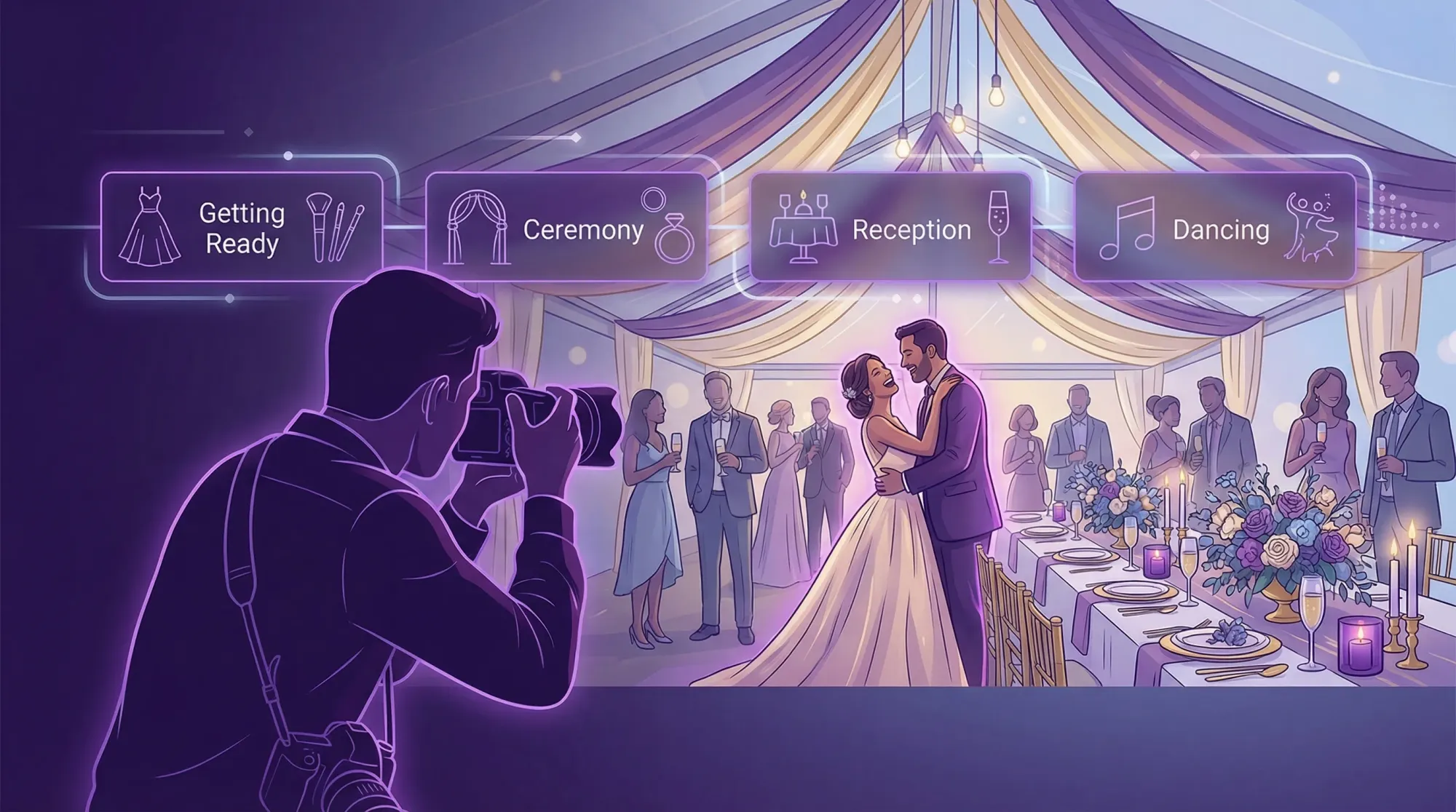
If you’re pricing photography for your wedding in 2026, you’ll notice something fast: two packages with the same “8 hours” can cost wildly different amounts. The difference is usually not the camera, it’s the coverage plan, the deliverables, the editing workload, the backup systems, and the business practices behind them.
This guide breaks down wedding photographer cost in 2026 by the pieces that actually change the price: packages, hours, deliverables, add-ons, and the contract details that affect your risk.
What most couples are really paying for in 2026
Wedding photography pricing is best understood as three buckets:
1) Coverage time (hours and timeline complexity)
Coverage includes the photographer’s on-site time, but it’s priced with the whole day in mind: travel, load-in, lighting setup, and the reality that most weddings lock out the calendar.
A 6-hour package for a single-location wedding often costs less than a 6-hour package that includes:
- Two venues (hotel, ceremony site, reception site)
- Tight travel buffers
- A dark venue requiring more lighting work
- A complex family formal list
2) Post-production (culling, editing, exporting, delivery)
Editing is where a huge amount of professional time goes. Even “light and airy” or “true-to-color” styles involve consistent color work, cropping, straightening, skin tone management, and export settings.
A useful rule of thumb when comparing quotes: more included images and heavier retouching usually raises cost more than adding 1 extra hour of coverage.
3) Deliverables (what you actually receive)
Deliverables are the outputs: digital gallery, print rights, albums, previews, turnaround time, and sometimes film or hybrid coverage.
In 2026, a lot of couples also want “experience deliverables,” like next-day sneak peeks for thank-you posts, or a curated gallery that is ready to share with family.
Typical wedding photography package price ranges (US, 2026)
Prices vary heavily by region (major metros and destination markets skew higher), demand (peak Saturdays), and photographer experience.
Use these as planning ranges, not guarantees.
| Package type (typical) | Coverage | Photographer(s) | Common deliverables | Typical price range (2026) |
|---|---|---|---|---|
| Elopement / micro wedding | 2 to 4 hours | 1 | Edited gallery, online delivery | $800 to $3,000 |
| Standard wedding | 6 to 8 hours | 1 | Edited gallery, timeline support, print release | $2,500 to $6,000 |
| Full-day wedding | 8 to 10 hours | 1 (sometimes 2) | Larger gallery, sneak peeks, online delivery | $3,500 to $8,500 |
| Luxury / multi-day | 10+ hours or weekend coverage | 2+ | Albums, concierge planning, faster turnaround | $8,000 to $20,000+ |
Why these ranges are wide: photography is a premium craft plus a logistics business. Insurance, backups, editing time, second shooters, and client service standards all change the underlying cost.
How many hours do you actually need?
Most couples overspend on hours when the real issue is a timeline that creates “dead space” (long gaps) and “crunch space” (too many must-do photos in 20 minutes).
Here’s a practical guide to choose hours based on what you want photographed.
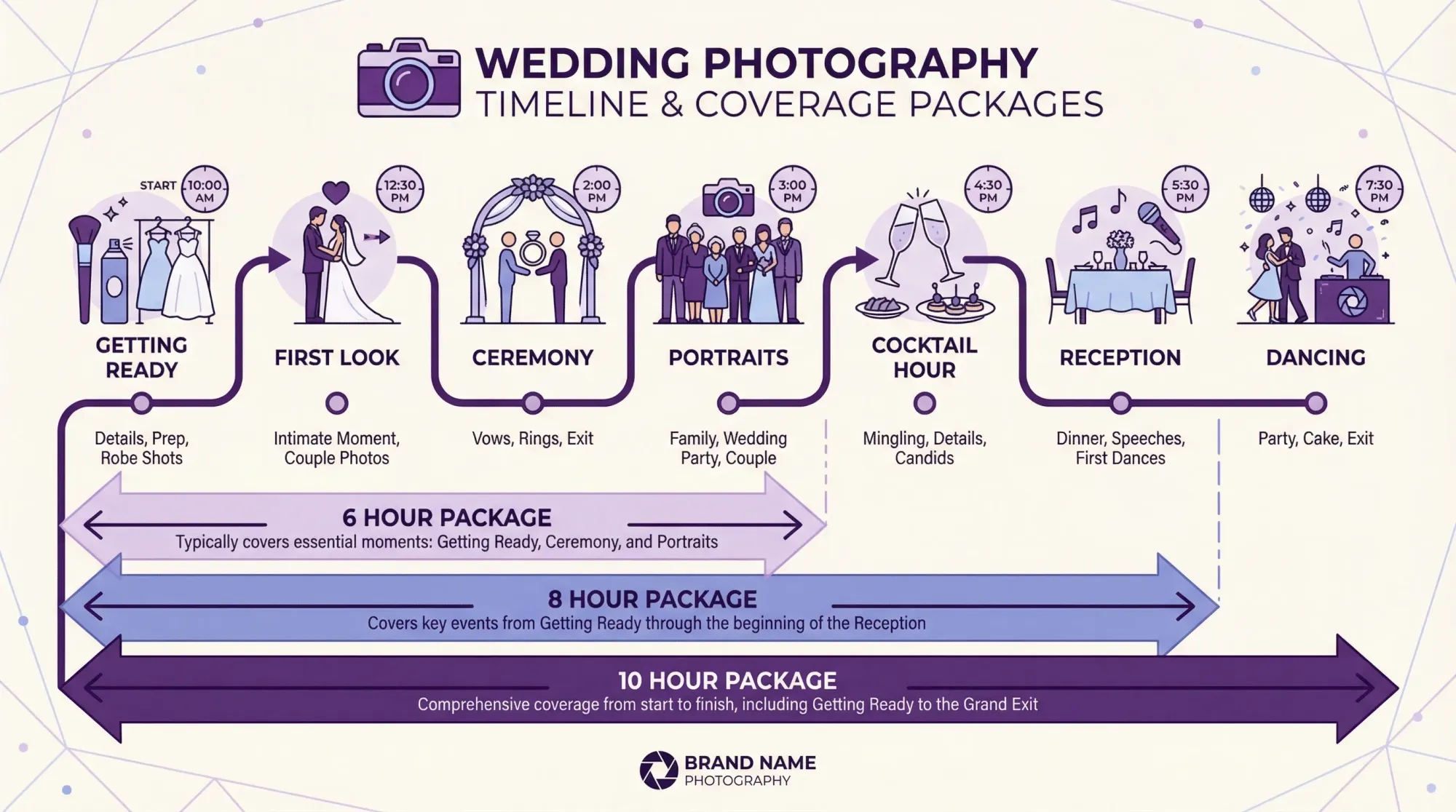
6 hours (lean, works best when you’re organized)
Best if:
- Ceremony and reception are in one location (or close)
- You’re okay skipping some prep coverage
- You want key events covered, not every minute
Common coverage:
- Final getting-ready details
- First look (optional) and portraits
- Ceremony
- Family formals (short list)
- Part of cocktail hour
- Reception entrances, first dances, toasts, cake
8 hours (most common “everything important” option)
Best if:
- You want full prep through early dancing
- You have multiple locations, or a larger bridal party
- You want more candids during cocktail hour
Common coverage adds:
- More getting-ready story
- More breathing room for portraits and family formals
- Wider reception coverage (party photos, table candids)
10 hours (full story, includes late reception energy)
Best if:
- You want the last hour of dancing covered
- You have travel time between locations
- You’re doing a big exit (sparkler, vintage car, etc.)
A quick planning shortcut
If you want a simple heuristic: start with 8 hours, then adjust based on travel time and whether you want prep and late dancing.
If you’re also comparing packages, this companion guide can help you evaluate beyond price: Wedding photographers near me: how to compare packages.
Deliverables: what you should expect, and what to clarify
Two photographers can both say “digital gallery included” and still deliver very different value.
Edited image count
Instead of asking “How many photos do we get?” ask:
- What’s the typical delivered range for a wedding like ours?
- Is there a minimum?
- Do you deliver near-duplicates (bursts), or do you curate tighter?
Many photographers land somewhere around 40 to 100 edited images per hour depending on the day’s pace and how much is happening, but style and culling philosophy matter.
Sneak peeks and turnaround time
In 2026, turnaround time is a major value lever.
Clarify:
- Whether sneak peeks are included (and how many)
- Typical full-gallery delivery time
- Whether a rush turnaround is available (and what it costs)
Albums and prints
Albums can be one of the most expensive “deliverables” because they combine design labor and print production.
Confirm:
- Album size, page count, and cover type
- Whether revisions are included
- Whether parent albums are discounted
Rights and usage
Most couples want personal printing and sharing rights. Many photographers also retain copyright.
Ask:
- Can we print anywhere, or only through your lab?
- Can we post on social media (and do you want credit)?
- Can guests download from the gallery?
If you’re planning a corporate event or brand activation wedding-adjacent (yes, it happens), usage rights can become more complicated. This explainer is helpful for the broader category: Event photography services: what’s included (and what’s not).
Common add-ons (and what they typically cost)
Add-ons are where quotes can become hard to compare. Here are the most common line items couples see.
| Add-on | What it usually means | Typical cost impact |
|---|---|---|
| Second shooter | More angles, more candids, more coverage overlap | +$400 to $1,500+ |
| Extra hour (overtime) | Extending coverage past contracted time | +$250 to $600 per hour |
| Engagement session | Separate shoot, often used for save-the-dates | +$300 to $1,200 |
| Albums | Design + professional printing | +$500 to $3,000+ |
| Travel / lodging | Mileage, flights, hotel, per diem | Varies widely |
| Film coverage | Film stock + processing + scanning + curation | +$300 to $1,500+ |
| Retouching | Advanced edits (blemish, flyaways, object removal) | Often per image |
Two reminders:
- Overtime pricing should be in the contract. If it isn’t, you’re exposed.
- A second shooter is not automatically “better,” it’s situational. If you’re deciding between extra hours vs. a second shooter, it can help to map coverage roles. This article lays out a clean approach: Wedding photos: a simple plan to avoid missing key moments.
What drives wedding photographer cost the most?
If you’re trying to control budget without sacrificing results, these are the levers that usually matter.
Location and market demand
Large metro areas, destination markets, and peak-season Saturdays cost more because demand is higher and operating costs are higher.
Experience level and consistency
A newer photographer might be talented, but experience shows up in:
- Timeline control (moving fast without stress)
- Handling bad weather and harsh light
- Backup plans for gear and files
- Clean, repeatable delivery workflows
Editing style and retouching expectations
If you want magazine-level skin retouching across a large gallery, expect to pay for it.
A good way to keep costs reasonable is to define where you want heavier edits:
- A small set of hero portraits
- A few family formals
- One or two “frame it” reception images
Coverage complexity (not just hours)
A wedding with three locations, a large wedding party, complex family dynamics, and strict venue rules costs more to cover well.
Business practices that reduce your risk
Some of the most valuable things are invisible:
- Liability insurance
- Dual card writing cameras
- Multiple backups (on-site and off-site)
- Contract clarity
- Communication speed
How to compare two packages apples-to-apples
When you’re staring at proposals, build a mini comparison grid that forces clarity.
| Comparison point | Photographer A | Photographer B |
|---|---|---|
| Coverage hours (start to end) | ||
| Number of photographers | ||
| Estimated delivery range (edited images) | ||
| Sneak peeks (count + timing) | ||
| Full gallery turnaround | ||
| Overtime rate | ||
| Travel fees | ||
| Print release + sharing permissions | ||
| Album included (specs) | ||
| Backup plan + equipment redundancy |
If you want a deeper question list for calls, you can borrow from this: Wedding photoshoot package: what to ask before you book.
Smart ways to lower cost without “cheapening” the photos
Cutting budget works best when you protect what matters most: key moments, great light, and real emotions.
Reduce coverage hours by fixing the timeline
Common timeline fixes that save money:
- Get ready at the venue (or near it)
- Do a first look to reduce post-ceremony portrait crunch
- Shrink the family formal list (and assign a wrangler)
Skip the second shooter, but add a guest-candid plan
A second shooter is great, but some couples primarily want more candid perspectives, more table photos, and more late-night chaos.
That “parallel storyline” can come from guests, if you remove the friction of collecting photos afterward.
Revel.cam is designed for exactly this: you create a private event “Moment,” guests scan a QR code or tap an NFC tag, then take photos that upload automatically into one gallery (no app installs, no logins). Hosts can set limits, end the Moment, and review shots before sharing.
If you want the tactical setup, start here: QR photo sharing made simple for weddings and parties.
Keep your deliverables digital-first
Albums are meaningful, but they are also a major cost driver. If budget is tight:
- Choose a smaller album now
- Plan an anniversary upgrade later
- Prioritize high-res digital delivery and backup storage
Watch for “budget leaks” outside photography
Photography is only one part of your wedding budget, and it often gets squeezed because other categories quietly balloon.
If you’re doing pre-wedding wellness spending (gym, training, nutrition), it may help to explore options like personal training covered by insurance so you can protect more of your event budget for the things you care about.
Hidden fees and contract clauses to read twice
These items create the biggest surprises:
Travel, parking, and lodging
Clarify what is included, what triggers lodging, and whether there are per-diems.
Overtime rules
Ask:
- How do we request overtime on the day?
- Is it billed in full hours or partial?
- Who can approve it (couple, planner, designated contact)?
Delivery and archiving
Some photographers archive galleries for a limited time.
Confirm:
- How long the gallery stays live
- Whether downloads are unlimited
- Whether there’s an archive/re-hosting fee
Force majeure and backup coverage
You want to know what happens if the photographer is sick, has an emergency, or equipment fails.
A realistic budget snapshot (to help you plan)
Instead of trying to predict an “average,” plan from your priorities.
- If photography is a top priority (you want full-day coverage, strong editing, fast delivery), expect to allocate more.
- If photography is mid-priority (you want ceremony, portraits, and core reception moments), focus on a tight timeline and a great lead shooter.
- If candids are a top priority, build a hybrid plan: pro coverage for must-not-miss moments, plus a guest system for everything happening in parallel.
That hybrid strategy is also a great way to avoid the “post-wedding photo gap,” where amazing guest moments live forever on other people’s phones.

Frequently Asked Questions
How much does a wedding photographer cost in 2026? Most couples see a wide range depending on market and experience, commonly from a few thousand dollars for standard coverage to $8,000+ for full-day or luxury teams. The best comparison is cost per hour plus deliverables, not just the headline number.
Is 6 hours of wedding photography enough? It can be, especially for one-location weddings with a tight timeline and a short family formal list. If you want getting-ready coverage and dancing photos, 8 hours is often a safer baseline.
How many photos do you get from an 8-hour wedding? It varies by photographer and the pace of the day, but many deliver several hundred edited images. Ask for a typical range from galleries similar to your wedding, and clarify whether they curate tightly or include near-duplicates.
What’s usually included in wedding photography packages? Typically: coverage time, one photographer, edited high-resolution images, an online gallery, and personal print rights. Albums, second shooters, film, rush delivery, and advanced retouching are often add-ons.
Is a second shooter worth the cost? Worth it when you have a large guest count, complex logistics, or you want simultaneous coverage (both partners getting ready, more ceremony angles, more candids during cocktail hour). If you mainly want more candid guest perspectives, a guest photo system can complement a single lead photographer.
Capture more than the “official” story
Even the best wedding photography package can’t be everywhere at once. While your photographer focuses on the must-not-miss moments, guests capture the in-between magic: the table laughs, the dance circle chaos, the hugs you never saw.
Revel.cam makes it easy to collect those guest photos in one place, in real time. Guests scan a QR code (or tap an NFC tag), take photos, and everything uploads automatically to a private gallery you control.
Create a Moment at Revel.cam and turn your wedding into a shared camera, without apps, logins, or chasing people after the weekend ends.

A writer interested in connection, memory, and the everyday moments that matter more than we realize.
Tags: Wedding photography costs , Wedding photography , DYI wedding photography , Group wedding photos , Wedding photo gallery , Wedding photos , Wedding photo sharing