Wedding Management Services vs Planning: Key Differences
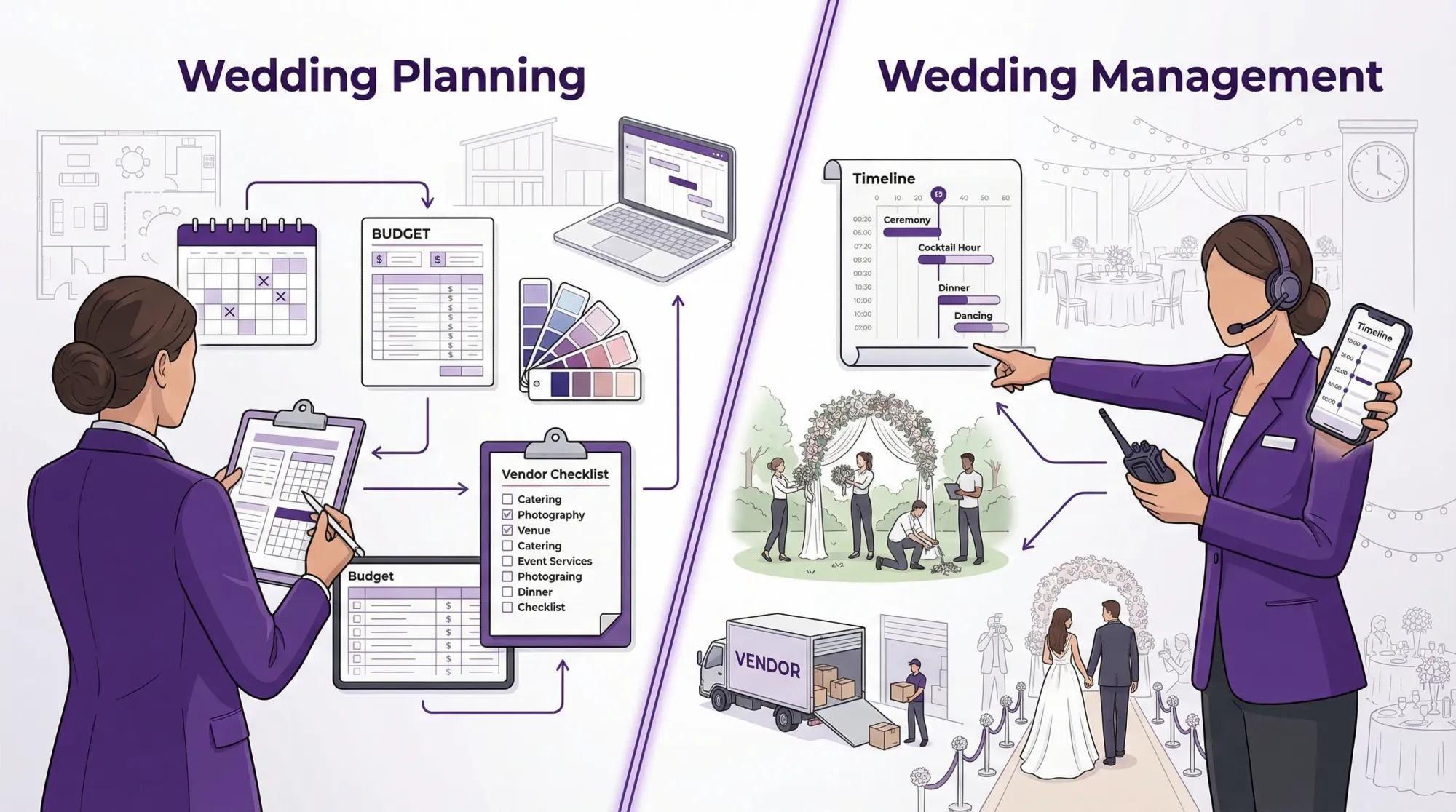
Most couples start wedding planning with one big question: “Do we need a planner?” The confusing part is that the industry uses overlapping terms, and wedding management services can sound like “full planning” when it is usually a very different scope.
This guide breaks down what “wedding management” typically means (in the U.S.), how it differs from wedding planning, where coordination fits in, and how to choose the right level of support without paying for help you do not need.
Quick definitions (so you are comparing the right things)
Vendors and regions use different labels, but these are the most common meanings:
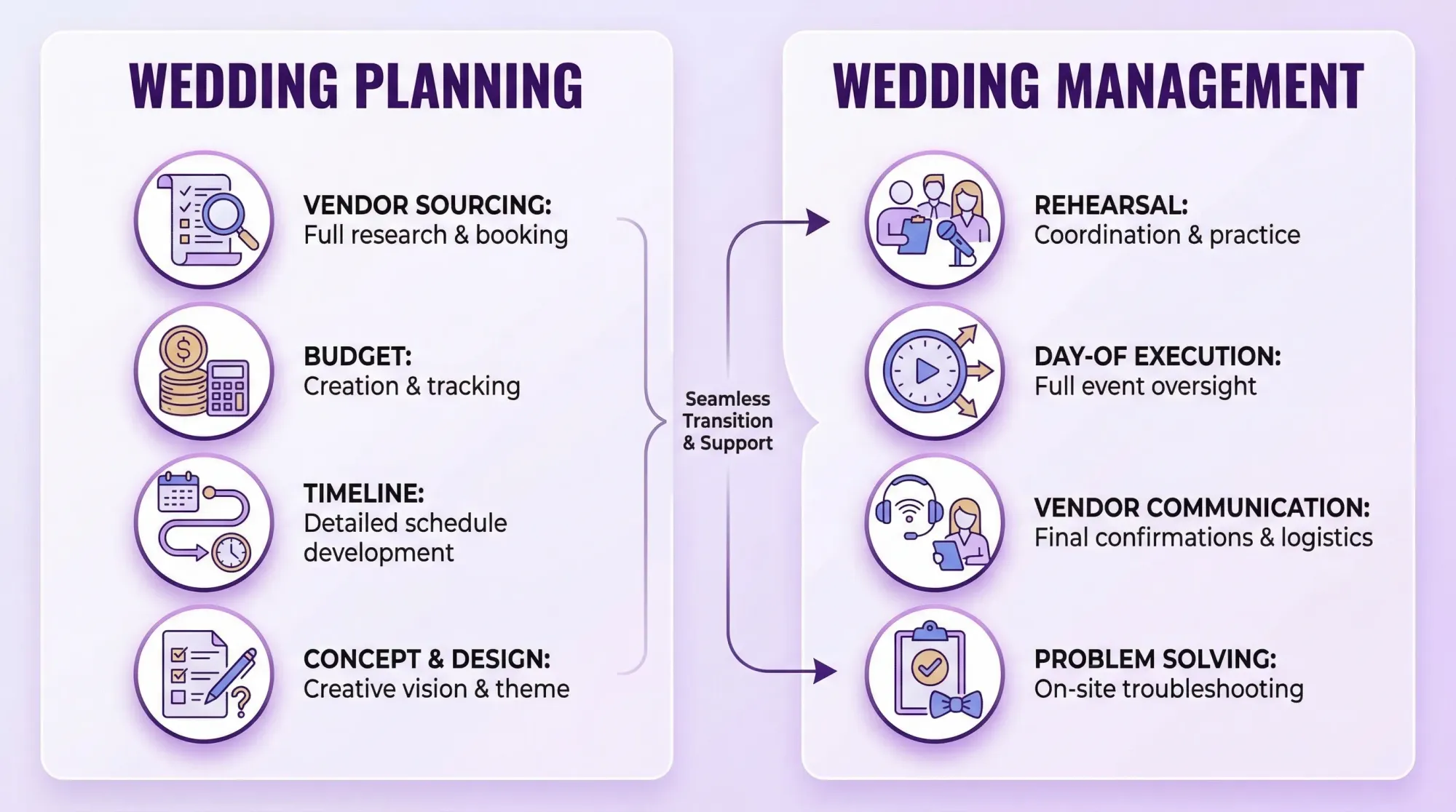
- Wedding planning (full or partial): A professional helps you design and build the wedding from early decisions through the wedding day, including vendor sourcing and ongoing project management.
- Wedding management services (often “month-of coordination”): A professional steps in later, confirms details, builds a working timeline, and runs the day so your plan actually happens.
- Day-of coordination: Often used as a marketing term, but true “day-of only” is rare because a coordinator cannot magically run a complex event without prep work.
If you want a cross-check from a mainstream wedding publication, Brides’ planner/coordinator guides are a helpful baseline for common U.S. definitions and expectations (terminology still varies by market): Brides.
Wedding management services vs planning: the key differences
The simplest way to think about it:
- Planning creates the wedding.
- Management executes the wedding you already created.
Here is how that shows up in real deliverables.
| Category | Wedding planning (full or partial) | Wedding management services (often month-of) |
|---|---|---|
| When they start | Early (often 12+ months out, sometimes sooner) | Later (commonly 4–8 weeks out, sometimes 8–12) |
| Core job | Build the plan and decisions | Stress-test the plan and run execution |
| Vendor sourcing | Often yes (recommendations, outreach, vetting) | Usually no (may review your vendor list) |
| Budget work | Often yes (build budget, track spend, advise tradeoffs) | Usually limited (final payments schedule, reminders) |
| Design support | Often yes (aesthetic direction, rentals, floor plan support) | Usually limited (ensure decor plan is installable) |
| Communication cadence | Ongoing meetings and check-ins | More concentrated, operational meetings |
| Wedding weekend leadership | Often yes | Yes (this is the main value) |
| Best for | Couples who want guidance, time savings, or complex logistics | Couples who already planned, but want a pro to run it |
What wedding planning typically includes (and what it should)
Wedding planning can mean full-service planning or partial planning. Either way, the planner’s value is reducing decision fatigue, preventing expensive mistakes, and getting you to a coherent plan earlier.
Common planning responsibilities include:
- Building a planning roadmap (what decisions happen when, and what depends on what)
- Vendor recommendations and outreach (sometimes including contract review support, depending on the planner)
- Budget allocation guidance (what tends to matter most for your priorities)
- Design direction and consistency (so your choices look intentional together)
- Guest experience planning (flow, comfort, communication, signage, timing)
- Timeline development that reflects your priorities and your venue’s realities
Planning is especially valuable when you have:
- A tight planning timeline
- A complex venue (multi-space, strict rules, difficult load-in)
- Multiple cultural events or a multi-day wedding weekend
- A high guest count, a destination event, or a nontraditional format
For couples still building their overall planning “stack” of tools and services, Revel.cam’s own guide on choosing tools can help you separate “nice to have” from “actually reduces work”: Best wedding planning apps in 2026.
What wedding management services typically include
Wedding management services are execution-first. Think of this as operational leadership that arrives once the big decisions are made.
Typical responsibilities include:
- Taking over vendor communication close to the wedding (confirmations, arrival windows, final details)
- Creating or refining the “production timeline” (the version vendors actually use)
- Running the rehearsal and ceremony processional logistics
- Managing setup, transitions, and cueing key moments (grand entrance, toasts, cake cutting)
- Troubleshooting real-time issues (weather pivots, missing items, late vendors)
- Handling the handoff at the end of the night (packing personal items, collecting cards and gifts, coordinating breakdown)
A helpful way to evaluate management is to ask: “Are they taking responsibility for outcomes, or just present?” A strong wedding manager is not only answering questions, they are preventing them.
Where couples get tripped up: “Day-of” is not a real start date
Many couples look for a “day-of coordinator” because they want relief at the finish line. The problem is that weddings have dependencies.
Even a relatively simple wedding requires:
- Confirmed vendor arrival windows
- A final floor plan and load-in plan
- A shot list and family photo grouping plan (or at least a wrangling strategy)
- A clear cue list for ceremony and reception moments
- A contingency plan for weather, timing drift, and missing items
If someone starts the morning of your wedding with none of that, they are forced into reactive mode.
When you compare packages, look for language like “handoff meeting,” “vendor confirmations,” “timeline creation,” and “final walkthrough.” Those details usually separate true management from “we will be there that day.”
The overlap (and how to keep it from becoming a gap)
Planning and management can overlap, but only if responsibilities are explicitly assigned.
Here is a simple way to divide ownership so nothing becomes “someone else’s problem.”
| Wedding responsibility | Best owner (typical) | Why |
|---|---|---|
| Vendor selection and contracting | Planner (or couple, if DIY) | Requires time, negotiation, and market knowledge |
| Design, rentals, styling plan | Planner (or couple + stylist) | Needs cohesion and early decisions |
| Final timeline and vendor confirmations | Wedding management services | Execution tool, depends on final details |
| Ceremony and reception cueing | Wedding management services | Live leadership and timing control |
| Guest communication (website, RSVP flow) | Couple + planning tool (or planner) | Ongoing updates and clarity |
| Photo collection from guests | Tool-based system + assigned helper | Best handled with a simple workflow, not constant reminders |
That last line matters more than couples expect. “Chasing photos” is a classic post-wedding headache, and it is also an avoidable operational problem.
Choosing the right support level (a practical decision framework)
Instead of asking “planner or coordinator,” ask two questions:
1) Do we need help deciding, or help executing?
- If you feel stuck on vendors, budget tradeoffs, or what choices matter, you want planning.
- If you have vendors booked and a clear plan, but you do not want to run the event, you want wedding management services.
2) How complex is the event, operationally?
Complexity is not only guest count. It is also:
- Multiple locations (ceremony here, reception there)
- Tight venue rules (sound curfews, limited load-in, mandatory vendors)
- Significant decor installs, rentals, or room flips
- Many “must happen” moments (cultural elements, speeches, surprise performances)
The more operational complexity you have, the more valuable experienced management becomes, even if you DIY planned.
Here is a simple guide.
| Your situation | Most couples choose | Why it fits |
|---|---|---|
| You want a cohesive vision, vendor guidance, and someone to keep you on track for months | Full or partial planning | Decisions and timeline need ongoing leadership |
| You planned the wedding, but want a pro to run rehearsal + day-of logistics | Wedding management services | You keep control of choices, they own execution |
| Small, simple wedding with minimal vendors, one venue, and flexible schedule | Limited coordination (or a strong venue coordinator) | Fewer moving parts, easier to self-manage |
What to ask before hiring either service
These questions work whether you are hiring a planner or wedding management services. They reveal scope, professionalism, and how they handle risk.
- What does your service start with, and what deliverables do we receive? Ask for examples: timelines, checklists, planning portals, vendor confirmation templates.
- How many weddings do you take per weekend? You want to understand bandwidth and backup coverage.
- Who is onsite, and for how many hours? Clarify whether an assistant is included.
- How do you handle vendor issues (late arrivals, missing items, weather pivots)? You are listening for process, not bravado.
- What is explicitly not included? This is where scope gaps hide.
For couples also comparing photo-related vendors and responsibilities, Revel.cam’s guide to package comparisons can help you ask sharper questions about what is truly covered: Event photography services: what’s included (and what’s not).
How tools can reduce the amount of “management” you need (without adding guest friction)
Some wedding tasks look like they require a human, but they actually require a reliable system.
Guest photo collection is the best example. Traditional approaches fail because they rely on guests doing extra work later (uploading to a shared folder, finding a link, joining an album, remembering to send photos).
A system that works tends to be:
- One step to start (scan QR, tap NFC)
- Camera-first (guests take photos inside the flow)
- Automatic uploads (nothing to remember later)
- Private by default, with host controls
That is exactly the job Revel.cam is built for. You create a private event called a Moment, guests scan a QR code or tap an NFC tag, then photos upload instantly to one gallery, no app install or signup. You can also set guest limits, photo limits, an end time, and review photos before sharing.
If you want a deeper, wedding-specific implementation plan, this checklist is designed to drop into your planning process without duplicating work: Wedding planning tool: the guest photo collection plan.
The bottom line
If you are still making foundational decisions (vendors, budget priorities, design direction), planning support pays for itself in time saved and mistakes avoided.
If your wedding is already planned and you need someone to take the wheel, wedding management services are the right fit, and often the most cost-effective way to protect your experience on the day.
And regardless of which pro you hire, look for opportunities to replace “manual chasing” with systems that guests will actually use. For memories, that can be as simple as a QR code that turns your wedding into a shared camera.
When you are ready, you can set up a Moment at Revel.cam and test the guest experience in under five minutes.

A writer interested in connection, memory, and the everyday moments that matter more than we realize.
Tags: Wedding Management , Wedding planning