Event Photography Services: What’s Included (and What’s Not)
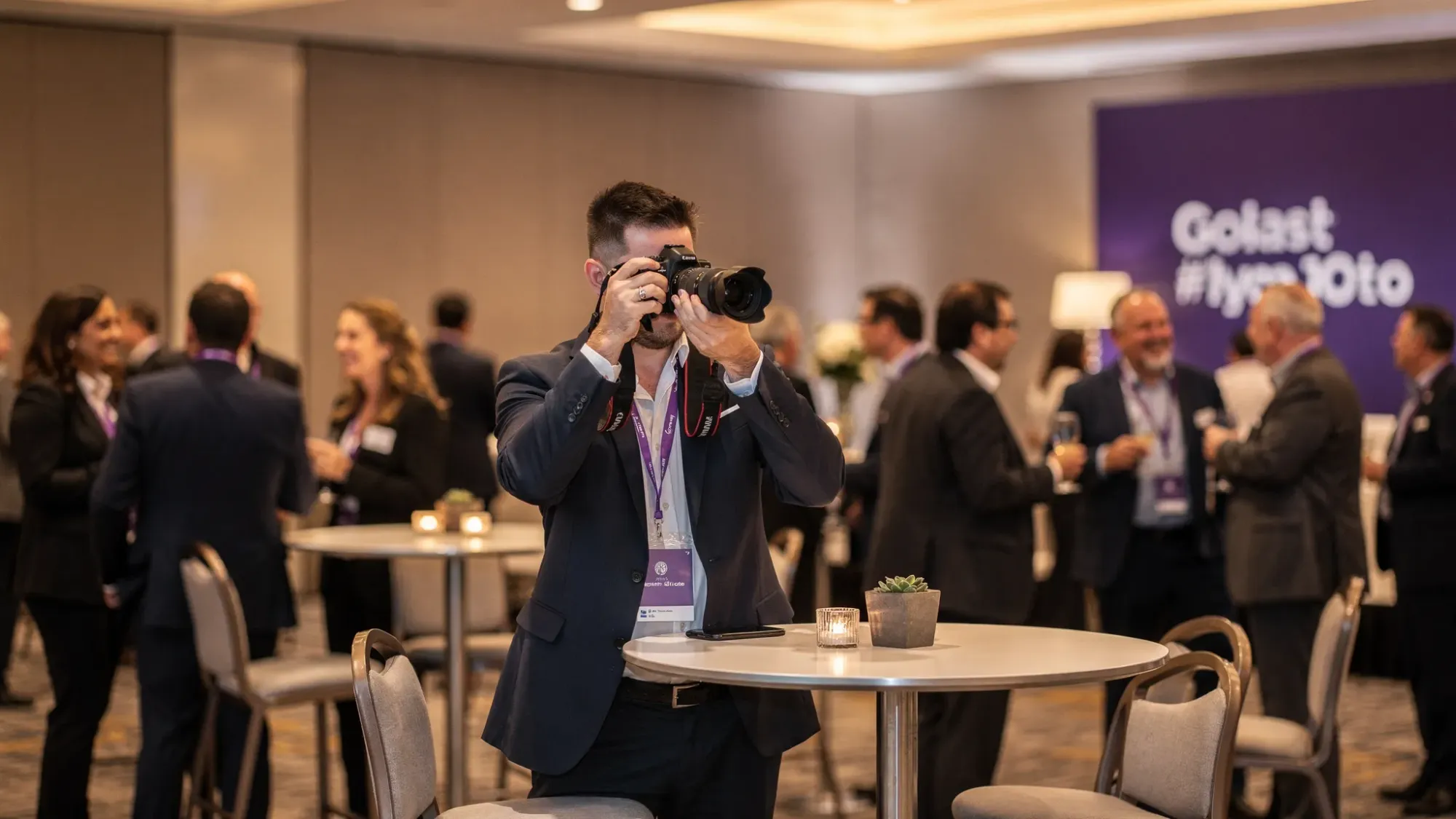
Hiring event photography can feel straightforward until you start comparing proposals and realize everyone is selling something slightly different. “8 hours of coverage” might mean one photographer and a Dropbox link, or it might include pre-event planning, lighting, assistant support, and a curated gallery with usage rights.
This guide breaks down what event photography services typically include, what’s often optional, and what’s commonly not included (unless you ask). It’s written for weddings, corporate events, conferences, parties, and brand activations.
The short version: event photography is not one standard product
Event photography services are a bundle of choices, not a fixed menu. What you get depends on:
- Event type (wedding vs. conference vs. private party)
- Deliverable goals (brand content, documentation, guest portraits, social highlights)
- Risk level (single chance moments, low light venues, VIPs, strict privacy)
- Distribution needs (internal-only gallery, press usage, client approvals)
If you review two quotes only by price and hours, you can easily miss the real differences.
What’s usually included in event photography services
Most professional event photography packages include the same core components, even if they’re described differently.
1) Coverage time (the hours you book)
This is the on-site shooting time. Confirm whether it includes:
- Arrival and setup time (some teams count it inside coverage, some don’t)
- Travel between venues (common for weddings with separate ceremony and reception locations)
- Breaks (especially for longer corporate days)
A common mismatch: you think you booked “6 hours of the event,” but the contract defines coverage as “arrival at 3:00pm, departure at 9:00pm,” including setup, room shots, and vendor details.
2) A professional shooter (and sometimes a team)
Your quote may include:
- One lead photographer
- A second photographer (often added for coverage breadth)
- An assistant (helpful for lighting, gear, and speed)
For crowded events, a second shooter can be less about “more photos” and more about being in two places at once.
3) Editing and curation (basic post-production)
Editing is typically included, but “editing” can mean different things:
- Culling (removing duplicates, blinks, misfires)
- Color correction and exposure balancing
- Light retouching (minor blemishes, small distractions)
Heavy retouching (skin smoothing across dozens of portraits, background swaps, object removal) is usually an add-on.
4) Delivery of images (a gallery or download)
Most services deliver a digital gallery or download link. Clarify:
- Turnaround time (days vs weeks)
- File format (JPEG is common, sometimes PNG for certain uses)
- Resolution (high-res for print vs web-size for social)
- How long the gallery stays online
5) Basic usage rights for the client (sometimes limited)
This is where corporate and private events diverge.
- For weddings and private events, clients typically receive broad personal-use rights.
- For corporate events, you often need clarity on commercial usage, paid ads, and whether you can share images with sponsors, speakers, or venues.
Copyright ownership is a legal topic and can vary by contract. In the US, copyright generally belongs to the creator unless transferred in writing. The U.S. Copyright Office provides a helpful overview of the basics.
What’s sometimes included (and often worth paying for)
These are common “gray zone” items. One vendor may include them, another may price them separately.
Pre-event planning and shot list alignment
For corporate events, this might include a call about:
- Brand priorities (logo visibility, sponsor deliverables)
- Run-of-show and key moments (awards, keynote, ribbon cutting)
- On-site contacts and access
For weddings, it’s often about timeline, family formals, and must-have moments.
On-site lighting (flash and modifiers)
Low-light venues, stage lighting, and dark dance floors can dramatically change outcomes. Ask whether they bring:
- On-camera flash
- Off-camera flash setups
- Continuous lights (more common for video)
Rush delivery or same-day selects
If you need images during the event (press, social posting, internal recaps), look for:
- Same-day highlight delivery
- A “social set” of 10 to 30 edited images within 24 hours
This usually costs extra because it compresses post-production time.
Step-and-repeat or headshot station
Some event photographers can run a mini portrait station. This is not the same as “coverage.” It’s closer to a structured experience with:
- Backdrop placement
- Lighting consistency
- Guest flow management
If you need this, ask how they handle lines, file naming, and delivery for each attendee.
Print products and albums
Prints, albums, or framed packages are more common in wedding photography than general event coverage. For corporate work, prints might appear as branded on-site activations.
What’s usually not included (unless explicitly stated)
This is the part that causes the most surprises.
Raw files
Many photographers do not deliver RAW files, and that’s normal. RAW files are unfinished materials and can reflect poorly if edited inconsistently. If you need RAWs for an internal creative team, ask early and expect an added fee or limited license.
Full-time content production for social media
Posting to Instagram during the event, making reels, writing captions, or managing approvals is usually a separate role (often a social producer or content creator). Some photography teams offer it, but don’t assume it’s part of standard event photography services.
Guaranteed coverage of “everything”
Even with two shooters, no team can guarantee they captured every interaction in a room. Professionals focus on priorities: key moments, important people, and a representative story.
If you truly want broad coverage, consider supplementing pro coverage with guest-generated photos (more on that below).
Guest photo collection and follow-ups
A professional photographer is not responsible for:
- Getting every guest to share phone photos later
- Collecting images from group chats
- Hunting down AirDrops
This “last mile” is a separate system problem, and it’s one reason hosts feel like they’re missing the candid layer.
Unlimited retouching
Most contracts include a defined style and baseline edits, not endless revision rounds. Ask what revision requests are allowed, and what costs extra.
A simple comparison table you can use when reviewing quotes
Use this as a quick way to normalize proposals that use different language.
| Category | Typically included | Often an add-on | Often not included |
|---|---|---|---|
| Coverage time | Shooting during booked hours | Overtime | Travel between venues (varies) |
| Team | 1 photographer | Second shooter, assistant | Dedicated social producer |
| Post-production | Culling + color correction | Advanced retouching, object removal | RAW delivery |
| Delivery | Online gallery + downloads | Rush delivery (24-48h) | Permanent hosting |
| Rights | Personal use (private events) or limited business use (corporate) | Expanded commercial license | Copyright transfer |
| Experiences | Candid coverage | Headshot station, step-and-repeat | Full photo booth service |
Contract details that affect the real value (and risk)
Two quotes can be the same price but wildly different in risk protection. Look for these clauses.
Backup plan for gear and failure
Ask what happens if:
- A camera fails
- A memory card corrupts
- A photographer is sick
Pros typically mitigate risk with redundancy (multiple bodies, multiple lenses, dual card slots, backups). The specific approach varies, but the existence of a plan matters.
Overtime rate and how overtime is approved
Events run late. Make sure you know:
- The hourly overtime rate
- Whether overtime is billed in 30-minute or 60-minute increments
- Who can approve overtime on-site
Delivery timeline and what “delivered” means
Clarify whether delivery includes:
- Edited finals only
- Both edited finals and a larger lightly edited set
- Any black-and-white conversions
Usage rights for corporate events
If you are an organizer, marketing lead, or HR team, ask specifically:
- Can we use these images in paid ads?
- Can sponsors use them?
- Can speakers use them?
- Are there restrictions on editing, cropping, or adding overlays?
If you need a broad license, negotiate it upfront instead of improvising later.
Weddings vs corporate events: what to expect to differ
Wedding photography services often emphasize storytelling, portraits, and heirloom outputs. Corporate event photography services often emphasize brand-safe documentation and fast distribution.
Here’s how that shows up in inclusions:
| Topic | Weddings | Corporate events |
|---|---|---|
| Primary goal | Story + emotion + key moments | Documentation + marketing assets |
| Deliverable pacing | Longer turnaround is common | Faster turnaround is often requested |
| Rights focus | Personal use | Commercial usage and approvals |
| Shot structure | Mix of posed + candid | Candid + speaker coverage + networking |
| Privacy | Guest comfort, personal boundaries | Brand safety, internal-only needs |
The coverage gap no one warns you about: the “parallel moments” problem
Even the best event photographer is one or two people. Meanwhile, your event has dozens of moments happening at once:
- Guests reacting in the back row during a keynote
- Friends laughing at a side table during dinner
- Behind-the-scenes setup, outfits, team prep
- After-party chaos and candid late-night photos
This is not a failure of professional services. It’s a physics problem.
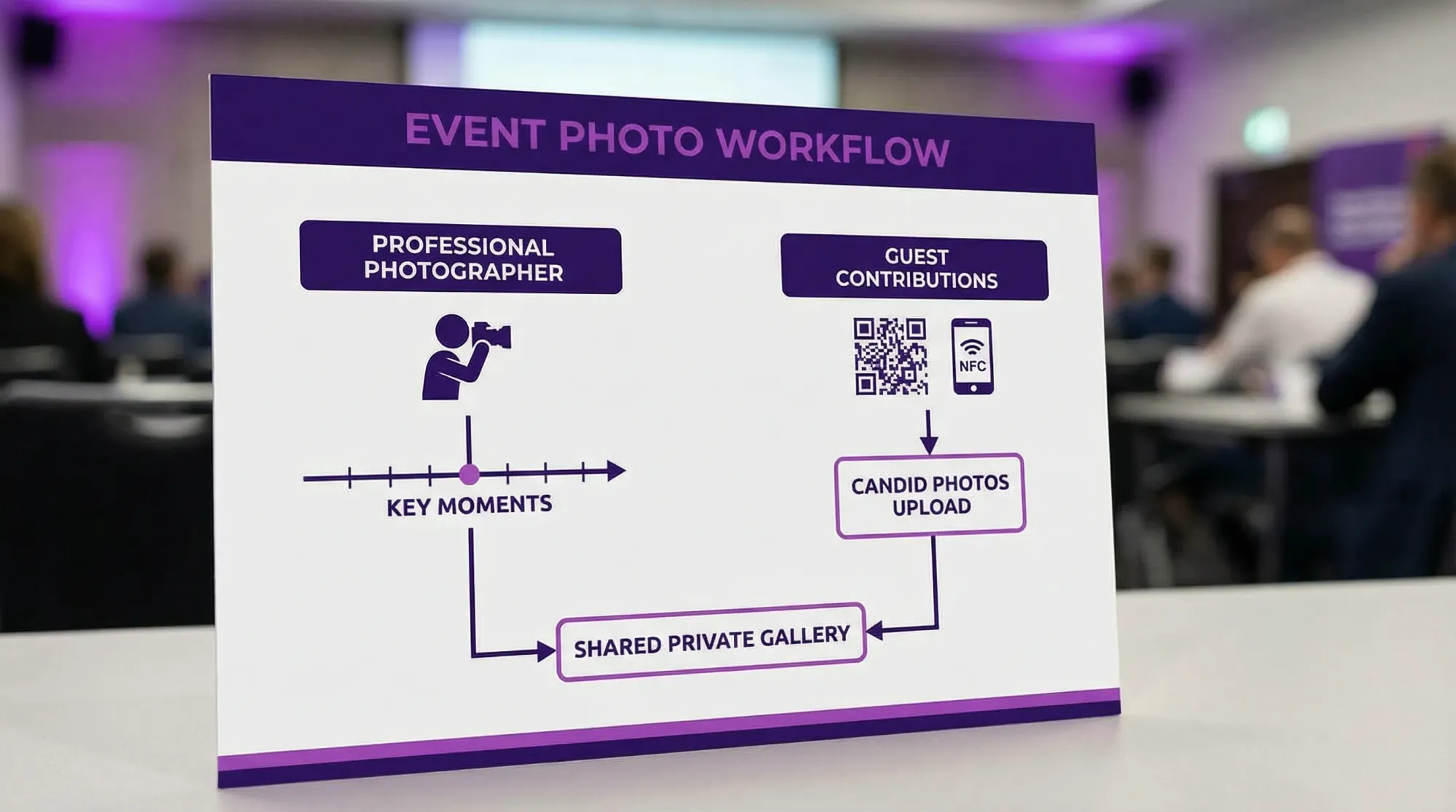
A practical solution: pair pro coverage with a guest photo system
If your goal is a complete story, the most reliable approach is:
- Hire a pro for the “must-have” moments and quality anchor images
- Use an app-less guest capture flow to collect the candid layer
Revel.cam is built for this second layer: hosts create a private Moment, guests scan a QR code (or tap an NFC tag) and take photos that upload automatically to one gallery. On iPhone it can open via an Apple App Clip, so guests do not need to install an app or create an account.
This approach is especially useful when you want participation without the usual friction of shared albums, group chats, or “send me that later.”
Questions to ask so you don’t discover exclusions after the event
Bring these to your calls when comparing event photography services:
- What exactly counts as “coverage time” (arrival, setup, travel, breaks)?
- Who is shooting (and will it be the same person whose portfolio you saw)?
- What editing is included, and what is considered retouching?
- How many final images do clients typically receive for an event like mine?
- What is the delivery timeline, and do you offer a 24-hour highlight set?
- How long is the gallery hosted?
- Do we receive print rights, commercial usage rights, or both?
- Can our sponsors/speakers reuse the images?
- What is your backup plan (gear, staffing, data)?
- What add-ons do you recommend for low light or fast-moving agendas?
Frequently Asked Questions
Are event photography services the same as wedding photography packages? They overlap, but they’re often structured differently. Weddings typically emphasize storytelling, portraits, and albums, while corporate event photography often emphasizes faster turnaround and clearer commercial usage rights.
Do event photographers provide RAW files? Many do not, and it’s common for RAW delivery to be excluded unless negotiated. If you need RAW files for in-house editing, ask upfront and expect it to be priced and licensed separately.
How many photos should I expect from event photography services? It depends on event length, guest count, and how “busy” the agenda is. Instead of chasing a number, ask to see a full gallery from a similar event and confirm what level of culling and editing is included.
Do I automatically get commercial usage rights for corporate event photos? Not automatically. Many contracts grant limited business usage and restrict resale, sponsor sharing, or paid advertising. Confirm the license terms in writing.
What’s the best way to collect guest photos in addition to professional photos? Use a dedicated, low-friction capture system that doesn’t require accounts or post-event uploads. A QR-based shared event camera (like Revel.cam) can capture candid guest perspectives automatically into one private gallery.
Capture the full story, not just the official angles
Professional event photography services are ideal for the moments you cannot miss: key speakers, formal portraits, high-quality brand images, and the core timeline.
To fill in everything happening around those moments, add a guest layer that’s effortless to use. With Revel.cam, guests scan a QR code or tap an NFC tag and start taking photos instantly, with automatic uploads to one private gallery and host controls like photo limits and moderation.
Create your next Moment in minutes at Revel.cam.
A writer interested in connection, memory, and the everyday moments that matter more than we realize.
Tags: Corporate events , Event photo collection , Event photo sharing , Event photography , Shared event photos